Building a Sustainable Fashion Supply Chain from Scratch
How to build a genuinely sustainable supply chain for your clothing brand. Material sourcing, manufacturing, logistics, certifications, and avoiding greenwashing.
 Pedro Carreira··8 min read
Sustainability Is a Supply Chain Problem
Every fashion brand talks about sustainability. Few understand what it actually requires.
Sustainability is not a label you attach to your marketing. It is a series of decisions made at every stage of your supply chain — from the cotton field to the customer's wardrobe. Each decision has a cost, a trade-off, and a measurable impact.
This guide walks through how to build a supply chain that is genuinely sustainable — not perfectly, because perfection is not realistic, but honestly and verifiably. We write this as a factory that deals with these trade-offs daily.
The Supply Chain, Stage by Stage
Stage 1: Raw Materials
The most impactful stage for environmental impact. Cotton farming alone accounts for approximately 10% of global pesticide use and significant water consumption.
Options (from most to least impactful):
- —GOTS-certified organic cotton — No synthetic pesticides, no GMO seeds, crop rotation, soil health management. The most rigorous standard. Premium of 20–50% over conventional cotton
- —BCI cotton (Better Cotton) — Reduced pesticide use, improved water management. Less rigorous than organic, but a meaningful improvement over conventional. Mass balance system (not physical traceability)
- —Recycled cotton — Cotton fibres recovered from pre-consumer waste (cutting scraps) or post-consumer waste (used garments). Reduces demand for virgin cotton, but fibre quality is lower (shorter fibres)
- —Recycled polyester — PET bottles melted and spun into polyester fibre. Diverts plastic from landfill. GRS certification verifies recycled content
- —Conventional cotton — No sustainability claim. But if the cotton is grown under regulated conditions (EU, US, Australia), it still represents better farming practices than unregulated sourcing
Our approach: We offer GOTS organic cotton, BCI cotton, and GRS recycled jersey. We source from European mills that can provide certification documentation for every fabric order.
For detailed information, read our organic cotton manufacturing guide.
Stage 2: Fabric Production
Fabric production — spinning, knitting, dyeing, finishing — is the most water and energy-intensive stage.
Key environmental impacts:
- —Water consumption (dyeing is the primary water-using process)
- —Chemical usage (dyes, softeners, finishing agents)
- —Energy consumption (heating water, running machines)
- —Wastewater discharge (potentially containing dye chemicals)
What to look for in a mill:
- —OEKO-TEX Standard 100 — Minimum. Ensures the finished fabric is free from harmful substances
- —GOTS-certified — If using organic cotton, the mill must be GOTS-certified
- —Water treatment — EU-based mills are required to treat wastewater before discharge. Non-EU mills may not be
- —Renewable energy — An increasing number of Portuguese mills are transitioning to solar and wind power
- —Closed-loop water systems — Some advanced mills recycle their dyeing water, significantly reducing consumption
The proximity advantage: Sourcing fabric from mills near your garment factory reduces transport emissions. In our case, the mills are typically within a 30-minute drive — read about the Barcelos textile cluster for context.
Stage 3: Garment Manufacturing
The factory stage has significant but often overlooked sustainability dimensions.
Key impacts:
- —Energy consumption (sewing machines, pressing, lighting, heating)
- —Fabric waste from cutting (typically 15–20% of fabric becomes waste)
- —Thread and trim waste
- —Worker welfare (wages, conditions, hours)
What makes a factory more sustainable:
- —Efficient cutting layouts — Good marker making reduces fabric waste from 20% to 15% or less
- —Fabric waste management — Offcuts can be recycled (sent back to mills for fibre recovery) rather than sent to landfill
- —Energy efficiency — Modern sewing machines use 50–70% less energy than older models
- —EU labour standards — European factories operate under strict labour laws covering minimum wages, working hours, health and safety, and worker rights
- —Vertical integration — When everything happens under one roof, there is less transport between stages and more accountability
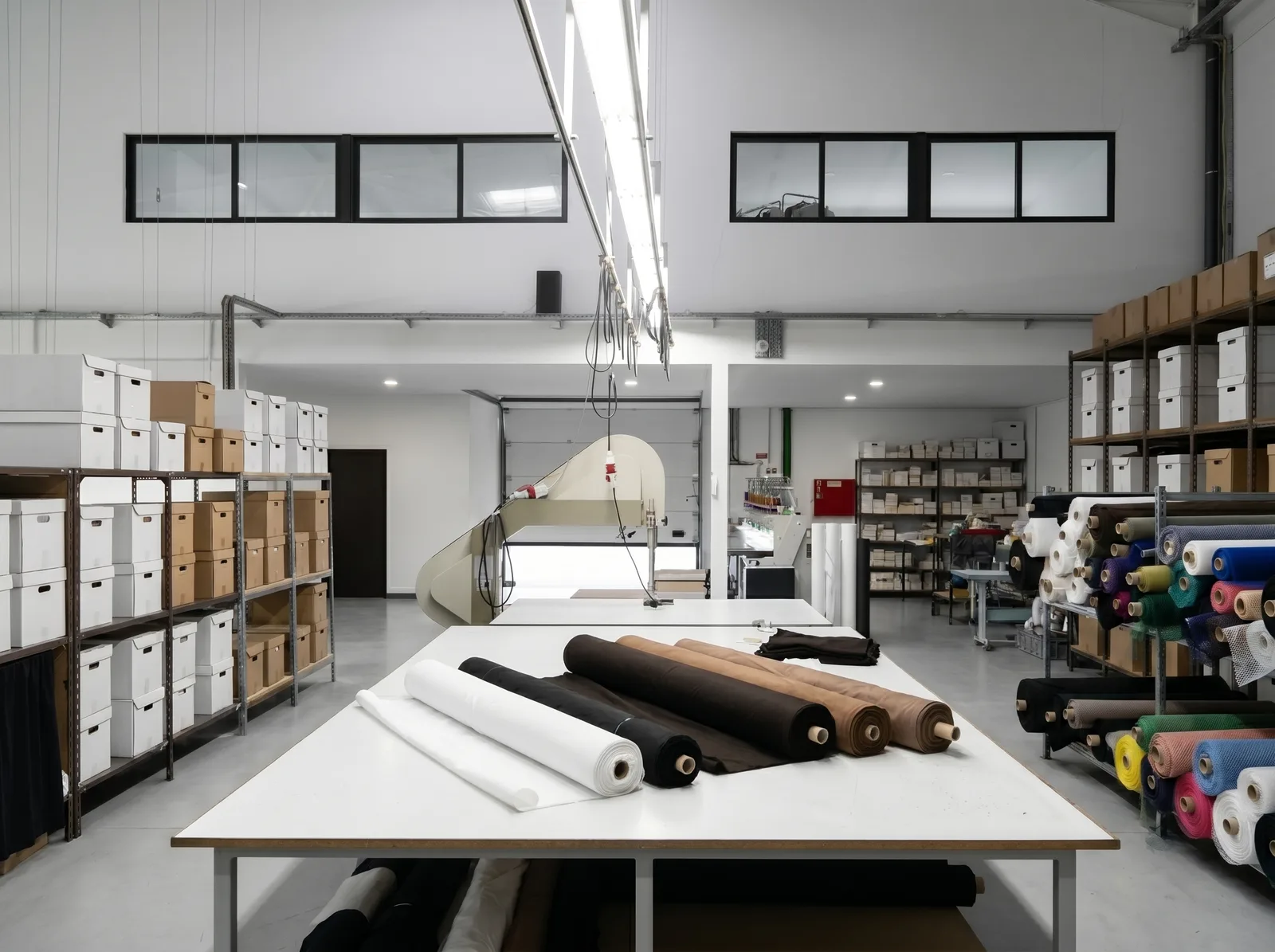
At White Cotton, our factory is vertically integrated — cutting, sewing, finishing, decoration, QC, and packing all happen in our Barcelos facility. This minimises transport between production stages and gives us full control over working conditions and waste management.
Stage 4: Decoration
Printing and dyeing methods have varying environmental impacts.
Lower impact:
- —Water-based screen printing — Uses water-soluble inks with lower chemical content. Our recommended option for sustainability-conscious brands
- —Embroidery — Thread on fabric. Minimal chemical impact. Highly durable (reduces replacement frequency)
- —Digital printing (DTG) — Less ink waste than screen printing. No screen chemicals
Higher impact:
- —Plastisol printing — PVC-based inks. More durable, but environmentally problematic
- —Garment dyeing — Water-intensive but can reduce overproduction (dye only what you need)
Stage 5: Packaging and Shipping
Often overlooked, but meaningful:
Packaging:
- —Individual polybags — Industry standard but creates plastic waste. Recycled LDPE polybags are available
- —Paper wrapping — Biodegradable alternative. Slightly less product protection
- —No individual packaging — Possible for bulk B2B shipments. Reduces waste significantly
- —Cardboard boxes — Recyclable. Use recycled cardboard where possible
- —Branded packaging (tissue paper, stickers, custom boxes) — Adds waste. Consider whether it genuinely adds customer value
Shipping:
- —Ground freight within Europe — Lowest carbon option for intra-European delivery (our standard)
- —Sea freight — Lowest carbon for intercontinental, but slowest
- —Air freight — Highest carbon. Avoid where possible
The Portugal advantage: Manufacturing in Europe for European markets eliminates ocean shipping entirely. A ground shipment from Barcelos to London produces a fraction of the emissions of a container ship from Shanghai.
Stage 6: Product Use and End of Life
Your supply chain decisions affect what happens after the garment is sold:
- —Durable construction — A garment that lasts 5 years is inherently more sustainable than one that lasts 5 months, regardless of the materials
- —Quality fabrics — Higher GSM, ring-spun cotton, pre-shrunk fabric — all extend garment life
- —Care instructions — Clear, accurate care labels help customers maintain their garments longer
- —Repairability — Simple construction and accessible seams make repairs possible
- —End-of-life design — Mono-material garments (100% cotton) are easier to recycle than mixed-material ones (cotton-polyester blends)
Avoiding Greenwashing
The EU is cracking down on vague sustainability claims. Under upcoming regulations, claims like "eco-friendly," "sustainable," or "green" without substantiation may be prohibited.
Rules for honest sustainability communication:
- 1.Be specific — "Made with GOTS-certified organic cotton" is verifiable. "Eco-friendly" is not
- 2.Certify your claims — If you say organic, show the GOTS certificate. If you say recycled, show the GRS certificate
- 3.Acknowledge trade-offs — Honesty builds more trust than perfection. "Our cotton is organic. Our packaging is not yet — we are working on it" is more credible than "100% sustainable"
- 4.Do not conflate certifications — BCI is not the same as organic. OEKO-TEX is not the same as sustainable. Each certification covers specific things
- 5.Report what you measure — If you claim reduced water usage, show the data. If you claim lower emissions, show the comparison
Read our broader guide on sustainable fashion manufacturing.
Building Your Sustainable Supply Chain: Action Steps
Start Here (Low Cost, High Impact)
- 1.Choose OEKO-TEX certified fabrics (chemical safety baseline)
- 2.Manufacture in Europe (eliminate ocean shipping)
- 3.Use water-based inks for printing
- 4.Minimise packaging (recycled polybags, recycled cardboard)
- 5.Design for durability (higher GSM, quality construction)
Next Level (Moderate Cost)
- 1.Upgrade to GOTS organic cotton or GRS recycled materials
- 2.Choose a factory with documented sustainability practices
- 3.Reduce SKUs and produce closer to demand (less overproduction)
- 4.Implement a mono-material design approach (100% cotton for recyclability)
- 5.Provide transparency information on your website (supply chain origin, certifications)
Advanced (Higher Cost, Stronger Position)
- 1.Full supply chain traceability (certified at every stage)
- 2.Carbon footprint measurement and reporting per product
- 3.Circular design (take-back programmes, garment recycling)
- 4.Digital Product Passport readiness (upcoming EU requirement)
- 5.Third-party sustainability audit of your entire supply chain
At White Cotton
We do not claim to be a "sustainable factory." We claim to be a factory that makes honest choices:
- —We source GOTS organic cotton, BCI cotton, and GRS recycled materials
- —All our fabrics are OEKO-TEX Standard 100 certified
- —We manufacture in Barcelos, Portugal — within the EU, under EU environmental and labour standards
- —Our supply chain is short: mills nearby, everything produced in-house
- —We use water-based inks as our standard for screen printing
- —We inspect every piece individually — quality is the most sustainable thing we offer, because durable garments are replaced less often
If sustainability is part of your brand, talk to us about how we can support it. We will be honest about what we can do and what we cannot. Related: organic cotton manufacturing, garment certifications guide, sustainable fashion manufacturing, Portugal vs China clothing.

Pedro Carreira
Founder of White Cotton, a textile manufacturer in Barcelos, Portugal. Producing custom clothing collections for brands across 15+ countries.
Continue Reading

Clothing Brand Founder Mistakes: The Ones That Cost Real Money

How to Advertise a Clothing Brand: The Numbers Before the Creative
How to Market a Clothing Brand Without Ads: The Organic Routes
How to Plan a Clothing Drop: The One Page Before the Money Leaves