Dropshipping vs Custom Manufacturing: Which Is Right for Your Brand?
An honest comparison of dropshipping and custom manufacturing for clothing brands. Margins, quality, branding, and when to make the switch.
 Pedro Carreira··8 min read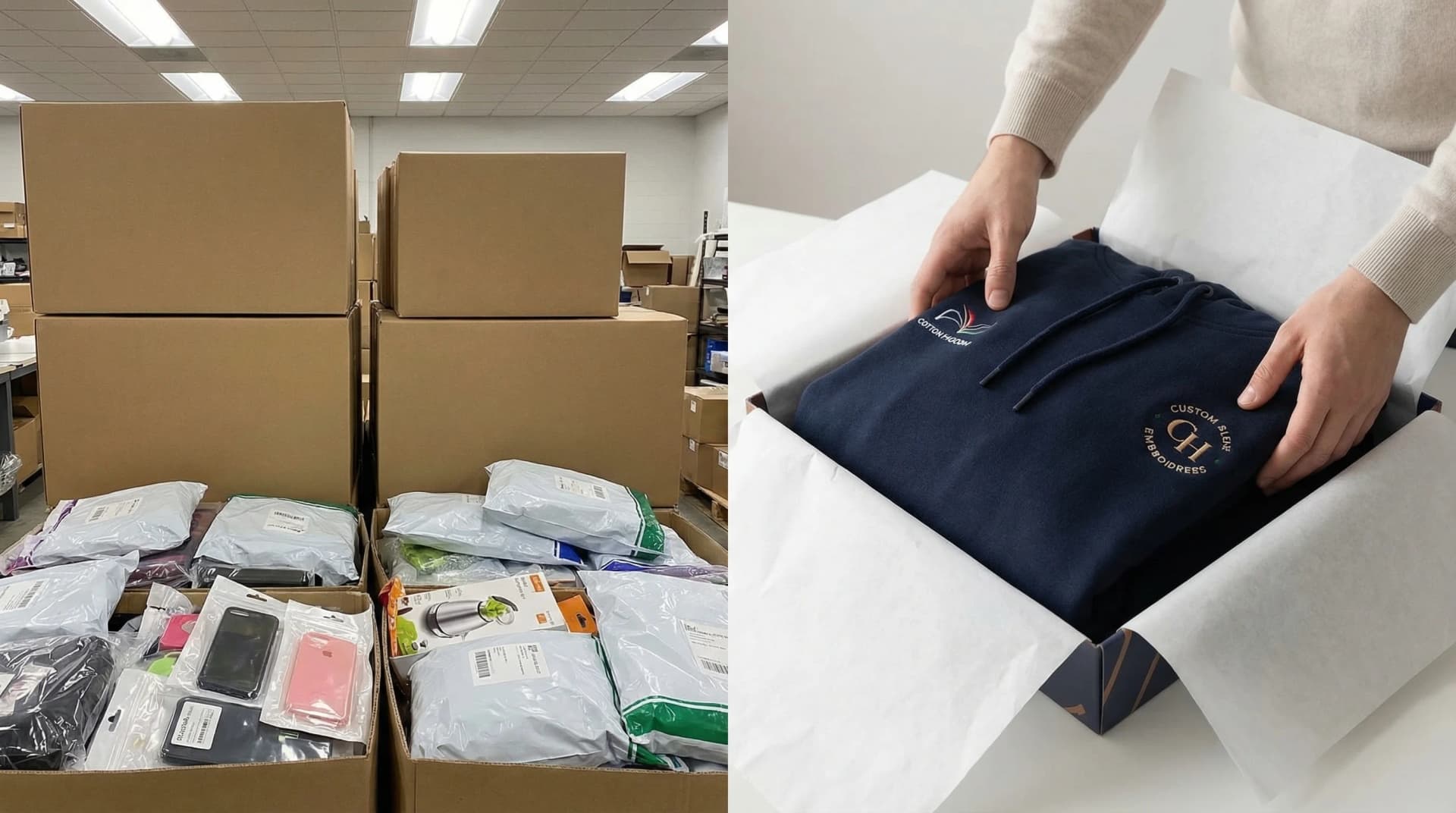
Two Paths, One Goal
Every clothing brand starts with the same ambition: build a brand people love and make money doing it. How you produce your garments is one of the most consequential decisions you will make — and the two most common paths could not be more different.
Dropshipping means you never touch the product. A customer orders from your website, the order is forwarded to a third-party supplier who prints, packs, and ships directly to the customer. You handle marketing and customer service.
Custom manufacturing means working with a factory to produce garments to your specifications — your fabric, your patterns, your labels, your fit. You carry inventory and fulfil orders yourself (or through a 3PL).
Both models work. Both have brands making money. But they serve different goals, different budgets, and different stages of a brand's life. This guide compares them honestly.
The Dropshipping Model
How It Works
- 1.You choose base products from a print-on-demand supplier (Printful, Printify, Gooten, etc.)
- 2.You upload your designs and set your retail prices
- 3.A customer places an order on your website
- 4.The supplier prints the design, packs the product, and ships it directly to the customer
- 5.You keep the difference between the retail price and the supplier's cost
Advantages
- —Zero upfront investment — No inventory to buy, no factory to pay, no warehouse to rent
- —No minimum orders — You can sell one piece at a time
- —No inventory risk — If a design does not sell, you lose nothing
- —Fast to launch — You can have a store live in a day
- —Low operational complexity — The supplier handles production, packing, and shipping
Disadvantages
- —Low margins — A t-shirt that costs the supplier €12–18 to print and ship leaves you €5–15 profit at typical retail prices. Marketing costs often eat most of this
- —No quality control — You never see or touch the product before your customer does
- —Generic products — You are decorating the same blanks every other dropshipper uses (often Gildan, Bella+Canvas, or similar mass-market blanks)
- —No brand differentiation — The fabric, fit, weight, and construction are identical to thousands of other brands using the same supplier
- —Limited decoration options — Typically DTG printing only. No embroidery, no screen printing, no specialty techniques
- —Slow shipping — Print-on-demand typically takes 5–10 business days to produce and ship
- —No custom labels — Most suppliers use their own packaging or generic unbranded packaging
Realistic Margins
For a DTG-printed t-shirt via a major print-on-demand supplier:
- —Supplier cost: €12–18 (product + print + shipping)
- —Retail price: €25–35
- —Gross margin: €7–17 per sale (28–49%)
- —After marketing costs (typically €5–15 per customer acquisition): Net margin: €0–12 per sale
The Custom Manufacturing Model
How It Works
- 1.You develop your products with a factory — fabric, patterns, labels, construction
- 2.You order a production run at agreed MOQs
- 3.The factory produces, quality-checks, and ships the finished garments to you
- 4.You hold inventory and fulfil orders yourself (or through a fulfilment partner)
- 5.You control the entire product and brand experience
Advantages
- —Higher margins — A custom-made t-shirt costs €6–12 to produce. At a retail price of €35–50, your gross margin is €23–44 per sale (66–88%)
- —Full brand control — Your fabric, your fit, your labels, your packaging. Everything is yours
- —Product differentiation — Your garments cannot be replicated by anyone with a Printify account
- —Quality control — You (or your factory) inspect every piece before it reaches a customer
- —Range of decoration — Embroidery, screen printing, DTG, DTF, puff print, foil, flock, chenille — whatever your design requires
- —Custom labels and packaging — Woven labels, printed care labels, branded hang tags, tissue paper, custom boxes
- —"Made in" story — "Made in Portugal" is a selling point. "Printed by an anonymous supplier" is not
Disadvantages
- —Upfront investment — Sampling costs, production deposits, inventory purchases
- —Inventory risk — If a style does not sell, you are left with unsold stock
- —Longer lead times — roughly 3 to 6 months for a first collection (samples usually 4–8 weeks, production usually 6–12 weeks from the deposit); reorders skip the sample but still run a full 6–12 week production cycle
- —Higher operational complexity — You need storage, fulfilment, and inventory management
- —MOQ requirements — Most quality factories require minimums of 75–100 pieces per colourway
Realistic Margins
For a 350 GSM French Terry hoodie, custom-manufactured in Portugal:
- —Production cost: €18–24 (fabric + manufacturing + decoration + labels + packaging)
- —Retail price: €65–95
- —Gross margin: €41–77 per sale (63–81%)
- —After marketing costs: Net margin: €26–72 per sale
The Numbers Side by Side
| Factor | Dropshipping | Custom Manufacturing |
|---|---|---|
| Startup cost | €0–500 | €5,000–15,000 |
| Per-unit cost | €12–18 (t-shirt) | €9–13 (t-shirt) |
| Gross margin | 28–49% | 63–88% |
| MOQ | 1 piece | 75–100 pieces |
| Lead time | 5–10 days per order | 6–12 weeks per production run |
| Quality control | None | Full |
| Brand control | Minimal | Complete |
| Inventory risk | None | Moderate |
| Decoration options | DTG only | All methods |
| Custom labels | No | Yes |
Print-on-Demand: The Middle Ground
Some brands use print-on-demand (POD) with premium blanks as a middle ground. Services like Printful now offer higher-quality base garments (organic cotton, heavier GSM), though at a higher cost.
This hybrid approach works for:
- —Brands testing designs before committing to production
- —Artists and creators who want merch without managing inventory
- —Niche brands with low volume but loyal customers
However, even premium POD cannot match the quality, branding, and margins of custom manufacturing. The fabric choices are limited, the fits are standard, and you still have no control over quality before it reaches the customer.
When to Graduate from Dropshipping to Manufacturing
If you are currently dropshipping and your brand is growing, consider the switch when:
- 1.You are spending more on marketing than you are profiting per sale. Thin dropshipping margins make paid acquisition unsustainable. Better margins from custom manufacturing give you more room to invest in growth
- 2.Customers are complaining about quality. Generic blanks and DTG prints do not build brand loyalty. If your reviews mention thin fabric, poor fit, or fading prints, you are losing customers to your product, not your marketing
- 3.You have validated demand. If 3–5 designs consistently sell, you have enough data to confidently invest in production
- 4.You want to build a real brand. A brand is more than a logo on a generic t-shirt. Custom manufacturing lets you create a product that is uniquely yours — from the fabric weight to the label to the packaging
- 5.You can afford the investment. Budget €5,000–10,000 for a first manufacturing run. If your dropshipping revenue can fund this, the economics overwhelmingly favour the switch
How to Make the Transition
Step 1: Start with Your Bestseller
Take your top-selling design and produce it as a custom-manufactured garment. This minimises risk — you already know the design sells.
Step 2: Choose Your Factory
Look for a factory that works with emerging brands, offers low MOQs, and can guide you through the process. Read our guide on how to start a clothing brand for a detailed roadmap.
Step 3: Upgrade Everything
Do not just replicate your dropshipped product on better fabric. Take the opportunity to upgrade:
- —Fabric (200+ GSM organic cotton instead of 150 GSM conventional)
- —Fit (contemporary silhouette instead of standard boxy)
- —Labels (custom woven labels instead of generic tags)
- —Packaging (branded polybags or boxes instead of plain mailers)
Step 4: Sell Both in Parallel
Keep your dropshipping store running while you introduce your manufactured products. Let customers compare. The manufactured product will sell itself.
Step 5: Phase Out Dropshipping
As your manufactured range grows and your margins improve, gradually retire your dropshipped products. Many brands complete this transition within 6–12 months.
At White Cotton
We work with brands making exactly this transition — from dropshipping to custom manufacturing. Our MOQs start at 75 pieces per colourway for hoodies and 100 per colourway for t-shirts (single-colourway runs start at 100 and 150), which makes the transition accessible without requiring a massive upfront investment.
We produce your garments in our own Barcelos factory — no agent, no trading company in between. You get custom fabrics, custom labels, custom packaging, and direct access to the people making your garments.
If you are ready to move beyond dropshipping, get in touch. We will help you develop your first manufactured product from scratch — fabric selection, sampling, production, and delivery. Also see: clothing manufacturing for startups, how much does it cost to manufacture clothing, blank clothing manufacturers in Europe.

Pedro Carreira
Founder of White Cotton, a textile manufacturer in Barcelos, Portugal. Producing custom clothing collections for brands across 15+ countries.
Continue Reading
Clothing Brand Founder Mistakes: The Ones That Cost Real Money

How to Advertise a Clothing Brand: The Numbers Before the Creative
How to Market a Clothing Brand Without Ads: The Organic Routes

How to Plan a Clothing Drop: The One Page Before the Money Leaves