Clothing Manufacturer for Startups: How to Find the Right Partner
What startups really need from a clothing manufacturer — low MOQs, guidance, and flexibility. How to evaluate factories, avoid red flags, and budget for your first production run.
 Pedro Carreira··10 min read
The Startup-Manufacturer Relationship Is Different
Most manufacturing guides are written for established brands. They assume you have a tech pack ready, a clear specification, and a buyer who knows exactly what they want. If you are launching your first clothing brand, none of that applies to you — and the wrong factory can easily derail a promising brand before it ever sells a single piece.
We work with a lot of startups at White Cotton. Some arrive with a full brief and clear vision. Many arrive with an idea, a reference garment, and a lot of questions. Both types are welcome. The difference in outcome usually comes down to one thing: choosing a manufacturer who is genuinely set up to work with early-stage brands.
This guide covers what to look for, what to avoid, and what to expect from the journey.
What Startups Actually Need From a Manufacturer
Low Minimum Order Quantities
For a brand at zero revenue, committing to 500 units per colour is an enormous financial and inventory risk. You do not yet know which colourways will sell, whether the sizing is right for your customer, or even whether the product will resonate at all.
Our minimum order quantities at White Cotton are deliberately set to support early-stage brands:
- —T-shirts: 100 pieces per colour (75 if you order 2+ colourways)
- —Hoodies and sweatshirts: 75 pieces per colour (50 if you order 2+ colourways)
These numbers let you test the market with a realistic investment rather than locking up €15,000 in unsold inventory.
Guidance, Not Just Production
A factory that only executes instructions is fine for a seasoned buyer. For a startup, it can be a disaster. If your measurements are off, your construction details are unclear, or your fabric choice does not match your intended aesthetic, you want a manufacturer who will flag it before cutting a single metre of fabric — not one who produces exactly what you asked for and sends you 200 pieces that miss the mark.
Good manufacturer relationships are collaborative. We treat early conversations as a consultation: helping you think through fabric weight, construction details, sizing, and decoration options before anything goes into production.
Flexibility and Communication
Startups iterate. The spec that made sense in month one may need to change based on sample feedback. You need a factory that communicates quickly and honestly — not one that disappears for two weeks between emails, or whose reply requires translating through three layers of intermediaries.
Factory visits are something we actively encourage. Coming to Barcelos to see the production floor, touch the fabrics, and meet the team changes the relationship entirely. You stop working with an abstract supplier and start working with people you trust.
Honest Pricing Transparency
One of the biggest frustrations startups report is arriving at production and discovering costs they did not anticipate. Sampling fees, decoration minimums, label setup costs, shipping charges — these add up and can blow a first-collection budget entirely.
We give full cost breakdowns upfront, and our quote turnaround is 48 hours. No surprises.
Red Flags to Watch for When Evaluating Factories
After years of working with brands that have come to us after bad experiences elsewhere, we have seen a consistent set of warning signs. Watch for these during your evaluation process.
No Sample Process
Any factory that wants to go straight from a brief to full production without a sample stage should be avoided. Samples are not optional overhead — they are the mechanism that ensures what you receive matches what you intended. A manufacturer who skips this step is optimising for throughput, not quality.
Vague or Non-Existent Lead Times
"We will try to deliver in 4–6 weeks" is not a lead time. It is a liability avoidance strategy. Legitimate factories give specific lead times and build them into your agreement. At White Cotton: samples in 7–10 working days, bulk production in 3–5 weeks. Written commitments, not verbal estimates.
Pressure to Commit to Large Volumes Immediately
Some factories use minimum orders as a filter to avoid working with small brands. That is their right. But a factory that pressures you to commit to 500+ units when you are not ready is not looking out for your interests. Start with a manufacturer who is genuinely comfortable with startup-scale volumes.
No References or Portfolio
If a factory cannot show you comparable work — garments they have produced for brands at your level — be cautious. Ask for references. Talk to their existing clients. A legitimate factory is proud of its work and happy to share it.
Communication Gaps
If a factory takes five days to respond to an initial inquiry, imagine what communication will be like when you have a time-sensitive production issue. Response speed during the sales process is a reliable signal of how they will treat you as a client.
No Certifications
For brands with any sustainability positioning, certifications matter — and they matter now, not later. OEKO-TEX Standard 100, GOTS, GRS Recycled — these are not nice-to-haves for modern brands. At White Cotton, we source fabrics with all four major certifications. If a manufacturer cannot produce certification documentation, that is a problem.
Questions to Ask Before Committing
These are the questions we recommend every startup ask a potential manufacturer before placing an order.
- 1.What is your MOQ, and does it change with multiple colourways?
- 2.Do you have an in-house sampling process, or do you outsource samples?
- 3.What is your typical sample lead time and bulk lead time?
- 4.What are your sampling costs, and how many rounds are included?
- 5.Can I visit the factory before committing?
- 6.What certifications do you hold, and can you share documentation?
- 7.Do you produce all stages in-house, or do you outsource any part of the process?
- 8.What happens if there is a quality issue with the bulk order?
- 9.Do you have experience working with brands at my stage?
- 10.What information do you need from me to start the sampling process?
Pay close attention to how the factory answers. A confident, specific, transparent response to each question is a good sign. Vague or evasive answers to any of them should make you pause.
Why Family Factories Often Work Better for Startups
Large manufacturing operations are optimised for large, consistent orders. Their production systems, communication structures, and minimum requirements are all calibrated for clients who order thousands of units per style, season after season. A startup placing a 100-piece order is, frankly, an inconvenience to most of them.
Family factories operate differently. The people you talk to during the sales process are often the same people who oversee your production. Decision-making is faster. Customisation is easier. Communication is more direct.
White Cotton has been a family business since the late 1980s. Three generations of the same family have worked in this building. That continuity creates something that is difficult to manufacture artificially: accumulated knowledge of what works, an honest understanding of what is possible, and a genuine stake in the outcome of every order.
When you are a startup and you place an order with us, it matters to us in a way that is different from a transactional relationship. Your success means you come back with bigger orders. Your failure costs us a long-term client. Our incentives are aligned.
The Typical Startup Journey From Idea to First Production Run
Here is how the process typically unfolds for a brand working with us for the first time.
Step 1: Initial Conversation
Share your idea — reference images, sketches, a garment you want to replicate or improve on, a mood board. At this stage, you do not need a tech pack. We will ask questions: expected volume, target price point, timeline, intended market, any sustainability requirements.
Step 2: Quote (48 Hours)
Based on your brief, we put together a detailed quote covering fabric options, construction, decoration, and unit pricing at your expected volume. This is not a ballpark — it is a real number you can build a business plan around.
Step 3: Sample (7–10 Working Days)
Once you approve the quote and submit your deposit, we begin the sample. Most brands go through 2–3 sample rounds before reaching a production-ready specification. This is normal and expected — we have built that into our process.
Step 4: Bulk Production (3–5 Weeks)
Once the sample is approved, we move to bulk. Your order is scheduled in our production calendar and completed in sequence. You receive regular updates and photos throughout the process.
Step 5: QC, Packing, and Delivery
Every order goes through our in-house QC process before packing. We check measurements, seam quality, decoration accuracy, and presentation against the approved sample. We ship worldwide.
Budget Expectations for a First Collection
One of the most common questions we receive from startups is: "How much does it actually cost to launch a first collection?" The honest answer depends on how many styles you produce and at what volume, but here is a realistic framework.
For a small first collection — 3 styles, 100 pieces each — expect:
- —Sampling: €150–€400 per style (2–3 rounds), so €450–€1,200 total
- —Production: Depending on garment type and complexity, €6–€25 per unit at 100 pieces
- —Decoration: Embroidery from €1.50–€4 per piece, screen printing from €1–€3 per colour per piece
- —Labels and packaging: €0.50–€2 per unit, depending on specification
- —Shipping to your warehouse: €200–€600 depending on volume and destination
For a first small collection of 3 styles at 100 pieces each, a realistic all-in budget is €5,000–€15,000 — depending on garment complexity, decoration, and fabric selection. Hoodies and heavier pieces sit at the higher end; basic tees at the lower end.
This budget is achievable for most serious first-time founders. It is also small enough that a poorly chosen manufacturer can waste most of it on bad samples and unusable production.
Choosing the right partner from day one is not just convenient — it is financially significant. See our full production cost breakdown for more detail on how these numbers break down.
How We Work With New Brands at White Cotton
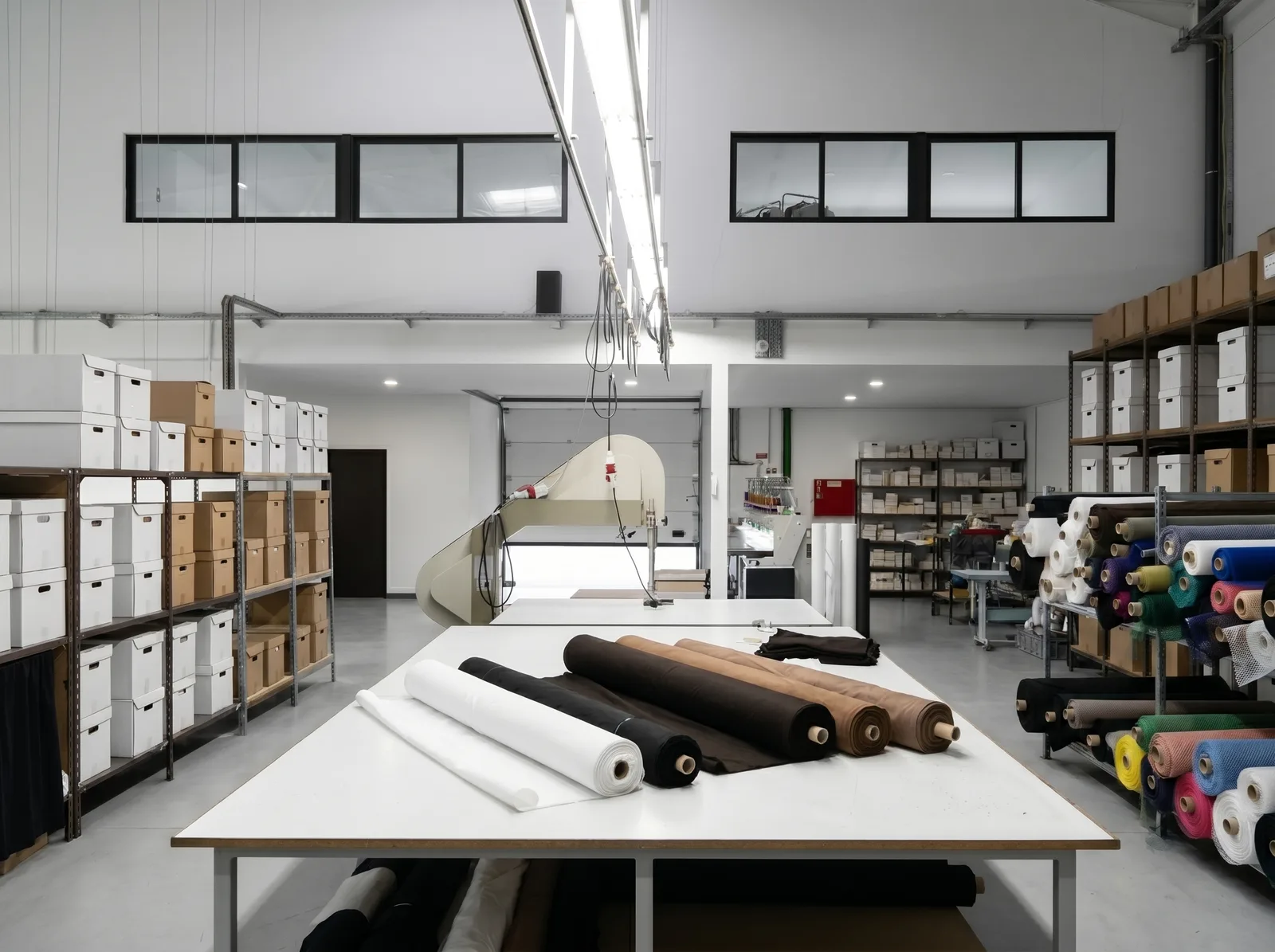
We are a vertically integrated factory in Barcelos, Portugal — which means everything happens under one roof. Pattern making, cutting, sewing, finishing, washing, QC, packing. No outsourcing to subcontractors who add cost and reduce accountability.
For startups specifically, we offer:
- —MOQs that match your stage — no pressure to over-commit
- —48-hour quote turnaround — so you can plan and budget quickly
- —Collaborative sampling — we flag issues before they become expensive mistakes
- —Factory visits — come and see exactly what you are buying
- —Fabric certification documentation — OEKO-TEX, GOTS, BCI certificates from our partner mills, ready to share with your customers
We have helped brands go from a sketched idea to a live product page. We have also worked with brands that arrived with a detailed tech pack and just needed reliable execution. Both are welcome.
If you are ready to take the first step, explore our products and fabrics to start shaping your brief — or reach out directly for a quote. We respond within 48 hours.
The right manufacturer is one of the most important decisions you will make as a brand. Take the time to find one you can grow with. Essential reading: clothing brand business plan, understanding MOQ, clothing production costs breakdown, how to start a clothing brand.

Pedro Carreira
Founder of White Cotton, a textile manufacturer in Barcelos, Portugal. Producing custom clothing collections for brands across 15+ countries.
Continue Reading

How Much Does It Cost to Start a Clothing Brand in 2026? Real Numbers
![Hoodie Manufacturing Costs: Real Prices from a Portuguese Factory [2026]](/_next/image?url=%2Fimages%2Fgenerated%2Fblog%2Fhoodie-manufacturing-costs-breakdown.webp&w=1920&q=75)
Hoodie Manufacturing Costs: Real Prices from a Portuguese Factory [2026]
![How to Find a Clothing Manufacturer in Portugal: A Factory Owner's Honest Guide [2026]](/_next/image?url=%2Fimages%2Fgenerated%2Fblog%2Fhow-to-find-clothing-manufacturer-portugal.webp&w=1920&q=75)
How to Find a Clothing Manufacturer in Portugal: A Factory Owner's Honest Guide [2026]
![How to Vet a Clothing Manufacturer: The Due Diligence Checklist [2026]](/_next/image?url=%2Fimages%2Fgenerated%2Fblog%2Fhow-to-vet-clothing-manufacturer.webp&w=1920&q=75)
How to Vet a Clothing Manufacturer: The Due Diligence Checklist [2026]
![27 Questions to Ask a Clothing Manufacturer Before Placing Your Order [2026]](/_next/image?url=%2Fimages%2Fgenerated%2Fblog%2Fquestions-to-ask-clothing-manufacturer.webp&w=1920&q=75)