How to Vet a Clothing Manufacturer: The Due Diligence Checklist [2026]
How to vet a clothing manufacturer in 12 steps — Google Maps checks to test orders. A factory owner shares the checklist most brands skip.
 Pedro Carreira··15 min read
![How to Vet a Clothing Manufacturer: The Due Diligence Checklist [2026]](/_next/image?url=%2Fimages%2Fgenerated%2Fblog%2Fhow-to-vet-clothing-manufacturer.webp&w=1920&q=75)
Why Due Diligence Matters More Than Price
Every month, I hear from brands recovering from a bad manufacturing experience. Late delivery, wrong fabric, poor stitching, vanishing communication — the details vary but the cause is the same. They chose not to vet a clothing manufacturer properly before committing real money. They picked based on price and a polished website, skipped the verification steps, and paid for it.
Most of these problems are avoidable with a straightforward checklist that takes a few hours. The checks below are what I would do if I were a brand evaluating any factory for the first time — including my own. If you are still identifying potential factories, start with our guide on how to find a clothing manufacturer in Portugal and come back here once you have a shortlist.
How to Vet a Clothing Manufacturer: 12-Step Checklist
1. Google Maps Check
Open Google Maps. Type in the factory address they gave you. Switch to satellite view, then drop into Street View.
What you are looking for: An industrial building. A loading dock. Company signage. Parked delivery vehicles. Surrounding businesses that make sense for a manufacturing area — warehouses, other factories, logistics companies.
What bad looks like: A residential neighbourhood. A co-working space. An office building with no industrial footprint. Or — and this happens — the address does not exist on the map at all.
A brand once contacted us after losing thousands of euros to a "manufacturer" whose listed address turned out to be an apartment block. They never checked. It took 30 seconds on Street View to see it.
This is the easiest verification step — two minutes, zero cost. If the building does not look like a place where garments are cut, sewn, and packed, you are not dealing with a factory.
For Portuguese factories: the main textile towns are Barcelos, Guimaraes, Braga, Vila Nova de Famalicao, and Santo Tirso. A company claiming to manufacture in Portugal but listing an address in Lisbon's city centre is almost certainly an agent or showroom.
2. Company Registration Verification
Every legitimate business is registered somewhere. Look it up.
Portugal: Search on RACIUS or Portal da Justica. You can verify the company name, tax number (NIF), incorporation date, and activity code (CAE). A manufacturer should have a CAE code starting with 14 (manufacture of wearing apparel).
UK: Companies House. Free search. EU: Most member states have equivalent public registries — Handelsregister (Germany), Infogreffe (France), Registro Imprese (Italy).
What good looks like: The company has been registered for several years. The activity code matches manufacturing. The registered address matches the factory address. The company has filed accounts recently.
What bad looks like: No registration found. The company was incorporated last month. The activity code says "wholesale trade" or "consultancy" rather than manufacturing. The registered address is different from the factory address they gave you.
I once helped a brand evaluate a potential manufacturer with a polished website and competitive pricing. A quick RACIUS search showed the business was recently registered with a retail activity code, not manufacturing. They were reselling production from actual factories. Not illegal, but the brand thought they were buying direct.
3. Website Audit
A factory website tells you far more than the factory intends. Read it carefully.
Signs you are dealing with a real factory:
- —Factory photos showing specific machines, production lines, and workers (not stock images)
- —A specific physical address — street, postcode, city
- —Details about machinery and capacity: "24 sewing stations", "Juki overlock machines", "daily output of 800 units"
- —Product ranges with clear limits: "we specialise in cut-and-sew knitwear" rather than "we manufacture all types of garments"
- —A page about their production process with genuine detail
Signs you are dealing with an agent or intermediary:
- —Vague language: "we work with a network of factories", "we source from trusted partners"
- —No factory address. A PO box or registered office only.
- —Stock photography of generic factory floors
- —Claims to produce everything from swimwear to outerwear to formal tailoring
- —No mention of specific machines, capacity, or technical capability
The difference is specificity. A factory that cuts and sews hoodies can tell you their daily output. An agent who subcontracts cannot — because the number changes depending on which factory they use.
There is nothing inherently wrong with using an agent, but you should know what you are paying for. A company that presents itself as a manufacturer but operates as a middleman will create transparency problems during production. For more on this distinction, see our guide on questions to ask a clothing manufacturer.
4. Request Factory Photos and Video
Not the marketing photos from the website. Ask for a phone video walkthrough of the production floor. Right now. Today.
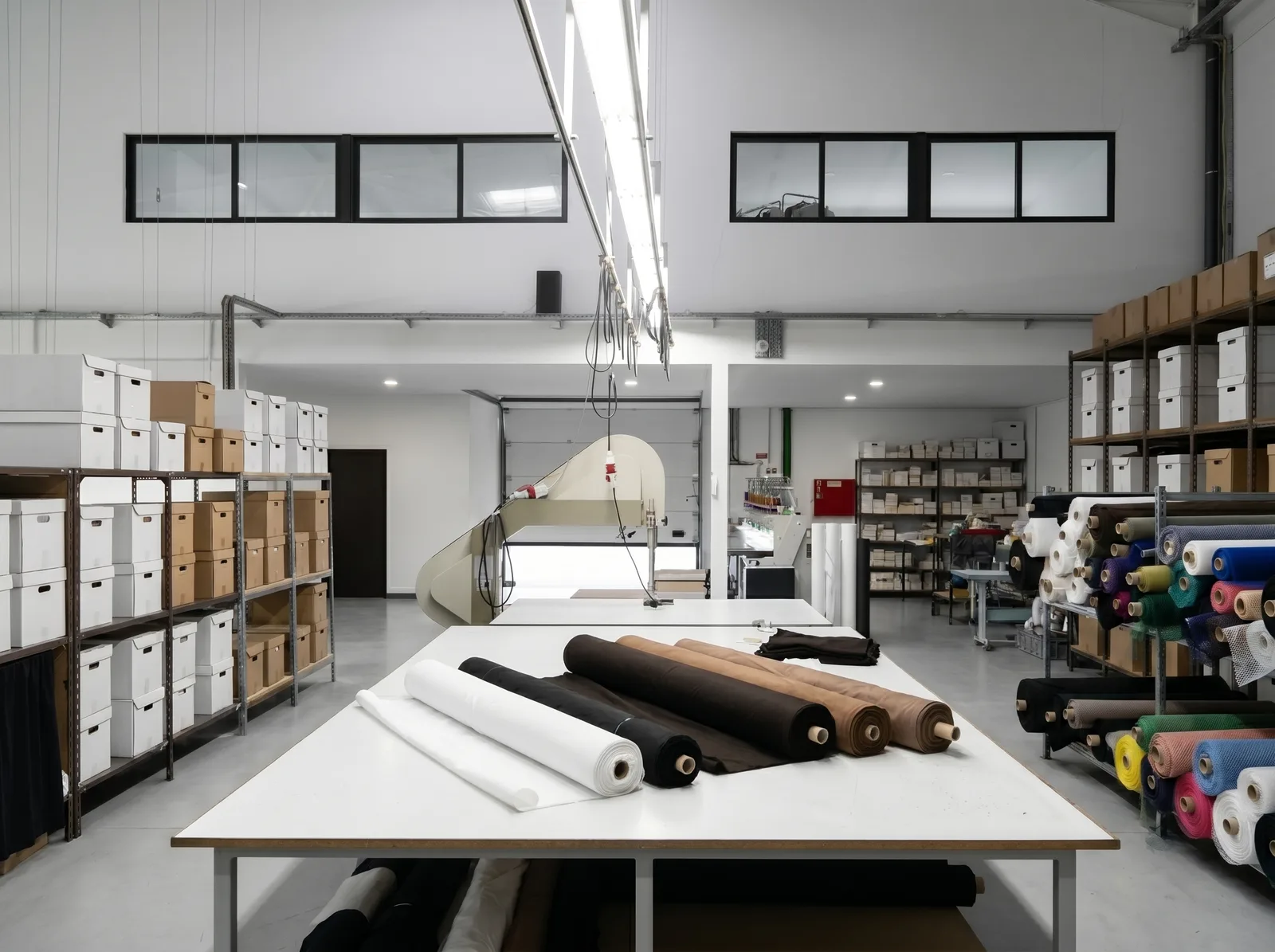
What you want to see: The cutting room with fabric rolls and cutting tables. The sewing floor with operators at machines. The finishing area. The QC station. The packing area. Ideally, garments in various stages of production.
What good looks like: They send it within 24-48 hours. The video is casual — phone footage, not a produced corporate video. Workers are actually working. The space looks like a functioning production facility.
What bad looks like: They stall. "We will send it next week." The video never arrives. Or they send polished marketing material instead of a real walkthrough.
Real factories are proud of their floor. When someone asks me for a walkthrough video, I can record and send it within an hour because the factory is running. People are sewing. Fabric is on the cutting tables. That is what a real operation looks like. If a manufacturer cannot show you their production floor on short notice, ask yourself why.
5. Ask for References
Request the names and contact details of two or three brands they have produced for. Then actually contact those brands.
What to ask the references:
- —Did the factory deliver on time?
- —Was the quality consistent with the approved sample?
- —How did they handle problems when they arose?
- —Would you order again?
What good looks like: The factory provides names willingly. The brands confirm a positive experience with specific details — "they caught a dye lot issue before production and alerted us" or "they shipped ahead of schedule."
What bad looks like: The factory refuses, citing confidentiality. Or the references feel scripted — generic praise with no specifics. Or you cannot reach the referenced companies because they do not exist.
Most established factories have brands who would happily vouch for them. If a manufacturer cannot name a single one, that tells you something important. One caveat: some brands do have genuine confidentiality agreements with their manufacturer. "I cannot share names, but I can connect you anonymously" is a reasonable response. A flat refusal is not.
6. Order a Sample
Before you commit to a production run, order a sample. One garment that lets you evaluate quality, communication, and timeline accuracy all at once.
Provide your tech pack with measurements, fabric specifications, construction details, and decoration requirements. A good factory will review the tech pack and come back with questions before proceeding. If they do not ask a single question about a complex garment, they are either not reading it or planning to interpret it however they see fit.
What good looks like: A realistic timeline stated upfront (4 to 8 weeks from payment is standard for a proper sample, not a rushed promise). Clarifying questions. The sample arrives on time with accurate measurements and clean stitching.
What bad looks like: No questions about the tech pack. Missed deadline with no communication. Fabric that feels different from what was discussed. Construction shortcuts — single-needle where the spec calls for double-needle.
A sample typically costs EUR 50-150 depending on complexity. Treat it as insurance — the money you spend here can save you thousands on a production run that goes wrong. For exact figures, see our clothing production costs breakdown.
7. Visit the Factory
Request a video call walkthrough of the production floor as part of your initial vetting. Physical factory visits are standard once samples are approved and production begins — most legitimate factories welcome this.
What to look for during a visit:
- —General cleanliness and organisation. A well-run factory is tidy, even if it is busy.
- —Workers who seem comfortable and engaged. The atmosphere tells you a lot.
- —Materials storage — fabric rolls should be stored properly, not thrown in piles.
- —Quality control in practice, not just in theory. Watch how they inspect garments.
- —How the owner or manager talks about their work. Pride shows.
What bad looks like: Reluctance to schedule a visit. Restrictions on where you can go ("you can see the showroom, but the production floor is off-limits"). A factory floor that does not match the photos they sent. Workers who look nervous when visitors appear.
Not every brand can visit in person — geography and budgets are real constraints. But if you are placing orders worth thousands of euros, a flight and a day at the factory is a reasonable investment. Most Portuguese factories are within an hour of Porto airport.
If a factory does not want you on their floor, that should concern you.
8. Evaluate Communication Quality
How a factory communicates during vetting is a preview of how they will communicate during production — except during production, the stakes are higher.
What good looks like: Responses within 24 hours. Specific answers, not just "yes, we can do that" but "here is how, here is the timeline, here is the cost." Proactive problem-flagging: "Your tech pack specifies 320gsm brushed fleece, but 280gsm would drape better for this design. Want us to sample both?"
What bad looks like: Days between responses. Vague answers. You chase for updates. Your contact changes and the new person does not know your project. Problems only surface after deadlines pass.
Communication is the single best predictor of a successful manufacturing relationship. I have seen brands choose the cheaper quote over the more communicative factory, then spend weeks chasing updates and managing rework. The "savings" evaporated long before the garments shipped.
9. Review the Contract and Terms
Before you sign anything or send a deposit, read every line. If there is no written agreement, that is itself a red flag — insist on one.
Key terms to verify:
- —Payment terms: Industry standard is 30-50% deposit, balance on completion before shipping. 100% upfront on a first order is unusual and risky.
- —Defect policy: What happens when garments do not meet the approved sample? Who pays for rework?
- —Lead time guarantees: Is the production timeline contractual or an estimate?
- —IP protection: Your patterns, tech packs, and brand assets remain your property and will not be used for other clients.
- —Shipping terms: Who arranges and pays for shipping? What Incoterm applies?
What bad looks like: No written agreement. Verbal promises only. A contract that is vague on defect handling. No IP clause.
We have had brands come to us after a dispute with a previous manufacturer where there was no defect policy in writing. A significant portion of the order arrived with visible stitching issues, and there was nothing documented to support their claim. A two-paragraph defect clause would have prevented that entirely.
10. Start Small
Your first order with any new manufacturer should be a test order. Not your full season. Not your biggest style. A controlled, manageable order that lets you evaluate the entire process from confirmation to delivery.
What this looks like in practice: 75-150 units across 1-2 styles and 2-3 colours. Enough to test production quality, timeline accuracy, communication, packaging, and shipping. Small enough that if something goes wrong, it is a learning experience rather than a catastrophe.
Why brands skip this: Impatience. They have a launch date and a pre-order list. Or the factory offers volume discounts that make a larger order tempting. But a sample is one garment made with careful attention. Production is hundreds of garments under time pressure. The gap between sample quality and bulk quality is where relationships succeed or fail.
Some of our best long-term production relationships started with small test orders. The brand was cautious, verified the process, and scaled from there. That progression — small, verify, scale — is how durable partnerships are built.
11. Check Social Proof
A legitimate manufacturer leaves traces in the industry beyond their own website.
Where to look:
- —LinkedIn: Does the factory have a company page? Do real people list it as their employer? A factory with a production manager, a pattern maker, and a commercial director all on LinkedIn is a strong signal.
- —Trade shows: Have they exhibited at Modtissimo, Premiere Vision, or regional textile fairs? Trade show attendance requires investment and physical presence — harder to fake than a website.
- —Industry forums: Search the company name in fashion manufacturing forums, Facebook groups, and Reddit threads. Brands talk about their manufacturers.
- —Google News: Even a small mention in a local newspaper or industry publication is evidence the business is real and active.
What bad looks like: Zero LinkedIn presence. No trade show history. No mention anywhere outside their own website. Legitimate businesses accumulate third-party mentions over time. A company with none has either just started or is not what it claims to be.
We have had brands find us through LinkedIn posts and trade show connections before ever visiting our website. That trail of real-world presence is something a fake factory cannot replicate.
12. Trust Your Gut
After working through steps 1 through 11, you will have a detailed picture of the manufacturer. Most of the time, the data leads clearly to a yes or a no. But sometimes, the data looks fine and something still feels off.
Trust that feeling.
Maybe they answered every question correctly but the responses felt rehearsed. Maybe the pricing seems impossibly low for the quality they claim. Maybe they dodged a specific question you asked twice.
The quality of a business relationship is set in the first interactions. A factory that is evasive about lead times during quoting will be evasive about delays during production. A factory that overpromises to win the order will underdeliver when pressure is on. The reverse is also true — a factory that tells you "that timeline is not realistic" is more likely to give you honest updates during production.
If something feels wrong after running this checklist, walk away. The cost of restarting the search is nothing compared to a failed production run.
For warning signs that a manufacturer is NOT legitimate, see our guide on red flags when choosing a clothing manufacturer.
White Cotton is a clothing manufacturer in Barcelos, Portugal, producing cut-and-sew cotton jersey and fleece garments for brands across Europe and the Middle East, from 75 pieces per colourway. If you are evaluating manufacturers for your next production run, start a conversation with us.

Pedro Carreira
Founder of White Cotton, a textile manufacturer in Barcelos, Portugal. Producing custom clothing collections for brands across 15+ countries.
Frequently Asked Questions
Start with a Google Maps check of their listed address to confirm it is an industrial building. Then verify their company registration — in Portugal, search RACIUS for the NIF and confirm the activity code starts with 14 (manufacture of wearing apparel). Request a phone video walkthrough of their production floor and contact brands they list as references. A legitimate factory passes all four of these checks without hesitation.
A video call walkthrough is a practical first step during initial vetting. Physical factory visits are standard once samples are approved and production begins — and most legitimate factories welcome them. If geography or budget makes an in-person visit difficult early on, the combination of video walkthroughs, references, and a test order gives you strong confidence before committing to larger volumes.
The basic checks — Google Maps, company registration, website audit, reference calls — can be completed in a single day. The sample stage usually adds 4 to 8 weeks from payment, depending on garment complexity. A test production order adds another 6 to 12 weeks from the deposit. From first contact to a confirmed, production-ready relationship, expect roughly 3 to 6 months if you move deliberately.
Industry standard for first orders is 30-50% deposit with the balance due on completion before shipping. Wire transfer (bank transfer) is the norm for European manufacturing — it creates a paper trail on both sides. Avoid paying 100% upfront on a first order, and be cautious of any factory that insists on it. As trust builds over multiple orders, some factories offer more flexible terms.
Continue Reading

How Much Does It Cost to Start a Clothing Brand in 2026? Real Numbers
![Hoodie Manufacturing Costs: Real Prices from a Portuguese Factory [2026]](/_next/image?url=%2Fimages%2Fgenerated%2Fblog%2Fhoodie-manufacturing-costs-breakdown.webp&w=1920&q=75)
Hoodie Manufacturing Costs: Real Prices from a Portuguese Factory [2026]
![How to Find a Clothing Manufacturer in Portugal: A Factory Owner's Honest Guide [2026]](/_next/image?url=%2Fimages%2Fgenerated%2Fblog%2Fhow-to-find-clothing-manufacturer-portugal.webp&w=1920&q=75)
How to Find a Clothing Manufacturer in Portugal: A Factory Owner's Honest Guide [2026]
![27 Questions to Ask a Clothing Manufacturer Before Placing Your Order [2026]](/_next/image?url=%2Fimages%2Fgenerated%2Fblog%2Fquestions-to-ask-clothing-manufacturer.webp&w=1920&q=75)
27 Questions to Ask a Clothing Manufacturer Before Placing Your Order [2026]
![12 Red Flags When Choosing a Clothing Manufacturer [2026]](/_next/image?url=%2Fimages%2Fgenerated%2Fblog%2Fred-flags-clothing-manufacturer.webp&w=1920&q=75)