12 Red Flags When Choosing a Clothing Manufacturer [2026]
A factory owner reveals the warning signs that separate legitimate manufacturers from agents, scammers, and factories that will waste your time and money.
 Pedro Carreira··16 min read
![12 Red Flags When Choosing a Clothing Manufacturer [2026]](/_next/image?url=%2Fimages%2Fgenerated%2Fblog%2Fred-flags-clothing-manufacturer.webp&w=1920&q=75)
Why I Wrote This
I run a cut-and-sew factory in Barcelos, Portugal. Every month we receive enquiries from brands that have already been burned by a previous clothing manufacturer — late deliveries, wrong fabrics, vanished deposits, garments that looked nothing like the approved sample. In almost every case, the warning signs were there before the brand sent money. They just did not know what to look for.
Not every red flag means you should walk away immediately. Some are yellow flags that deserve a direct conversation. But if you see three or four of these in the same clothing manufacturer, protect your money and keep looking.
The 12 Red Flags
1. "We can make anything"
No factory does everything well. The garment industry is specialised by construction type. A factory that excels at cut-and-sew knits — hoodies, t-shirts, sweatshirts, joggers — will not produce a tailored blazer or a down jacket to the same standard. The machinery is different. The skills are different. The fabric handling is different.
Why it is dangerous: A factory that claims to make anything is either subcontracting styles they cannot handle (adding cost and removing your quality control) or producing outside their competence (which you will discover when the garments arrive).
What to do instead: Ask what they specialise in. A good factory will give you a specific list of garment types and tell you honestly when a style falls outside their wheelhouse. That honesty is a green flag. If you need help identifying the right type of factory for your product, our guide to finding a manufacturer in Portugal covers how to match your product to the right facility.
2. No factory address on the website
A real factory has a physical location — an industrial address with cutting tables, sewing lines, and finishing stations. It is not a secret. Factories in Portugal, Turkey, Italy, and every other major production country are proud of where they are. The address is on the website, often with photos of the building.
Why it is dangerous: No address usually means one of two things: you are talking to an agent who does not own a factory, or the "factory" is a residential operation that cannot handle real production volume. Agents are not inherently bad, but you should know you are paying an intermediary margin — and that you will have no direct relationship with whoever actually makes your garments.
What to do instead: Check for a physical address, ideally in a known textile region. For Portugal, that means the Porto-Braga corridor: Barcelos, Guimaraes, Famalicao, Santo Tirso, Vizela. Plug the address into Google Maps. Does it look like a factory or an apartment?
3. Suspiciously low quotes
If a factory quotes 50% less than every other quote you have received, something is wrong. Fabric costs are fabric costs — the same French terry from the same mill costs roughly the same regardless of who buys it (volume discounts help, but not by half). Labour rates are set by the country. Trims have fixed prices. There is no magic formula that makes a hoodie cost half as much.
Why it is dangerous: The gap has to come from somewhere. Cheaper fabric than specified (lighter weight, different composition). Subcontracting to an undisclosed facility with lower standards. Skipping quality control steps. Using off-spec thread or trims. You will not discover these shortcuts until production is finished — and by then, your money is spent and your delivery deadline is gone.
What to do instead: Get at least three quotes and compare them line by line. If you do not know what a reasonable cost looks like, read our clothing production costs breakdown for real factory pricing on common garments. A quote that falls dramatically below the range is not a bargain — it is a warning.
4. 100% upfront payment
The industry standard for production payment is 30-50% deposit on order confirmation, with the balance due on completion — typically after you have seen photos of the finished goods. This structure exists for a reason: it gives both sides skin in the game. The factory has working capital to buy materials. The brand has leverage if something goes wrong.
Why it is dangerous: Full upfront payment removes all your leverage. If the factory delivers late, delivers poor quality, or disappears entirely, you have no recourse. You cannot withhold payment because they already have it. This is particularly dangerous with a new factory you have never worked with before.
What to do instead: Agree on standard terms: 30-50% deposit, balance before shipping. A factory that refuses this arrangement either has cash flow problems (which means they may not be able to afford your fabric) or does not plan to deliver what was agreed. Either way, walk away.
5. "Free" samples
Samples cost real money. Pattern making, fabric sourcing, cutting a single garment, sewing it, finishing it, shipping it — a sample that would cost EUR 50-150 to produce is not free just because a factory says it is. That cost is going somewhere.
Why it is dangerous: Factories offering free samples typically recover the cost in one of two ways: inflated production pricing (you pay more per unit than you should) or lower sample quality (the sample is made with cheaper fabric or less care, giving you a misleading impression of what production quality will be). Some use free samples as a hook to lock you into a production commitment before you have properly evaluated the factory.
What to do instead: Pay for your samples. A factory that charges EUR 50-150 per sample and tells you so upfront is being transparent. They are showing you exactly what production will look like, because they are charging you for the real work. Read more about what to expect from the sampling process in our questions to ask a manufacturer guide.
6. Stock photos on the website
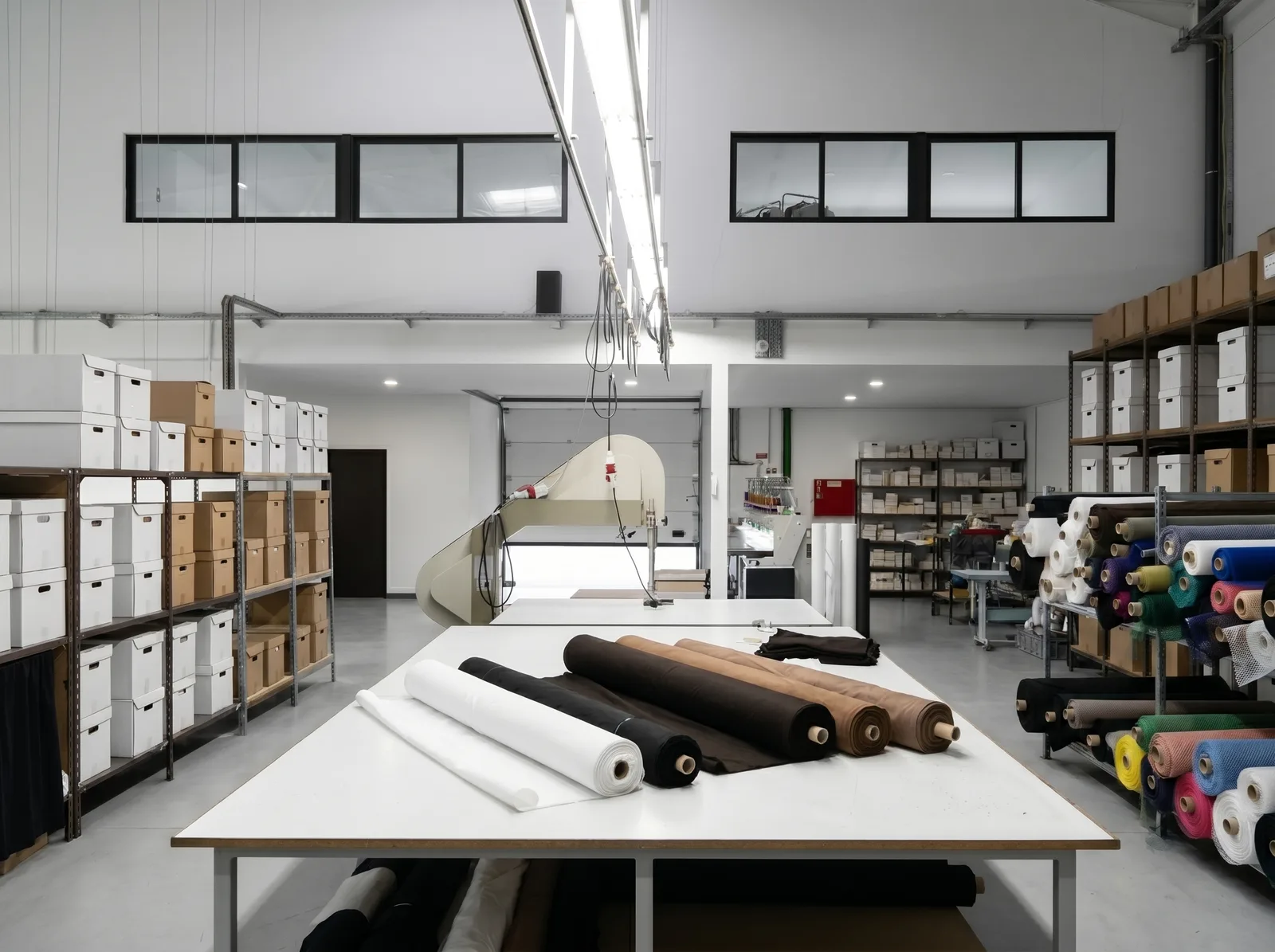
Real factories photograph their own facility. They show their cutting room, their sewing floor, their quality control station, their finished goods. These photos are not professionally lit or perfectly composed — they look like a factory, because they are a factory.
Why it is dangerous: Stock photos of generic sewing machines, anonymous workers, and perfectly arranged fabric rolls are purchased from image libraries. They tell you nothing about the actual facility that will produce your garments. A website built entirely on stock photography is almost always a trading company, an agent, or a recently created entity with no production history.
What to do instead: Look for original photography that shows the specific facility. Factory name on the wall, employees at real workstations, garments in various stages of production. If the website looks like a template with interchangeable images, ask for a video call tour of the factory before proceeding.
7. No references or portfolio
Every factory that has been operating for more than a year has produced garments for real brands. They should be able to show you examples of their work — even if client confidentiality prevents them from naming the brands. Photos of finished production, fabric swatches, garment construction details. Something tangible.
Why it is dangerous: A factory with no references is either brand new (higher risk), does not produce the volume or quality they claim, or has references they cannot share because previous clients were unsatisfied. None of these scenarios give you confidence.
What to do instead: Ask for anonymised production examples. "Can you show me a hoodie you produced recently, without naming the brand?" Ask if any of their clients would be willing to speak with you. Check Google reviews, Trustpilot, and industry forums. A factory with a track record will have some footprint. If you want a framework for evaluating factories, our how to vet a clothing manufacturer guide walks through the full process.
8. Vague timelines
"6 to 12 weeks from the deposit" is a real answer. It accounts for fabric lead time, cutting, sewing, finishing, and quality control. It is a range because production timelines depend on fabric availability, current capacity, and order complexity.
"We will see" or "as soon as possible" or "it depends" without any further detail is not an answer. It is avoidance.
Why it is dangerous: Vague timelines usually mean the factory does not control their own production schedule — either because they subcontract and cannot commit on behalf of another facility, or because they overcommit capacity and push orders back when they fall behind. You cannot plan a product launch, a seasonal drop, or a retail delivery around "we will see."
What to do instead: Ask for a production timeline broken into stages: fabric sourcing (X weeks), sampling approval (X days), cutting and production (X weeks), finishing and QC (X days), shipping preparation (X days). A factory that can give you this breakdown has planned your order. A factory that cannot has not.
9. Won't show the production floor
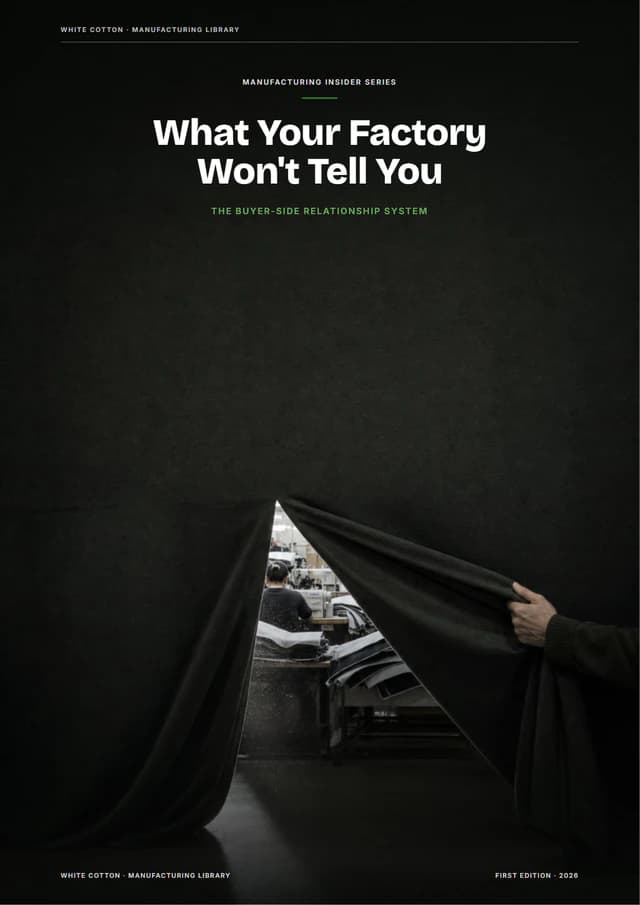
If you ask for a video walkthrough of the production floor and the answer is anything other than "yes," ask yourself why.
Legitimate factories are proud of their facility. Machines, workflow, cleanliness, organisation, the skill of their operators — a factory that does good work wants you to see it.
Why it is dangerous: Refusal to show the facility typically means one of three things: there is no factory (you are dealing with an agent), the factory conditions are not something they want you to see, or the production will be subcontracted to a facility they do not control. All three are deal-breakers for any serious production order.
What to do instead: Ask for a live video walkthrough of the production floor. Any factory proud of its facility will do this without hesitation. Physical visits are standard once you begin production — but a video call during vetting tells you everything you need to know about whether the factory is real. See how our craft and process works for an example of what transparency looks like.
10. Changing specs after quoting
You receive a quote based on 320 GSM organic cotton fleece with a YKK zip and woven labels. Production begins. Somewhere along the way, the fabric becomes 280 GSM conventional cotton, the zip becomes an unbranded alternative, and the woven labels become printed.
This is bait-and-switch, and it happens more often than brands realise.
Why it is dangerous: You approved and paid for one specification. You receive another. The per-unit cost stays the same, but the factory's margin increases because they are using cheaper materials. Your retail customers receive a garment that does not match the quality you promised. Your brand reputation takes the hit, not the factory's.
What to do instead: Get every specification in writing before production: fabric composition and weight, trim brands, label type, thread colour, stitch density, finishing process. Include a clause in your purchase order that material substitutions require written approval. Request a pre-production sample (a sample made with the exact production materials) before bulk cutting begins. For a full cost reference, check our production costs breakdown.
11. Communication goes dark during production
You send the deposit. The factory confirms the order. And then... silence. Emails go unanswered for days. WhatsApp messages get a single blue tick. Updates stop. You hear nothing between "deposit received" and "your goods are ready" — or worse, "there has been a delay."
Why it is dangerous: Silence during production almost always means problems. Fabric delivery is late. A sewing issue was discovered. The production schedule slipped because another order took priority. Factories that communicate proactively will tell you about these issues when they happen — giving you time to adjust your plans. Factories that go dark are hoping to solve the problem before you notice. Sometimes they do. Often they do not.
What to do instead: Agree on a communication schedule before production starts. Weekly updates with photos at key stages — fabric arrival, cutting, sewing in progress, finished goods before packing. A factory that resists this level of transparency is not the right partner for your brand.
12. "We handle everything, don't worry"
This phrase sounds reassuring. It is not. Good manufacturers want you involved in the process. They want your approval at each stage because catching a problem at cutting is infinitely cheaper than discovering it at delivery. They send photos. They ask questions. They flag issues early.
Why it is dangerous: "Don't worry" is a request for you to disengage. It means the factory does not want your scrutiny during production — which is precisely when scrutiny matters most. Brands that step back and wait for delivery are the ones most likely to receive garments that do not match the approved sample.
What to do instead: Stay involved. Approve fabric swatches before cutting. Review a pre-production sample. Request mid-production photos. Check measurements against your spec sheet. A good factory will appreciate your engagement because it means fewer problems at the end. A bad factory will resist it because it means they cannot cut corners unnoticed.
Green Flags: What a Good Clothing Manufacturer Looks Like
Red flags tell you who to avoid. Green flags tell you who to trust. Here is what a legitimate, trustworthy clothing manufacturer looks like in practice.
They have a specific specialisation. They tell you what they are good at — and what they are not. A factory that says "we specialise in cut-and-sew knits: hoodies, sweatshirts, t-shirts, joggers, and basic outerwear" is telling you the truth about their capabilities.
They show you the factory. The address is on the website. Photos of the production floor are real, not stock images. They welcome visits and do not hesitate to do a video call walkthrough.
Their pricing makes sense. The quote is line-by-line: fabric, trims, CMT, finishing, decoration, packaging. It is not the cheapest quote you received, but you can see exactly where your money goes.
They charge for samples. Typically EUR 50-150 per style, deducted from the first bulk order. They use production-grade fabric and real trims for samples because they want the sample to represent what you will actually receive.
They have clear timelines. "Sampling takes 4 to 8 weeks from payment. Production takes 6 to 12 weeks from the deposit. Your quotation states the date for your order." They tell you when they are busy and adjust expectations accordingly.
They communicate proactively. You receive updates without asking. Photos at key production stages. A heads-up when fabric delivery is a few days late. An email when cutting is complete. This is not exceptional service — this is how competent manufacturing works.
They want your involvement. They send pre-production samples for approval. They ask you to confirm fabric swatches. They flag potential issues and ask for your decision rather than making assumptions. Your engagement is welcomed, not tolerated.
They have references. Past clients who will vouch for them — or at minimum, anonymised examples of production work that demonstrate their quality level.
Payment terms are industry standard. 30-50% deposit, balance on completion. They send photos of finished goods before you pay the remaining balance. They do not need your full payment to buy fabric.
How to Choose a Clothing Manufacturer You Can Trust
Most of these red flags are not about malicious intent. Some factories are simply disorganised. Some are overcommitted. Some are agents who genuinely believe they are adding value but are not transparent about their role.
The damage to your brand is the same regardless of the reason. Late delivery costs you the same whether the factory was dishonest or just incompetent. Wrong fabric feels the same to your customer whether it was a deliberate substitution or a careless mistake.
Your job as a brand is not to fix factories. It is to find good ones and build long-term relationships with them. Use these red flags as a filter, not a rehabilitation programme.
For a proactive approach to due diligence, see our step-by-step guide to vetting a clothing manufacturer. If you are in the early stages of finding a manufacturer, start with our guide to finding a clothing manufacturer in Portugal for practical steps on where to look and how to evaluate. And if you want a ready-made list of the right questions to ask, read 27 questions to ask a clothing manufacturer before you send your first email.
We manufacture in Barcelos, Portugal — cut-and-sew knits from 75 units per colourway, or 100 in a single colourway. If you want to see how a transparent factory operates, start a conversation.

Pedro Carreira
Founder of White Cotton, a textile manufacturer in Barcelos, Portugal. Producing custom clothing collections for brands across 15+ countries.
Frequently Asked Questions
The most dangerous signs are 100% upfront payment demands, no factory address on the website, and communication that goes dark after you send a deposit. Any one of these deserves scrutiny. Three or four together means you should walk away and keep looking.
Check for a real factory address in a known textile region and verify it on Google Maps. Ask for a live video walkthrough of the production floor — not a pre-recorded tour. Request references from past clients. A legitimate manufacturer will have no problem with any of these requests. A scam operation will stall, deflect, or disappear when pressed.
No. Industry standard is 30-50% deposit on order confirmation, with the balance due after you have seen photos of the finished goods. Full upfront payment removes all your leverage if something goes wrong. Any factory that insists on 100% before production either has serious cash flow problems or does not plan to deliver what was agreed.
Be cautious. Samples cost real money to produce — fabric, pattern making, sewing, finishing, shipping. When a factory absorbs that cost, they typically recover it through inflated production pricing or lower sample quality. A transparent factory charges for samples upfront and uses production-grade materials so the sample accurately represents what you will receive.
Continue Reading

How Much Does It Cost to Start a Clothing Brand in 2026? Real Numbers
![Hoodie Manufacturing Costs: Real Prices from a Portuguese Factory [2026]](/_next/image?url=%2Fimages%2Fgenerated%2Fblog%2Fhoodie-manufacturing-costs-breakdown.webp&w=1920&q=75)
Hoodie Manufacturing Costs: Real Prices from a Portuguese Factory [2026]
![How to Find a Clothing Manufacturer in Portugal: A Factory Owner's Honest Guide [2026]](/_next/image?url=%2Fimages%2Fgenerated%2Fblog%2Fhow-to-find-clothing-manufacturer-portugal.webp&w=1920&q=75)
How to Find a Clothing Manufacturer in Portugal: A Factory Owner's Honest Guide [2026]
![How to Vet a Clothing Manufacturer: The Due Diligence Checklist [2026]](/_next/image?url=%2Fimages%2Fgenerated%2Fblog%2Fhow-to-vet-clothing-manufacturer.webp&w=1920&q=75)
How to Vet a Clothing Manufacturer: The Due Diligence Checklist [2026]
![27 Questions to Ask a Clothing Manufacturer Before Placing Your Order [2026]](/_next/image?url=%2Fimages%2Fgenerated%2Fblog%2Fquestions-to-ask-clothing-manufacturer.webp&w=1920&q=75)