T-Shirt Manufacturing Process: From Cotton to Finished Garment [2026]
The t-shirt manufacturing process step by step — from tech pack to delivery. Real costs at 100, 200, and 500 units from a Portuguese factory.
 Pedro Carreira··19 min read
![T-Shirt Manufacturing Process: From Cotton to Finished Garment [2026]](/_next/image?url=%2Fimages%2Fgenerated%2Fblog%2Ft-shirt-manufacturing-process-explained.webp&w=1920&q=75)
A t-shirt looks simple — four pattern pieces, a few seams, done. But the t-shirt manufacturing process has more decision points than most brands expect, and each one affects cost, quality, and lead time in ways that compound across a production run. Get the fabric weight wrong and your retail price stops making sense. Skip the sample and you are reworking 500 garments.
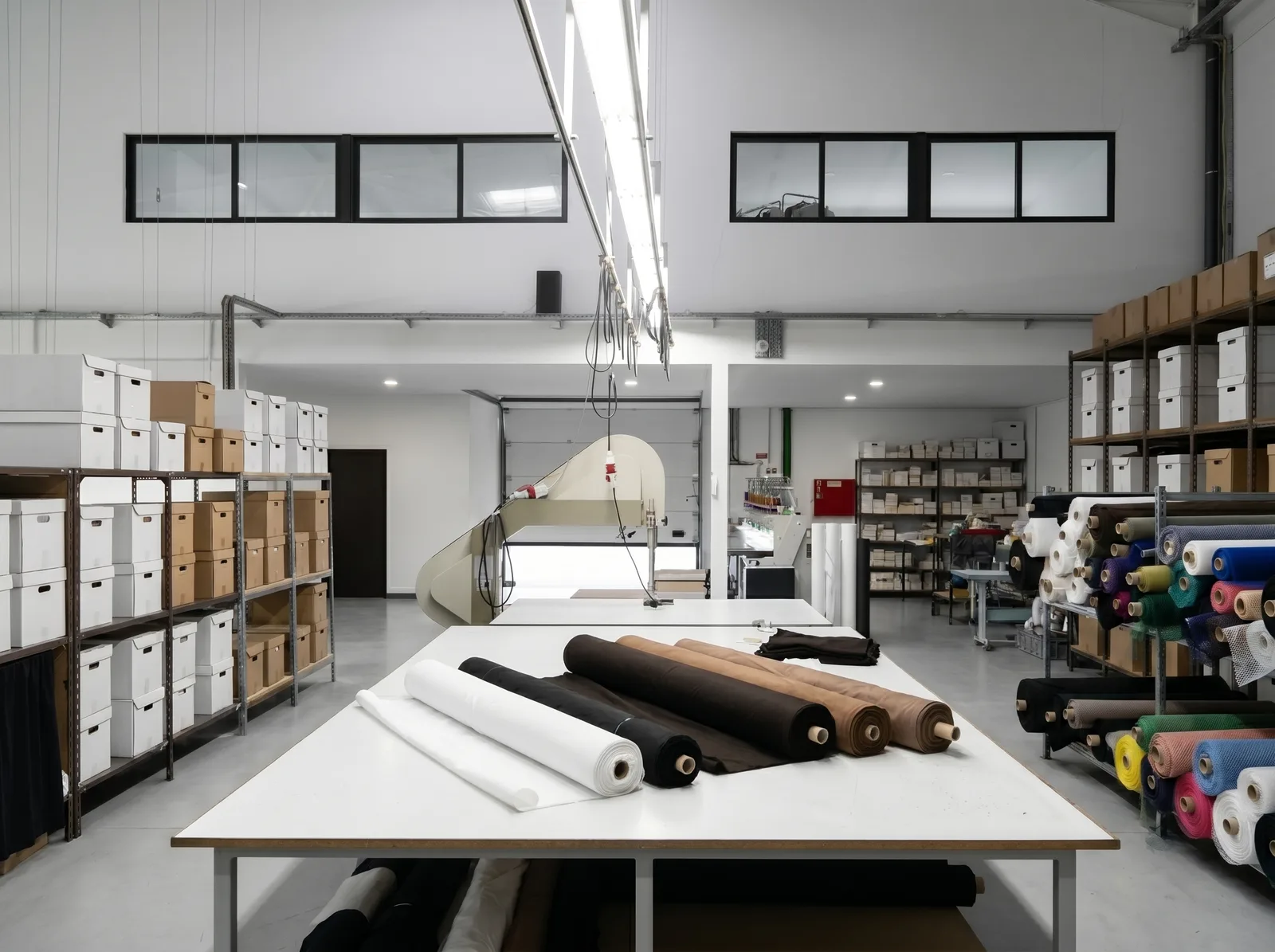
I run a garment factory in Barcelos, Portugal, starting orders from 75 pieces per colourway. T-shirts are our highest-volume product — we produce them for brands across Europe, the Middle East, and the US. This guide walks through every stage, from the initial tech pack to shipping, with real costs, real timelines, and the mistakes I see brands make repeatedly.
Step 1: Design and Tech Pack
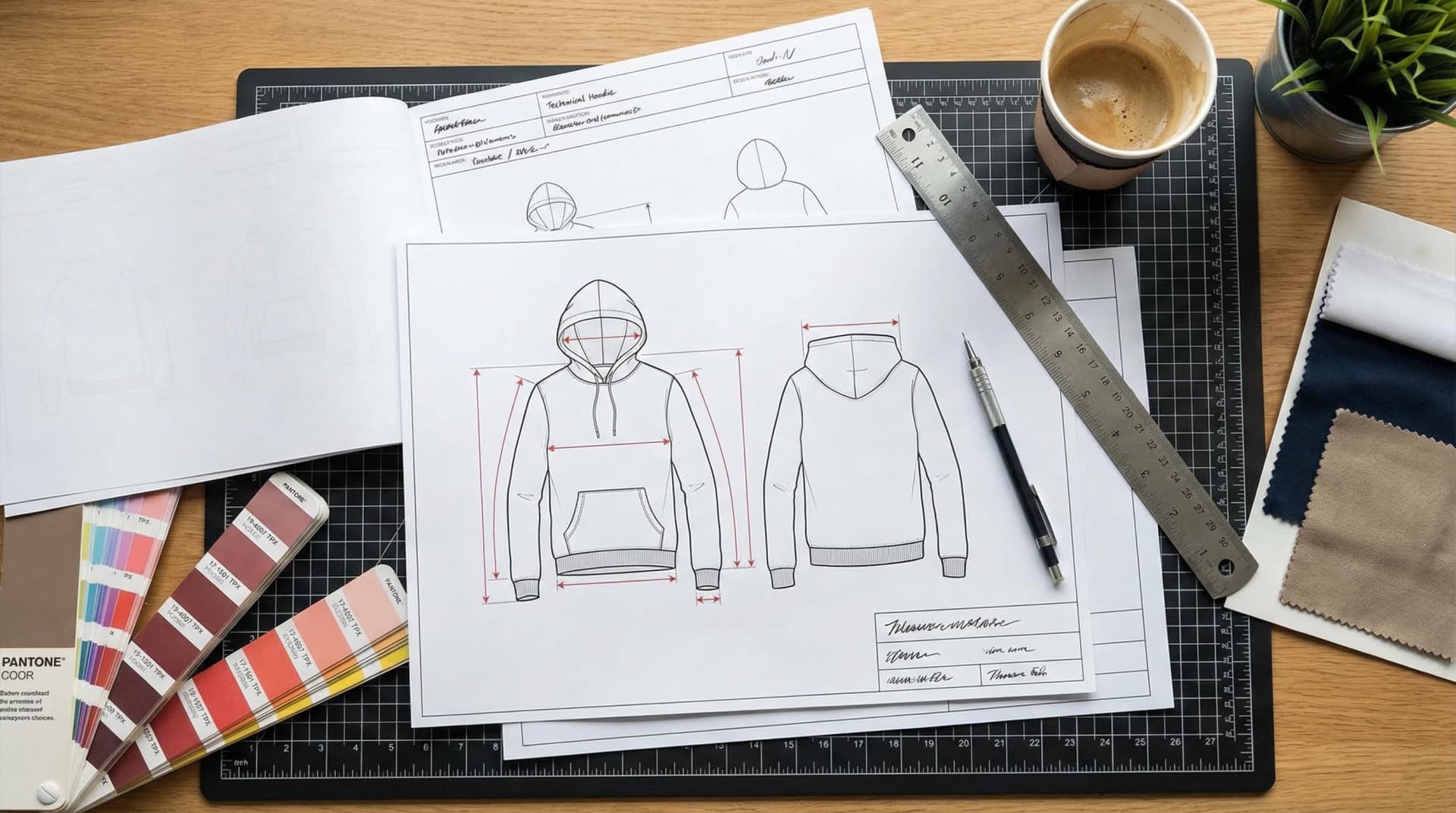
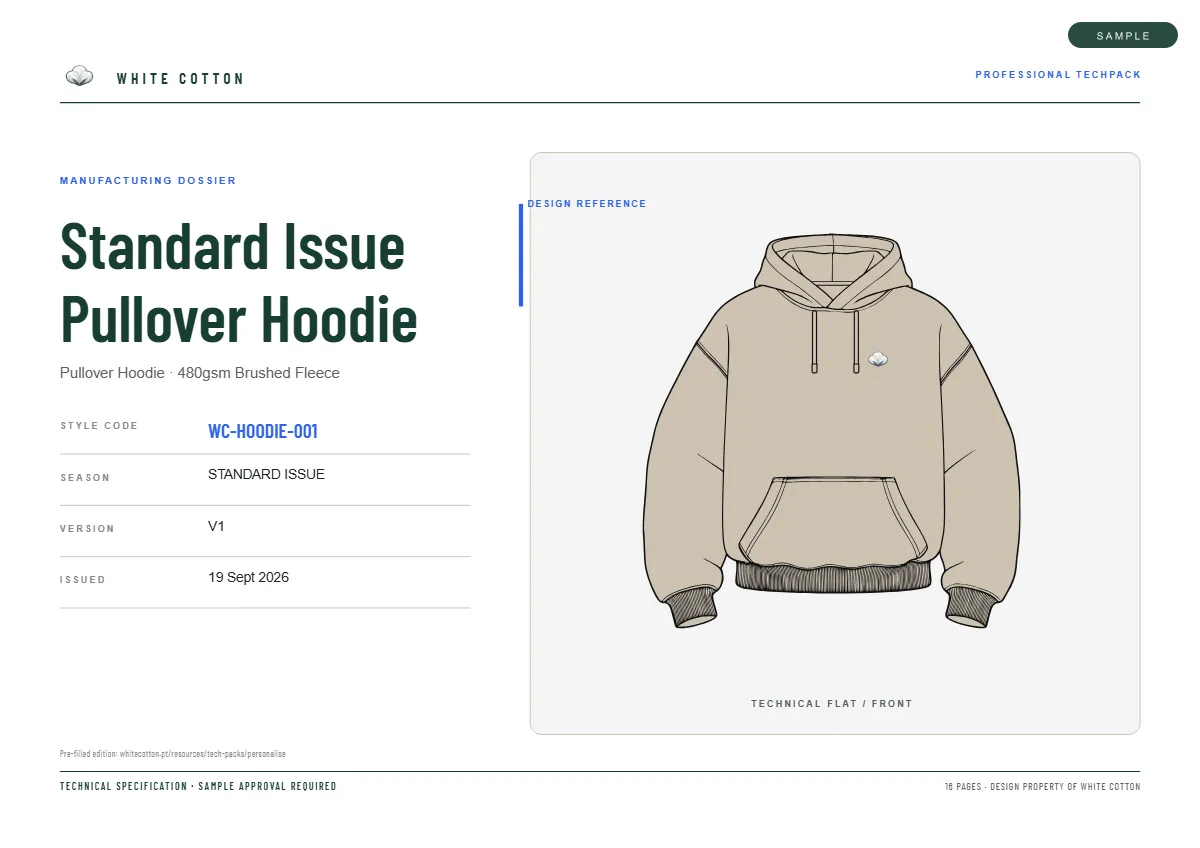
A tech pack is the document that tells the factory exactly what to build. Without one, we are guessing — and guessing produces garments nobody is happy with.
For a t-shirt, a complete tech pack includes:
- —Flat sketch with front, back, and side views
- —Measurements for every size (chest, body length, shoulder width, sleeve length, hem width)
- —Fabric specification — fibre composition, target GSM, finish, colour references (Pantone or fabric swatch)
- —Construction details — neckline type (crew, V-neck, scoop), hem style (single fold, twin needle, raw edge), stitch type for each seam
- —Decoration placement — print or embroidery position, dimensions, colour breakdown, artwork files
- —Trims — main label, care label, size label, hang tag specs
- —Packaging instructions — folding method, polybag, tissue, carton configuration
Brands that arrive with a clear tech pack keep the sample timeline at the short end of our usual 4 to 8 weeks. Brands that arrive with "something like this Instagram photo" add weeks of back-and-forth before we can even begin.
If you do not have a tech pack yet, that is fine — we help develop them. But understand that this step is where the timeline starts, and the more complete your brief, the faster everything moves. Our tech pack creation guide covers this in detail.
Step 2: Fabric Selection
Fabric is the single biggest decision you will make on a t-shirt. It determines the feel, the drape, the durability, and roughly 40-55% of the final cost.
Jersey Weights for T-Shirts
T-shirts use single jersey knit fabric. The weight, measured in grams per square metre (GSM), determines the character of the garment:
- —140-160 GSM — Lightweight. Soft, drapey, slightly sheer on lighter colours. Good for summer, fashion basics, promotional tees. Lower perceived value.
- —160-180 GSM — Midweight. The sweet spot for most brands. Opaque, comfortable, not too heavy for warm weather. This is what you find on most quality retail tees.
- —180-200 GSM — Upper-midweight. More substantial hand feel. Good body, holds its shape well after washing. Popular with streetwear and premium basics.
- —200-220 GSM — Heavyweight. Structured, thick, premium feel. Drapes differently — more boxy, less clingy. The weight associated with brands charging over 40 euros for a plain tee.
Composition
- —100% combed cotton — Softest feel, most breathable. Shrinkage of 3-5% after first wash (pre-shrunk fabric reduces this to 1-2%). The standard choice for quality tees.
- —100% organic cotton — Same properties as conventional cotton, sourced from certified organic farms. We source organic cotton jersey with GOTS certification — the fabric itself is certified, which gives your brand verifiable sustainability claims. Expect a 15-25% fabric premium.
- —Cotton-polyester blends (60/40 or 50/50) — Better shape retention, less shrinkage, faster drying. Slightly less breathable. Good for active or promotional use. Lower cost.
- —Tri-blends (cotton/polyester/rayon) — Extremely soft hand feel, vintage-style drape. Popular in the US market. More expensive due to rayon content.
- —Cotton-elastane (95/5 or 97/3) — Slight stretch for fitted or athleisure styles. The elastane adds recovery so the garment returns to shape.
The right choice depends on your price point, your market, and your brand positioning. A brand selling basics at 25 euros and a streetwear brand selling at 55 euros need different fabrics — not just in quality, but in weight and hand feel.
Step 3: Pattern Making and Grading
The pattern translates your measurements into flat pieces that, when cut and sewn, create the three-dimensional garment.
A basic crew-neck t-shirt has 4-5 pattern pieces:
- 1.Front body panel
- 2.Back body panel
- 3.Two sleeves (left and right, identical if no asymmetric design)
- 4.Neck binding strip (or a separate collar piece for a ribbed collar)
The pattern maker adds seam allowances — typically 1cm for overlock seams, 2-2.5cm for hems — and marks notch points where pieces align during sewing.
Grading scales the base pattern across your full size range. This is not uniform scaling — a size S to XL jump might add 6cm to the chest but only 1cm to the sleeve length. Each measurement follows its own grade rule, and these rules vary depending on whether you are targeting a European, American, or oversized fit.
For t-shirts specifically, the critical grading points are chest width, body length, and across-shoulder measurement. Get these wrong and the tee either looks like a tent in larger sizes or restricts movement.
Step 4: Fabric Cutting
Once patterns are graded and approved, we move to the cutting room.
Marker Making
A marker is the layout plan — arranging all pattern pieces on the fabric width to minimise waste. For t-shirts, a good marker achieves 88-95% fabric utilisation. The remaining 5-12% is waste (off-cuts between pieces, selvedge trim).
T-shirt pieces are relatively simple shapes, so marker efficiency is higher than for complex garments like jackets. Mixing sizes in a single marker helps — a small sleeve fits neatly into the gap between two large body panels.
Cutting
The fabric is spread in multiple layers on the cutting table (the number of layers depends on order quantity and fabric weight), then cut through all layers simultaneously following the marker. For our typical t-shirt runs, we use manual cutting with electric straight knives. Our craft page shows more of what happens on the factory floor.
Jersey fabric requires careful handling during cutting — it stretches, and tension during spreading causes dimension errors in the finished garment. This is where experience matters more than equipment.
Step 5: Sewing and Assembly
A t-shirt is one of the simpler garments to construct, but "simple" does not mean "fast" — a well-made tee still requires 15-25 minutes of sewing time depending on construction details.
Construction Sequence
The typical sewing order for a crew-neck tee:
- 1.Join shoulder seams (overlock)
- 2.Attach neck binding — the folded strip that finishes the neckline. This is the most visible construction detail on a tee. Sloppy neckbands look cheap. We use a coverstitch machine for a clean, flat finish.
- 3.Tape the neck seam — a strip of fabric or twill tape covers the inside neck seam, preventing it from stretching and irritating the skin. This is a quality marker — cheap tees skip it.
- 4.Set sleeves — attached to the armhole with an overlock seam.
- 5.Close side seams — from sleeve hem down to body hem in a single continuous pass.
- 6.Hem body — twin-needle coverstitch for a professional flat finish (the two parallel lines of stitching you see on the inside of a quality tee). Single-fold or raw-edge hems are alternatives for different aesthetics.
- 7.Hem sleeves — same twin-needle coverstitch.
- 8.Insert labels — main label at centre back neck, care label at side seam or hem.
What Adds Sewing Time (and Cost)
- —Pocket — a chest pocket adds 3-5 minutes per garment
- —Ribbed collar instead of neck binding — requires separate collar attachment step
- —Contrast stitching — thread colour changes mean re-threading machines
- —Side vents at the hem — additional cutting and finishing
- —Curved hem — more complex than a straight hem
- —Double-needle topstitching along shoulder or neckline — precision work
Each additional detail is 2-5 minutes of labour. On a run of 500 tees, a 3-minute addition translates to roughly 25 extra hours of sewing time.
Step 6: Decoration
Most t-shirts include some form of decoration — a logo, graphic, or text. The method you choose depends on your design, quantity, and budget.
Screen Printing
Best for: bold graphics, solid colours, runs of 50+ per design/colour. Each colour requires a separate screen (setup cost of 30-60 euros per screen). Per-print cost drops significantly with volume — at 200+ units, screen printing is the most cost-effective method for 1-3 colour designs. Water-based inks give a softer hand feel on cotton tees than plastisol. Read our full screen printing guide.
DTG (Direct to Garment) Printing
Best for: photo-realistic designs, unlimited colours, small runs under 50 units. A digital printer prints directly onto the fabric — no screens, no setup cost. Per-unit cost is higher than screen printing at volume (2-5 euros per print), but there is no minimum. Works best on light-coloured cotton. See our DTG printing page for more detail.
Embroidery
Best for: logos, small text, premium positioning. Embroidery on a tee is typically limited to chest logos or small back-of-neck details — large embroidered areas on lightweight jersey can pucker the fabric. Stitch count determines cost (1-3 euros per position for standard logos). Embroidery adds perceived value disproportionate to its cost.
Which to Choose
For most t-shirt brands, the decision is straightforward:
- —One location, 1-3 colours, 100+ units — screen print
- —Complex artwork, small batch — DTG
- —Logo-only, premium feel — embroidery
- —Multiple locations (front + back + sleeve) — screen print for the large areas, embroidery for small accent logos
Our guide on screen printing vs DTG vs embroidery compares all three methods in detail.
Step 7: Finishing
After sewing and decoration, the garment goes through finishing:
- —Thread trimming — every loose thread is cut. Sounds trivial, but skipping this is the fastest way to make a garment look unfinished.
- —Pressing and steaming — the tee is steamed to remove creases and set the shape. Heavy pressing can damage jersey; we use steam rather than high-pressure ironing.
- —Wash treatments (if specified) — enzyme wash for softness, silicone wash for a vintage hand feel, garment dyeing for a lived-in look. Garment-dyed tees are dyed after construction, which gives a unique colour depth and slight variation between pieces. This adds cost but creates a distinctive product. See our garment dyeing vs piece dyeing guide for the tradeoffs.
Step 8: Quality Control
Every tee is individually inspected before it leaves the factory. Our QC checks:
- —Measurements — chest, body length, shoulder, and sleeve measured against the approved spec sheet. Tolerance is typically plus or minus 1cm.
- —Stitch quality — consistent stitch count (stitches per inch), no skipped stitches, no puckering at seams.
- —Fabric inspection — no holes, stains, or dye inconsistencies.
- —Decoration check — print alignment, colour accuracy, embroidery clean and centred.
- —Overall appearance — does it match the approved sample?
Defective garments are pulled and either reworked or rejected. Our target defect rate is under 2%. For a deeper look at what quality control involves across all garment types, read our QC guide.
Step 9: Labelling and Packaging
Labels
Every t-shirt ships with:
- —Main label — your brand label, sewn at centre back neck (woven or printed satin)
- —Care label — fibre composition, washing instructions, country of origin. Legally required in the EU and most markets.
- —Size label — either integrated into the main label, printed on the care label, or a separate label at the side seam
We can also add heat-transfer labels (printed directly onto the fabric) for a tagless finish — increasingly popular for brands that want a cleaner neck feel. Our labels and packaging guide covers all the options.
Packaging
Standard packaging for t-shirts:
- —Folded to your specification (or our standard fold)
- —Individual polybag with size sticker
- —Hang tag attached (if applicable)
- —Packed into cartons by style, colour, and size
- —Full packing list with carton contents, quantities, weights, and dimensions
Custom packaging (tissue paper, branded boxes, belly bands) is available and adds 0.30-1.50 euros per unit depending on complexity.
Step 10: Shipping
We ship EXW Barcelos — the goods are ready for collection at our factory. Your own forwarder can collect them, or we book the courier for you and invoice the transport separately. We handle all export documentation either way. The buyer handles import duties and local taxes on arrival; we do not offer DAP or DDP.
Typical shipping methods from Portugal:
- —Road freight (Europe) — 3-7 working days. Most cost-effective for EU deliveries.
- —Air freight (outside Europe) — 3-5 working days. Higher cost, necessary for urgent orders or distant markets.
- —Sea freight (large volumes) — 15-30 days depending on destination. Significantly cheaper per unit for bulk orders.
We provide all export documents: commercial invoice, packing list, certificate of origin, and any additional documentation your market requires.
T-Shirt Manufacturing Costs Per Unit
These are real price ranges from our factory in 2026, for cut-and-sew custom t-shirts at our standard MOQ. Prices vary based on exact specifications, but this gives you honest reference points. For the full cost methodology across all garment types, see our clothing production costs breakdown.
Basic Tee — 160 GSM Cotton Jersey
A straightforward crew-neck tee in conventional combed cotton, one-colour screen print on the chest.
| Component | Cost per unit |
|---|---|
| Fabric (160 GSM cotton jersey, ~0.9m per tee) | 1.80-2.50 |
| Trims (labels, thread, hang tag) | 0.40-0.70 |
| CMT — cut, make, trim (15-18 min sewing time) | 2.00-3.00 |
| Screen print (1 colour, 1 position) | 0.50-0.80 |
| Total per unit at 200 units | 4.70-7.00 |
At 100 units: 6.50-9.00 (higher per-unit CMT and screen setup amortised over fewer pieces).
At 500 units: 3.80-5.50 (better fabric pricing, faster line efficiency, lower setup cost per unit).
Mid-Range Tee — 180 GSM Organic Cotton, Enzyme Wash
Organic cotton jersey, enzyme-washed for softness, two-colour screen print, woven main label.
| Component | Cost per unit |
|---|---|
| Fabric (180 GSM organic cotton jersey, ~1.0m per tee) | 3.00-4.50 |
| Enzyme wash | 0.80-1.20 |
| Trims (woven labels, quality hang tag) | 0.60-1.00 |
| CMT (18-22 min, taped neckline, curved hem) | 2.50-3.50 |
| Screen print (2 colours, 1 position) | 0.80-1.20 |
| Total per unit at 200 units | 7.70-11.40 |
At 100 units: 10.00-14.50.
At 500 units: 6.50-9.00.
Premium Tee — 220 GSM Heavyweight, Garment Dyed
Heavyweight cotton, garment-dyed after construction for that rich colour depth, dropped shoulders, oversized fit, DTG or multi-position screen print.
| Component | Cost per unit |
|---|---|
| Fabric (220 GSM heavyweight cotton, ~1.1m per tee) | 3.50-5.00 |
| Garment dye | 1.50-2.50 |
| Trims (heat-transfer main label, woven care label, custom hang tag) | 0.80-1.30 |
| CMT (20-25 min, reinforced neckline, twin-needle throughout) | 3.00-4.00 |
| DTG print or 3-colour screen print (2 positions) | 2.00-3.50 |
| Total per unit at 200 units | 10.80-16.30 |
At 100 units: 14.00-20.00.
At 500 units: 9.00-13.00.
T-Shirt Manufacturing Timeline: Tech Pack to Delivery
A realistic timeline for a standard t-shirt manufacturing order:
| Phase | Duration |
|---|---|
| Sample development and approval | Usually 4 to 8 weeks from payment |
| Bulk production (cutting, sewing, decoration, QC) | Usually 6 to 12 weeks from the deposit |
| Packing and shipping (EU) | 5 to 7 working days |
These phases only compress for a paid rush order, which we take on mainly for returning clients and only when our plan can take it. With a complete tech pack and a quick sample approval you land at the short end of those ranges; multiple sample revisions or a custom-dyed fabric push you toward the long end. For a first collection, plan on roughly 3 to 6 months from first email to delivery.
The biggest variable is sample approval. Brands that approve first samples quickly keep the timeline tight. Brands that request 3-4 sample revisions add weeks.
Common Mistakes Brands Make with T-Shirt Production
After years of producing tees for brands at every stage — from first-time founders to established labels — these are the patterns I see repeatedly.
Choosing the wrong GSM for the price point. A 140 GSM tee feels flimsy when you are charging 35 euros retail. A 220 GSM heavyweight is overkill for a promotional giveaway. Match the fabric weight to the perceived value you need to deliver.
Skipping the sample. I have had brands try to go straight to production to "save time." A sample costs between 60 and 300 euros, depending on the garment and decoration, and usually takes 4 to 8 weeks. Fixing a mistake across 500 garments costs thousands. Every order gets a sample. No exceptions.
Underestimating the neck finish. The neckline is the first thing a customer touches and the most visible construction detail. A cheap, wobbly neckband on an otherwise decent tee destroys the perceived quality. Specify the neck construction in your tech pack — binding width, twin-needle vs coverstitch, taped or untaped.
Designing for screen print but ordering 30 units. Screen printing has setup costs (screens, ink mixing, registration). Below 50 units per design and colourway, DTG is almost always more economical. Plan your decoration method around your actual order quantity, not your ideal one.
Ignoring shrinkage. Cotton jersey shrinks. If your pattern is made to exact finished measurements without accounting for shrinkage, every tee will come back smaller than intended after the first wash. We build shrinkage tolerance into our patterns (typically 3-5% for cotton, 1-2% for pre-shrunk), but you need to communicate your expectations — is the spec sheet before or after wash?
No size grading specifications. Telling the factory "S, M, L, XL" without providing a measurement chart for each size means the factory uses its own standard grade. That standard might not match what your customers expect. Always provide a full measurement chart.
Ordering too many sizes, not enough quantity per size. A brand ordering 200 units split across 6 sizes (XS through XXL) ends up with roughly 30-40 per size. That is fine, but if they then want 4 colours, each size-colour combination drops to under 10 units — and the production complexity increases disproportionately. Start with 3-4 core sizes and expand the range once you know your sales data.
Getting Started
If you are ready to produce custom t-shirts, here is what we need to begin:
- 1.Tech pack or detailed brief — measurements, fabric preference, decoration, and label specs
- 2.Target quantity and size breakdown — total units and how they split across sizes and colours
- 3.Budget indication — helps us recommend the right fabric and construction tier
- 4.Artwork files — vector (AI/EPS) for screen print, high-resolution PNG/TIFF for DTG
Submit these through our order request page, and we will have a quote back to you within a few days.
We are a clothing manufacturer in Portugal producing from our own factory in Barcelos — no agent, no trading company in between, direct communication with the people cutting and sewing your garments.
Related reading: Cut and sew manufacturing guide | T-shirt manufacturer Portugal | Clothing production costs breakdown

Pedro Carreira
Founder of White Cotton, a textile manufacturer in Barcelos, Portugal. Producing custom clothing collections for brands across 15+ countries.
Frequently Asked Questions
From tech pack submission to delivery, plan on roughly 3 to 6 months for a first order: usually 4 to 8 weeks for the sample and 6 to 12 weeks for bulk production from the deposit, plus shipping. The biggest variable is sample approval — brands that approve quickly keep the timeline at the short end, while multiple revisions push it toward the long end. Rush production is possible — mainly for returning clients and subject to capacity — at an extra charge.
A basic 160 GSM cotton tee with a one-colour screen print costs 4.70-7.00 euros per unit at 200 units. At 100 units, expect 6.50-9.00 euros. Premium heavyweight garment-dyed tees range from 10.80-16.30 euros at 200 units. Fabric accounts for 40-55% of the total cost.
For premium positioning, 180-220 GSM is the range to target. 180 GSM delivers a substantial, quality feel without being heavy. 200-220 GSM gives the thick, structured hand feel associated with brands charging 40+ euros retail — it drapes differently, holds its shape, and communicates value before anyone reads the label.
Screen printing uses physical screens (one per colour) and is most cost-effective above 50 units for 1-3 colour designs — setup costs are 30-60 euros per screen, but per-print cost drops fast with volume. DTG prints directly onto the fabric with no setup cost, handles unlimited colours and photo-realistic artwork, but costs 2-5 euros per print regardless of quantity. Below 50 units, DTG wins. Above 50, screen print wins for simple designs.
At minimum: a tech pack or detailed brief with measurements, fabric preference, and decoration specs; your target quantity and size breakdown; artwork files (vector for screen print, high-res PNG/TIFF for DTG); and a budget indication so the factory can recommend the right fabric and construction tier. The more complete your brief, the faster you get a sample — incomplete briefs add 1-3 weeks of back-and-forth.
Continue Reading
How to Make a Tech Pack a Factory Can Cut From
What Is a Tech Pack for Clothing? A Real Example, Page by Page

How Much Does It Cost to Start a Clothing Brand in 2026? Real Numbers
![Hoodie Manufacturing Costs: Real Prices from a Portuguese Factory [2026]](/_next/image?url=%2Fimages%2Fgenerated%2Fblog%2Fhoodie-manufacturing-costs-breakdown.webp&w=1920&q=75)
Hoodie Manufacturing Costs: Real Prices from a Portuguese Factory [2026]
![How to Find a Clothing Manufacturer in Portugal: A Factory Owner's Honest Guide [2026]](/_next/image?url=%2Fimages%2Fgenerated%2Fblog%2Fhow-to-find-clothing-manufacturer-portugal.webp&w=1920&q=75)