Answers · White Cotton
Ask anything. It is answered here.
Minimums, samples, tech packs, quotes, payment, shipping — every answer we give by email, written down once.
Read this first
Thirteen things new brands only learn by email
Each of these has cost a brand an extra round of emails before a single piece was made. Here, it costs a minute of reading.
- 1The minimum is per style and per colour: 75 black + 75 white hoodies works, 50 of one colour does not.
- 2Custom labels have their own minimum — usually 1,000 per item, far above the garment minimum.
- 3A sample costs several times a bulk piece, because it carries the one-time setup.
- 4Setup is charged once per design — again only if dimensions or artwork change.
Minimums & quantities
How many pieces per style and colour, sizes, and starting small.
All 7 answers →Quotes & prices
Asking for a quotation, what it includes, setup and validity.
All 10 answers →Samples & development
How sampling works, what a sample costs and why, and corrections.
All 12 answers →Tech packs & artwork
Why a tech pack is essential, how to get one, and artwork files.
All 8 answers →Delivery dates & production
When work starts, delivery dates, quality, reorders and capacity.
All 10 answers →Fabrics & colours
Weights, compositions, organic and certified fabrics, custom colours.
All 13 answers →Prints & embroidery
Screen print, digital print, embroidery and patches — what to choose.
All 7 answers →Labels & packaging
Neck labels, care labels, hangtags, their minimum, and packing.
All 6 answers →Garments, fits & sizes
What we make and what we don't, fits, size ranges, no stock.
All 11 answers →Payment, VAT & invoices
Payment terms, the proforma, VAT with or without a VAT number.
All 9 answers →Shipping & customs
EXW Barcelos, never DDP — duties, documents and destinations.
All 9 answers →Working with us
Email only and why, factory visits, confidentiality, who we are.
All 9 answers →01 · 7 questions
Minimums & quantities
How many pieces per style and colour, sizes, and starting small.
What is your minimum order quantity (MOQ)?
It depends on the garment and on how many colours you order:
- Light garments — t-shirt, long sleeve, polo, tank top, shirt: 150 pieces per style in one colour, or 100 per colour when you order two colours or more.
- Heavy garments — hoodie, zip-up hoodie, sweatshirt, joggers — and shorts: 100 pieces per style in one colour, or 75 per colour with two colours or more.
You can mix up to five sizes inside that quantity. A sample has no minimum: it is one piece.
Is the minimum per style, per colour or per order?
Per style and per colour. Each garment style counts on its own, and every colour of that style has to reach the minimum for its category.
A worked example with hoodies: 75 black + 75 white works — two colours, 75 each. 50 black on its own does not — a single colour needs 100.
Different garments are not added together: 50 hoodies and 50 t-shirts are two quantities below the minimum, not one order of 100.
Can I split the minimum across sizes?
Yes — the minimum counts per colour across its sizes. You can mix up to five sizes inside it, with at least five pieces per size: for example 100 black t-shirts as 15 S, 30 M, 30 L, 20 XL and 5 XXL.
Can I order fewer pieces than the minimum?
Not for production. Below the minimum, the setup, the fabric and the cutting cost more per piece than the run is worth, and we would rather not make a run we cannot make well.
Two honest ways to start smaller:
- Start with a sample — one piece — and decide on quantities once you have it in your hands.
- Put the same total into fewer colours, so that each colour reaches its minimum.
Why is there a minimum at all?
Every style needs one-time work before the first piece exists — the pattern for your fit, the cutting layout, the decoration setup — and fabric comes from the mill in rolls, not by the metre. The minimum is the quantity at which that fixed work is spread over enough pieces to make the garment properly and at a sensible price per piece.
Is the minimum higher for organic, recycled or special fabrics?
Yes. Organic, recycled, Supima and other specialty fabrics are bought from the mill for your order, so they need a higher minimum: from 300 metres of fabric, which your quotation turns into a number of pieces for your garment.
Can different prints on the same garment and colour share one minimum?
The minimum is set by the garment style and its colour. How the pieces inside that quantity may be split between designs depends on the decoration — each design has its own setup — so put the split in your request and the quotation confirms what works.
02 · 10 questions
Quotes & prices
Asking for a quotation, what it includes, setup and validity.
How do I get a quotation?
Send your request through the order-request form on our website, with your tech pack or design files attached, the quantity per colour, the colours and the decoration. We quote from the design itself — a quotation without it would be a guess you could not plan on. You receive an automatic confirmation that the request arrived; the quotation itself follows by email.
What information do you need to quote?
The more of this the request carries, the more exact the quotation:
- The garment and its fit — ideally as a tech pack.
- Fabric, weight (GSM) and composition, or the look and feel you want so we can recommend one.
- Quantity per colour, and the size split if you know it.
- Colours, with Pantone references if a colour must be exact.
- Decoration: method, size and position, with the artwork.
- Labels, hangtags and packaging.
- The country it ships to.
How much does a piece cost? Do you have a price list?
As a guide, garment prices before decoration, at 50 to 149 pieces per colour, excluding VAT and shipping, from our price calculator:
- T-shirts: about €9 to €13, depending on fabric weight
- Long sleeves: about €10 to €16
- Tank tops: about €7 to €10
- Polos: about €15 to €22
- Sweatshirts and joggers: about €17 to €26
- Hoodies: about €21 to €29; zip hoodies about €24 to €32
- Jersey shorts: about €10 to €14
Decoration, custom labels and packaging are added on top, and the unit price starts to fall from 150 pieces per colour. The calculator gives an indicative price for your own garment; your quotation is the price.
What does the quoted price include?
The quotation lists each line separately: the garment (fabric, cutting, sewing, finishing), the decoration, the labels and packaging you asked for, and any one-time setup for your design. Shipping and import duties are never included — shipping is quoted apart if you want delivery, and duties are paid in your country.
What are setup costs, and when are they charged?
Setup is the one-time work a design needs before it can be produced, and it is charged once per design — again only if the dimensions or the artwork change, so a repeat of the same design does not pay it twice. As a guide:
- Pattern development: around €25 per style
- Grading to your sizes: around €10 per size
- Embroidery program: from around €20 for a small logo up to around €200 — it depends on the size, the number of colours and above all the stitch count
- Screen-printing setup, per colour: around €20 up to 15 cm, €25 to €30 up to 30 cm, and €35 above
Your quotation itemises the setup for your design.
How long is a quotation valid?
90 days from the date on it. After that we re-quote, because fabric prices move.
Do you give discounts for larger or first orders?
The unit price already falls as the quantity per colour rises — from 150 pieces per colour upwards — because the setup is shared by more pieces; the quotation shows it for your quantities. We don't add discounts on top of the quoted price, for a first order or any other.
Can you quote more than one quantity?
Yes. Say in your request which quantities you want to compare — for example 100 and 250 per colour — and the quotation prices each one, so you see how the unit price changes.
Can I change the quantities or details after I get the quotation?
Yes — reply with the change and we send a revised quotation. A quotation is priced on exactly what it lists, so any change to the garment, fabric, decoration or quantity is re-quoted before you pay.
Another factory quoted less. Can you match it?
No. Our quotation is the real cost of making your garment the way it is specified — fabric, construction, decoration and checks — made in Portugal, inside the EU. We don't adjust it to match other quotes. If two quotes differ a lot, compare what each one actually specifies: fabric weight and composition, finishing, and what is left out.
03 · 12 questions
Samples & development
How sampling works, what a sample costs and why, and corrections.
How does sampling work?
- You send a quotation request with your tech pack.
- We send the sample quotation and a proforma invoice; the sample is paid in full before we start.
- We develop the pattern and make the sample — one piece, in one colour.
- You check the fit, the fabric and the decoration, and send your corrections in writing.
- Once the sample is approved, we quote the production from it.
A sample can also be smaller than a garment: a fabric swatch, colour swatches or a test of the print or embroidery.
How much is a sample, and why does it cost more than a bulk piece?
Most samples cost between €60 and €300, depending on the garment and the decoration — several times the price of the same piece in production. A sample carries the one-time work of your design — the pattern, the cutting setup, the decoration setup — which a production order spreads over many pieces, and it is made on its own, outside a production run. Your sample quotation states the exact amount, with the setup itemised.
How long does a sample take?
Usually 4 to 8 weeks from the day your payment reaches our account, depending on the garment, the fabric and the decoration. A colour that needs a lab dip, or a fabric bought in specially, sits at the longer end. Your sample quotation states the date.
Can I get the sample in several colours?
Samples are made in one colour. A sample settles the fit, the fabric, the construction and the decoration; the other colours follow in production from the same pattern. For several colours the route is a lab dip per colour, so you approve each shade, then one pre-production sample before the cut — not a full sample in every colour.
What happens if the sample isn't right?
A first sample is expected to need adjustments — it is how the fit and the details get settled. Send your corrections in writing, with measurements where you can ("body length +2 cm") and photos marked up. We correct the pattern and quote the next sample before we make it: a revised sample is charged at half the price of the first, plus the pattern work (around €10 for a minor correction, around €25 if the pattern has to be redone) and any new setup if the artwork changes.
Is the sample cost deducted from the production order?
No. The sample is paid in full and is not credited or refunded against the production order. It covers the one-time work of developing your design — the pattern, the setup and a piece made on its own — which is why it costs more than a bulk piece.
Is there a minimum for samples? Are samples free?
There is no minimum: a sample is one piece. It is not free — it is paid in full before we start, because it is real development work on your design.
Is shipping of the sample included?
No. As with every quotation, shipping is not included; the sample's shipping is charged separately — around €40 to €55 within the EU, and insurance is available on request — and any import duties in your country are paid on arrival.
Do you make the patterns and grade them across sizes?
Yes. We develop the pattern for your fit from the measurements in your tech pack, make the sample from it, correct it with your feedback, and grade it across your size range for production. It is part of the one-time setup of the design.
What does the sample price include?
Included: the development, cutting, sewing and finishing, quality control, standard packing, a plain composition label, a size label and a polybag.
Not included: shipping, your custom labels, hangtags and packaging, and special finishes. Any of those can be added to the sample as separate lines on its quotation.
In which size is the sample made?
In one size, which you choose — normally the base size your pattern is graded from. If you want to check the fit in another size too, ask for it as an extra piece on the sample quotation.
Can I send you a garment whose fit I like, as a reference?
Yes. A garment that already fits the way you want is a strong starting point: send it with a note of what to keep and what to change, and its measurements go into your tech pack as the base for your own pattern. Shipping it to us is at your cost.
04 · 8 questions
Tech packs & artwork
Why a tech pack is essential, how to get one, and artwork files.
Do I need a tech pack?
Yes. A tech pack ensures we manufacture your exact vision: it is the document we quote from, cut from and check the finished pieces against.
Still developing yours? We can help. Start from one of our free tech packs — one per garment, ready to adapt — or build yours in our tech-pack builder, which asks the questions a factory would ask and turns your answers into a complete, factory-ready document.
I only have an idea, sketches or AI images. Can we start?
Yes — but not from the images alone. AI images, mood boards and sketches are references: they show a look, not the measurements, the fabric or the construction, so nothing can be quoted or cut from them.
The same goes for a tech pack written by an AI tool: it reads like one, but its measurements and construction are not real, and it does not work for production.
Turn your references into a real tech pack first: take the free tech pack closest to your garment, or use the tech-pack builder, and attach your references to it. That is what makes a first sample come back close to what you imagined.
Can you make the tech pack for me?
We help you make it, through our tech-pack builder on the website: you choose the garment, the fit, the fabric, the colours, the decoration and the labels, and it produces a complete tech pack in the format we work from. If you prefer to write it yourself, our free tech packs give you the structure and a graded size chart to start from.
What should a tech pack include?
Everything a factory would otherwise have to guess:
- Flat drawings of the front and back, with construction details.
- A measurement chart for every size, with tolerances.
- Fabric: type, weight (GSM), composition and colour.
- Decoration: method, size and position, with the artwork attached.
- Labels, trims and hardware, and where they go.
- Colours with Pantone references where they must be exact.
- How each piece is folded and packed.
What artwork files do you need for prints and embroidery?
A vector file — AI, PDF or SVG, with fonts converted to outlines — drawn at the size it will be printed or embroidered, with its colours specified.
A mockup is not artwork. A logo placed on a photo of a garment shows where it goes, but it cannot be printed from. A low-resolution image or a screenshot has to be redrawn as vector before production. For embroidery, a clean logo in your tech pack is usually enough for our digitiser to build the stitch file.
In what format should I send my tech pack?
PDF, attached to your quotation request. Send the artwork files separately, as vectors, so they can be used for production as they are.
Can I use a tech pack made for another factory?
Yes, if it is complete: measurements for every size, fabric, construction, decoration and labels. When you attach it to your request we tell you if something a factory needs is missing before we quote.
I don't know my measurements. Where do I start?
From a garment that already fits the way you want, or from one of our free tech packs: each one carries a complete measurement chart graded across sizes. Change the measurements that make your fit — length, chest, shoulder, sleeve — and keep the rest.
05 · 10 questions
Delivery dates & production
When work starts, delivery dates, quality, reorders and capacity.
What is your production lead time?
Usually 6 to 12 weeks for production, counted from the day the 50% deposit reaches our account — or 4 to 8 weeks when the fabric is already in stock. Where your order falls in that range depends on the garment, the fabric, the decoration and how full our production plan is when you confirm; your quotation states the date for your order. A colour dyed specially for your order adds about 3 to 4 weeks for the fabric.
I have a launch date. Can you do a rush order?
Put your date in the quotation request. The quotation states the delivery date we can commit to; if it cannot meet yours, you know before you pay anything. Rush production is possible — mainly for returning clients, and for a first order only when it's really needed and our production plan can take it — at an extra charge, confirmed on the quotation. Remember production counts from payment, so the sooner the sample is approved and the deposit paid, the sooner it starts — for a first collection, plan on roughly 3 to 6 months from first email to delivery.
How do you check quality?
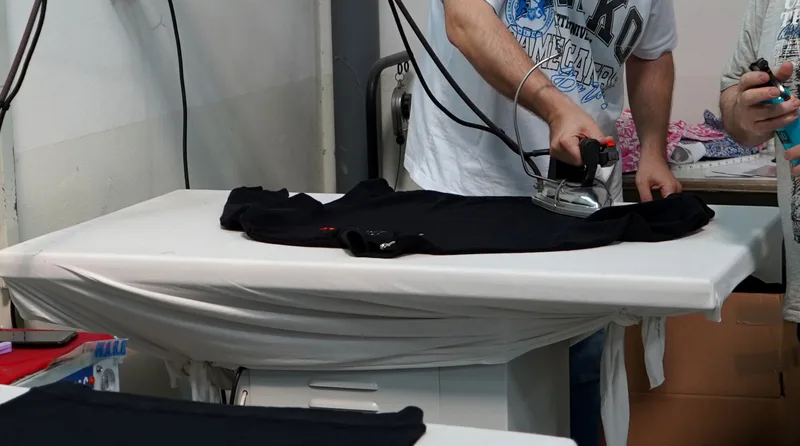
At every stage, against the approved sample and your tech pack: the fabric when it arrives, the cutting, the sewing, checks during production, the finishing, and a final inspection before packing — measurements against the chart and its tolerances, seams, decoration and finish. Printing, done by our partner print shops, is checked by us too. Defective pieces don't go to you.
Will the garments shrink?
Very little. Our fabrics are pre-shrunk, and shrinkage after washing is typically 3–5%, which is normal for quality cotton. The sample is where you check it: wash it following its care label and measure it against your chart before approving. If something moves more than you accept, say so on the sample — it is corrected before production.
How do reorders work?
Send the reorder with the quantity per colour and size. It follows the same minimum per style and colour as a first order — a reorder restarts production — and gets its own quotation and delivery date. For an unchanged design the setup is not charged again (only if the dimensions or the artwork change), and custom labels left over from your last order are used on it.
Can you handle large orders? What is your capacity?
We plan every order into our production individually, so the answer for your quantity is on your quotation: its delivery date already accounts for the size of the order. For a large or recurring volume, give the full quantities and the timing in the request so the plan is made for all of it.
Do you close for holidays?
Yes. We close every summer, from mid-August to the start of September, and the delivery date on your quotation already takes our closures into account. Requests sent while we are closed are answered when we are back.
Will I hear from you during production?
Your quotation already states the delivery date. Before the run, we send you photos to approve: the print or embroidery strike-off, and the label placement on a real piece. When the order is finished we send the invoice for the remaining 50%, and the export documents travel with the shipment. If anything could affect your date — a fabric delay at the mill, for example — we tell you by email as soon as we know.
Are you the factory itself? What is made in-house?
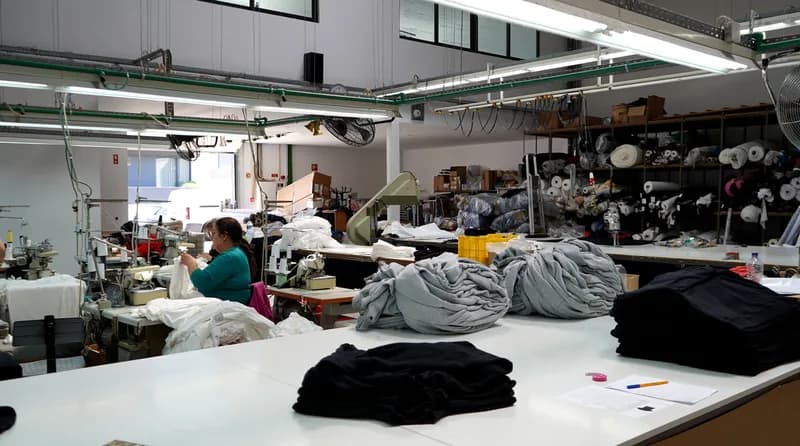
We are the factory — no agent, no trading company in between. Everything is made in our own factory in Barcelos — pattern making and grading, sample development, fabric purchasing, cutting, sewing, embroidery, finishing and quality control — except printing, dyeing and washes: screen printing, DTF, DTG, garment dyeing and washes are done by partner shops close to us, and checked by our own quality control before anything ships.
How long does it take from first email to delivery?
For a first collection, plan on roughly 3 to 6 months:
- The sample: usually 4 to 8 weeks from payment.
- Corrections, if the first sample needs them — a revised sample takes a similar time again.
- Production: usually 6 to 12 weeks from the deposit.
- Shipping: within the EU, usually 5 to 7 working days by courier.
Arriving with a complete tech pack, and answering sample corrections quickly, is what keeps you at the short end. Reorders of an approved design skip the sample.
06 · 13 questions
Fabrics & colours
Weights, compositions, organic and certified fabrics, custom colours.
Which fabrics do you work with?
Mostly cotton knit, plus woven cottons and linen for shirts and outerwear:
- Combed cotton jersey for t-shirts, long sleeves and tanks.
- Cotton piqué for polos.
- Brushed fleece and French terry for hoodies, sweatshirts and joggers, in 100% cotton or cotton-polyester blends.
- Sherpa for jackets and outerwear.
- Woven fabrics — cotton poplin, oxford, flannel, corduroy and linen — for shirts, overshirts and jackets.
We buy the fabric for each project unless we already have it in stock. Certified organic cotton and recycled-content versions exist for many of them. We don't work with technical or performance fabrics.
What fabric weights (GSM) can I choose?
Our usual ranges:
- Cotton jersey for t-shirts and long sleeves: 180 to 320 GSM, from a light tee to a heavy, structured one.
- Piqué for polos: 200 to 245 GSM.
- Brushed fleece and French terry for hoodies, sweatshirts and joggers: 300 to 520 GSM.
A variation of about ±10 GSM between rolls is normal in production. Tell us the feel you want — light and drapey, or heavy and boxy — and we recommend the weight; the fabric library also lists lighter and heavier special fabrics.
Do you have organic or recycled cotton?
Yes. We source certified organic cotton and recycled-content fabrics, and the mill's certificate travels with the material. Like other specialty fabrics they are bought from the mill for your order, so they need a higher minimum — from 300 metres of fabric — and your quotation turns that into pieces.
Are you certified — GOTS, OEKO-TEX, BSCI?
We don't hold factory certifications. We source certified fabrics — for example OEKO-TEX Standard 100 or GOTS-certified organic cotton — and the mill's certificate travels with the material, so the certificate you receive covers the fabric of your order.
Can my product say it is GOTS or OEKO-TEX certified?
The certificate we pass on covers the fabric. A certification logo or claim on the finished garment usually requires every step of the chain to be certified — including the garment factory — and we don't hold factory certifications, so we can't authorise one. What you can state is what the documents prove: the fabric's certification, backed by the mill's certificate. Check the exact wording against the standard's own labelling rules.
Can you get a fabric that isn't in your library?
Often, yes — but an unusual fabric means a dedicated roll, bought from the mill for your order, with the mill's own minimum and its own time to arrive. Send the composition, weight and a reference or swatch if you have one; the quotation states the minimum and the cost.
Can I supply my own fabric?
Yes, for the garments we make — cotton jersey and fleece t-shirts, hoodies, sweatshirts, joggers, polos and shorts. Send the fabric's composition, weight and quantity with your request: it has to arrive in enough quantity for the whole order plus the cutting allowance, and we check it before cutting. Any certification of a fabric you supply sits with you, as it comes from your mill. Fabric for a garment outside what we make is not something we can take.
Which colours can I choose?
On 100% cotton, the colour is yours to choose: we work with Pantone references, and a colour that must be exact is matched through a lab dip you approve first. On cotton-polyester blends the choice is the stock colour card of that fabric, because the two fibres take dye differently. A colour the mill doesn't already hold is dyed for your order, which adds its own step to the date on the quotation.
Can you match an exact Pantone colour?
Yes, on 100% cotton, through a lab dip: a small test is dyed to your Pantone reference and you approve it before your order's colour is dyed. A lab dip costs around €15 per colour and adds time before the fabric is dyed; both are on the quotation. Give the Pantone TCX or TPX (textile) reference — paper references come out differently on cotton. Cotton-polyester blends can't be matched this way; they come in their stock colours.
Can I get fabric swatches or colour cards?
Yes. Fabric swatches — from the weights and colours on hand — and our colour card can be sent on request, and they can also travel with your garment sample. Shipping is charged to you. A swatch shows weight and hand, not a finish: a wash or a softening treatment only shows on a real sample.
Do you do garment dyeing, acid wash or vintage washes?
Yes, on 100% cotton: garment dyeing, enzyme, stone and acid washes, silicone softening, vintage and distressed finishes. Cotton-polyester blends can't be garment-dyed reliably — the two fibres take dye differently — so choose 100% cotton for a dyed or washed look. A wash is done in batches after sewing, which can raise the minimum for that colour and adds its own step to the date; the quotation states both.
Will the colour be the same across my whole order?
Yes. The fabric for a production run is made together, so the colour is uniform across the order. Between separate orders, dye lots can differ very slightly; an approved lab dip or your approved sample is the reference each new lot is checked against.
Can I get the fabric's composition, origin and certificate in writing?
Yes. Once the fabric for your project is final, we share its specification — composition, weight and origin — and, for a certified fabric, the mill's certificate that travels with the material.
07 · 7 questions
Prints & embroidery
Screen print, digital print, embroidery and patches — what to choose.
Which printing methods do you offer?
- Screen printing, including puff and high-density inks — the choice for bold, flat colours.
- DTF (direct-to-film) — full colour and fine detail, including photographic artwork.
- DTG (direct-to-garment) — full colour printed into the fabric; on dark colours it goes over a white base.
- Silicone and flock prints, for a raised or velvety finish.
- Sublimation — on polyester-rich fabrics only; it doesn't take on cotton.
For anything else — rhinestones, special effects — send the artwork and we confirm. Printing is done by partner print shops close to us, under our own quality control.
Do you do embroidery and patches?
Yes, in our own factory: flat, 3D puff, high-density and tonal embroidery, chenille and chain stitch, and woven or chenille patches sewn on. Every embroidery needs an embroidery program made from your logo — part of the design's one-time setup — and works best with clean shapes and text that is not too small.
Print or embroidery — which should I choose?
A rule of thumb:
- A small logo with clean lines and a premium feel: embroidery.
- A bold graphic in a few flat colours: screen printing.
- A photo, a gradient or many colours: DTF or DTG.
Tell us what the artwork is and where it goes, and we recommend the method for your fabric and quantity.
Where can the print or embroidery go, and how big can it be?
Front, back, sleeves, neck and hem are all possible, and a garment can carry several placements. The maximum size depends on the method and the garment; state each placement's position and size in centimetres in your tech pack, with the artwork at that size, and the quotation prices each one.
Can one garment combine several techniques?
Yes — for example an embroidered chest logo with a printed back. Each technique and each placement has its own setup and its own line on the quotation.
Can I see a test of the print or embroidery before the sample?
Yes. A strike-off — your print or embroidery on a piece of the fabric — can be ordered as its own sampling step, and before production we send you a photo of it to approve colour and placement. It is a quick way to check colours, size and detail before a whole garment is made.
How many colours can a print have?
In screen printing each colour is its own screen, so the number of colours drives the setup — designs in a few flat colours suit it best. DTF and DTG print full colour in one pass, whatever the number of colours. Give Pantone references for colours that must be exact.
08 · 6 questions
Labels & packaging
Neck labels, care labels, hangtags, their minimum, and packing.
Can you make my own labels, hangtags and private label?
Yes. Every piece already comes with a plain composition label and a size label. On top of that, your brand: woven or printed neck labels, your own care and composition labels, and hangtags, made to your artwork. Custom labels are made in their own runs, so they have their own minimum — far above the garment minimum — and they are quoted as separate lines. As a guide at those minimums: a woven neck label around €0.15 to €0.18 each, a custom care label €0.10 to €0.12, a hangtag €0.16 to €0.21, a printed polybag around €0.70 to €0.75. For label artwork we need a vector file.
Is there a minimum for custom labels?
Yes, and it is far above the garment minimum: usually 1,000 pieces per item for woven neck labels and hangtags, and from 500 for a custom care or composition label or a printed polybag. They are made by specialist suppliers in runs of their own. Labels left over from one order are stored and used on your next ones, so the minimum is not paid again with every order.
Does every garment need a composition and care label?
A garment sold in the EU must state its fibre composition, and care instructions are expected in most markets. Put yours in the tech pack — composition, care symbols, country of origin and your brand details — and it becomes a care label sewn into each piece. Check your own country's labelling rules if you sell outside the EU.
Can the label say “Made in Portugal”?
Yes. Garments cut and sewn in our factory in Barcelos are made in Portugal, and the label can say so.
How are the garments packed? Can you do custom packaging?
Each piece is packed individually in a plain polybag — that is always included. A custom printed polybag with your brand can replace it; like custom labels, it has its own supplier minimum and is quoted as a separate line. We customise polybags, labels and hangtags only: rigid boxes, gift boxes and presentation packaging are not something we make.
Can I send you my own labels, or have them on the sample?
Yes. Labels and hangtags you have made yourself can be sent to us and sewn or attached in production — send them with the quantities and where each one goes. A sample doesn't include custom labels by default, because their supplier minimum doesn't fit one piece: send your own for the sample, or add a labelled sample as a separate line on the sample quotation.
09 · 11 questions
Garments, fits & sizes
What we make and what we don't, fits, size ranges, no stock.
What garments do you make?
Cut-and-sewn garments in cotton jersey, fleece and woven fabrics, made to your tech pack or from one of our base styles:
- T-shirts, long sleeves and tank tops
- Polos
- Hoodies, zip-up hoodies and sweatshirts
- Joggers and shorts
- Jackets and overshirts in cotton fleece or jersey
- Woven shirts, overshirts and jackets in cotton poplin, oxford, flannel, corduroy or linen
- Sherpa and varsity jackets
- Cotton canvas tote bags
In any size range, from babywear and children's sizes to adult.
What don't you make?
We don't make:
- Activewear or anything in performance or technical fabric
- Knitwear — knitted sweaters, cardigans, knitted polos
- Underwear, lingerie and swimwear
- Denim, and tailored or technical jackets and coats
- Dresses, occasion wear and tailored trousers
- Leather, shoes, caps, hats, socks or other accessories
If your garment is on this list, we are not the right factory for it.
Do you make activewear or sportswear?
No. We don't work with performance or technical fabrics — no leggings, sports bras, cycling or training wear in synthetic stretch fabrics. What we do make for a sports or athleisure brand is the cotton side: t-shirts, hoodies, sweatshirts, joggers and shorts in cotton jersey and fleece.
Do you make jackets, denim or outerwear?
Yes: zip-up hoodies and zip sweatshirts, jackets and overshirts in cotton fleece or jersey, woven overshirts and jackets in poplin, oxford, flannel, corduroy or linen, and sherpa and varsity jackets. Denim, and tailored or technical outerwear — coats, puffers, windbreakers — are outside what we make.
Do you make children's and baby clothing?
Yes — children's sizes of the garments we make (t-shirts, hoodies, sweatshirts, joggers, shorts, polos) and babywear in cotton jersey, such as rompers, graded to your size chart. A children's line has a minimum of 150 pieces per style and colour.
Can you make oversized, boxy or cropped fits?
Yes. A fit is a set of measurements — body width, length, shoulder drop, sleeve and rib proportions — so oversized, boxy, cropped, regular or slim are all made the same way: from the measurement chart in your tech pack. Our free tech packs start you from a complete chart you can push in the direction you want.
Which sizes can you make, and do you grade the sizes?
The size range is yours to choose — men's, women's and children's, as your brand needs. Your tech pack's measurement chart sets each size, and we grade the pattern across your range from it. Our free tech packs come graded XS to XXL as a starting point.
Do you have a catalogue, stock or blank garments?
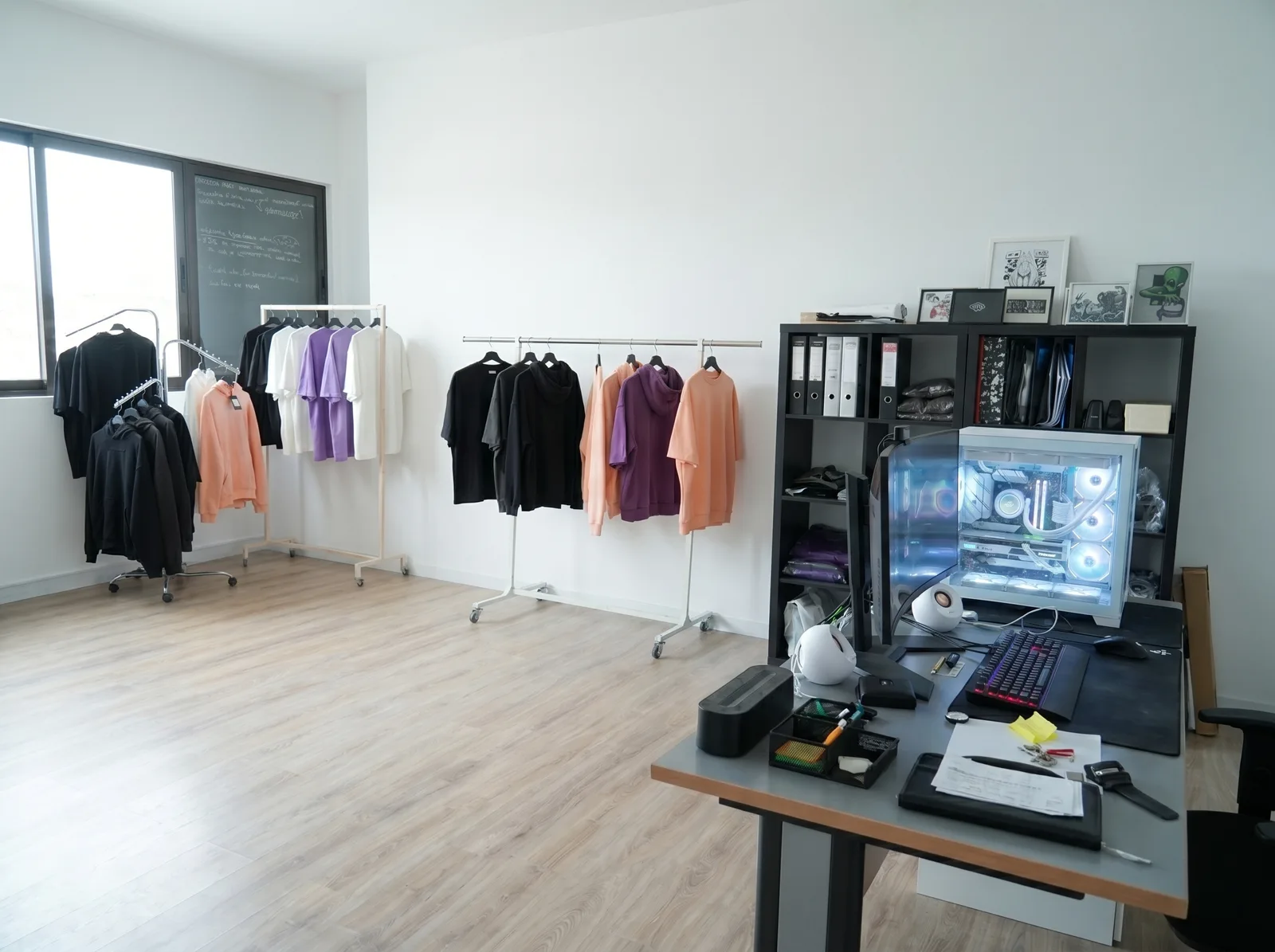
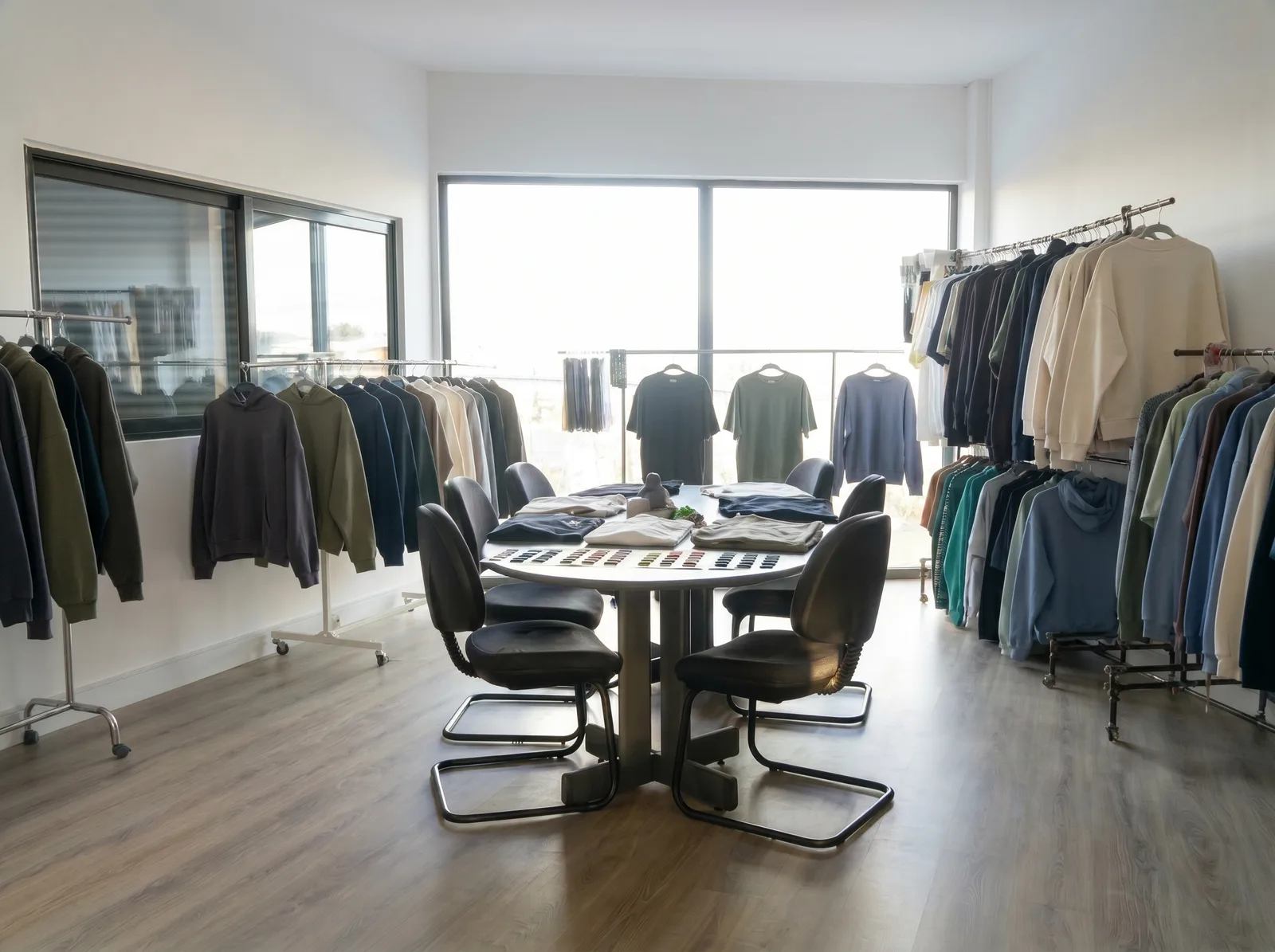
No. No finished garments are held in stock — no blanks, nothing ready-made to add your logo to. Every order is cut and sewn for you, from one of our base styles or from your own tech pack. Our showroom shows garments we have made, to help you choose a base style or describe yours.
Do you make company uniforms, merchandise or event t-shirts?
Yes, when the garments are ones we make — t-shirts, polos, hoodies, sweatshirts — made to your specification, with your logo, at the same minimums per style and colour as any brand.
Can I start from one of your existing styles and change it?
Yes. We keep our own base styles — patterns already made and proven in production — and you can order one as it is, in your fabric colour, with your decoration and labels: there's no pattern-making charge, and the sample is optional. Or change the measurements and details that make it yours, and it is developed from there as your own garment, with a sample to approve first. Our free tech packs are built on these base styles. What we don't have is finished garments waiting to be relabelled — every order is cut and sewn for you.
Do you make tote bags?
Yes — cotton canvas tote bags, made to your specification and decorated like any garment, with print or embroidery. The quotation states their minimum.
10 · 9 questions
Payment, VAT & invoices
Payment terms, the proforma, VAT with or without a VAT number.
What are your payment terms?
- Samples: 100% before work starts.
- Bulk production: a 50% deposit to start, and the other 50% before the goods ship.
Both are paid by bank transfer against our proforma invoice. The delivery date on your quotation counts from the day the payment reaches our account.
When does work on my order start?
Only after payment, against a proforma invoice. A sample starts when it is paid in full; bulk production starts when the 50% deposit reaches our account. Until then nothing is bought or cut for your order, and the delivery date on your quotation is not yet running.
How can I pay? Do you take cards or payment apps?
By bank transfer only, in euros, against our proforma invoice — we don't take card payments. The bank details — IBAN and SWIFT/BIC — are printed on the proforma. Use the proforma number as the transfer reference so the payment is matched to your order the day it arrives.
What is a proforma invoice?
The document you pay against before work starts. It lists exactly what you are paying for — the sample or the production, quantities, amounts, VAT if it applies — and our bank details. Once paid, it is followed by the final invoice with the same details.
Do I pay VAT?
It depends on where you are and whether you have a VAT number:
- A business in another EU country with a valid EU VAT number: invoiced without Portuguese VAT (reverse charge). The number is checked in the EU's VIES system.
- No VAT number, in Portugal or anywhere in the EU: 23% Portuguese VAT is added.
- Outside the EU: goods exported from Portugal are invoiced without Portuguese VAT. Your country's import VAT and duties are paid there, on arrival.
I don't have a VAT number or a registered company yet. Can I still order?
Yes. We don't require a registered company. Without a VAT number, we invoice with 23% Portuguese VAT, as for any buyer without one. If your VAT number is on its way, you can wait for it before we invoice — but work only starts once the proforma is paid, so waiting moves your start date too.
What details do you need for the invoice?
The name the invoice should carry (company or person), the full billing address, the VAT number if you have one, a phone number, and the delivery address if it is different. Send them before we issue the proforma: the final invoice follows it, a Portuguese certified invoice cannot be edited once issued, and a delivery address that changes after invoicing can mean the goods travel uninsured.
When do I pay the balance?
Before the goods ship. When your order is finished we send the invoice for the remaining 50%; once it is paid, the order is released — collected by your forwarder, or handed to the courier we booked for you.
Who issues the invoice?
White Cotton, Unipessoal Lda — our company in Barcelos, Portugal. Proformas and invoices are issued directly by us; we don't invoice through marketplaces or third-party platforms.
11 · 9 questions
Shipping & customs
EXW Barcelos, never DDP — duties, documents and destinations.
Do you ship to my country, and how does shipping work?
Yes. We work EXW Barcelos: the goods are ready for collection at our factory. Your own courier or forwarder can collect them, or we book the courier for you and the transport is invoiced separately — the terms stay EXW either way.
We never ship DDP: freight, customs clearance, import duties and VAT in your country are yours. Within the EU there is no customs. Outside it, every shipment carries full export documents — commercial invoice, packing list, EUR.1 where it applies, and HS codes.
Is shipping included in the price?
No. Shipping and import duties are never included in a quotation. We work EXW Barcelos: if we book the courier for you, the transport is invoiced separately, and duties and import VAT are paid in your country on arrival.
Do you ship DDP or DAP, delivered to my door?
No. We work EXW Barcelos only — no DDP, and no DAP either. DDP would require us to register for VAT and import duties in your country. Your forwarder collects the goods, or we book the courier for you and invoice the transport separately; customs clearance, import duties and VAT are yours on arrival. Full export documentation is included.
Who pays customs duties and import taxes?
You do, in your country, when the goods arrive: we work EXW, so customs clearance and import charges are always the buyer's. Within the EU there are none. Outside the EU the amount depends on your country's rules and the garment's HS code, which is on our export documents; a customs broker or your courier can tell you the rate before you order.
Do you ship to the USA, the UK, Australia or the Middle East?
Yes — outside the EU on the same terms as everywhere: EXW Barcelos, never DDP. Every shipment carries the export documents your customs will ask for: commercial invoice, packing list, HS codes, and an EUR.1 certificate for the countries where it gives preferential treatment. For the UK, a statement on origin on our invoice can let you claim the EU–UK preferential tariff on duty — conditions apply, and your customs broker confirms them; UK import VAT and the carrier's clearance fees apply either way. Import duties and taxes in your country are yours to pay on arrival.
Can I use my own courier or freight forwarder?
Yes — we work EXW, so your courier or forwarder can collect the goods at our factory in Barcelos, and we hand over the export documents with them. If you prefer, we book the courier for you instead and invoice the transport separately.
How much does shipping cost?
It depends on the weight, the volume and the destination, and courier rates change, so it is confirmed per shipment. As a guide within the EU by courier: a sample parcel around €40 to €55, 100 pieces around €150 to €250, 200 pieces around €300 to €350, usually delivered in 5 to 7 working days. Outside the EU it costs more. If we book the courier for you, the cost is confirmed once the order is packed and invoiced separately; if your forwarder collects, they quote you directly.
Can you ship orders to my customers, dropshipping or print on demand?
No. Every order is a production run from the minimum up, shipped to you or collected by your forwarder. We don't hold stock, print single pieces on demand or send individual parcels to your customers.
Who is responsible for the goods while they travel?
We work EXW (Incoterms 2020): the risk passes to you when the goods are collected at our factory. When we book the courier for you, transport insurance is available on request and appears as a line on the proforma; when your forwarder collects, insurance is arranged by them.
12 · 9 questions
Working with us
Email only and why, factory visits, confidentiality, who we are.
Can we talk on a call, a video meeting or WhatsApp?
We work by email only — no calls, no video meetings, no WhatsApp. It is deliberate: everything we agree with you stays in writing, in one thread, where both sides can check it later — measurements, colours, quantities, prices, dates. Nothing depends on what someone remembers from a call.
Write to comercial@whitecotton.pt, or start with a quotation request on the website.
Can I visit the factory?
Factory visits are available for production clients — once samples are approved and bulk production is underway. Before that stage, everything the factory needs from you travels by email: the tech pack, the sample and your corrections.
Which brands do you work with? Can I contact a reference client?
We don't name the brands we make for, and we don't pass on their contacts. The same discretion protects your brand once you work with us. Our showroom shows examples of our work instead — references, not a catalogue — and what you can really judge us by is your own sample: it is made to your tech pack, and you approve it before any production.
Where are you, and who is White Cotton?
A family-run garment manufacturer in Barcelos, in northern Portugal's textile region, making garments since the late 1980s: a team of around twenty specialists, with pattern making, cutting, sewing and finishing under one roof. Address: Rua Industrial do Corujo 10, 4750-784 Lijó, Barcelos, Portugal.
Do you work with new brands and first collections?
Yes. A first collection follows the same steps as any other: a tech pack, a sample you approve, the minimum per style and colour, and payment before work starts. What helps a new brand most is arriving with a complete tech pack — it saves rounds of emails and a sample that misses. Start with the thirteen things new brands only learn by email, listed on this page.
Which languages do you work in?
English, Portuguese and Spanish. Write in any of them and we answer in the same.
What are the steps, from first email to delivery?
- Send a quotation request with your tech pack, quantities and colours.
- You receive the sample quotation and a proforma; the sample is paid in full.
- We make the sample, in one colour, and send it to you.
- You check it and send corrections in writing; a first sample usually needs some.
- With the sample approved, you receive the production quotation and proforma.
- Production starts when the 50% deposit reaches our account.
- When the order is finished you pay the remaining 50%, and it ships — or your forwarder collects it.
Will you sign an NDA? Are my designs kept confidential?
Your tech packs, files, samples and specifications are confidential by default: used only to quote and make your garments, never shared. The patterns and designs developed for you are yours and exclusive to your brand. If you want it formally in writing before you send your files, we are happy to sign your NDA or a mutual one.
How should I write to you so nothing gets lost?
Always reply in the same email thread. Each project is followed as one conversation; a new email for every message starts a separate thread and splits your project in two. Keep attachments — tech pack, artwork, corrections — in that thread too, and send everything from the same address.
Your question is not here?
Send it to comercial@whitecotton.pt. We answer it by email and add the answer to this page, so the next brand does not have to ask.