The Problem with Cheap Uniforms: Why Dubai Companies Are Going European [2026]
Cheap corporate uniforms in Dubai tested positive for azo dyes. Why companies are switching to OEKO-TEX certified European-made uniforms for staff safety and brand image.
 Pedro Carreira··10 min read
![The Problem with Cheap Uniforms: Why Dubai Companies Are Going European [2026]](/_next/image?url=%2Fimages%2Fgenerated%2Fblog%2Fcheap-uniforms-problem-dubai.webp&w=1920&q=75)
School Uniforms Have Been Tested for Banned Chemicals. The Results Were Not Good.
Consumer safety testing has found banned azo dyes in school uniform samples sold in the region. Azo dyes are a class of synthetic colourants linked to carcinogenic aromatic amines — substances that are absorbed through the skin, particularly in heat and when the wearer is sweating. They have been banned in the European Union since 2002 under EU Directive 2002/61/EC (now enforced through REACH regulation). Yet they continue to be found in clothing worn by children for 8 hours a day, 5 days a week.
The uniforms in question were manufactured for approximately AED 12 per unit and sold to parents for AED 80–120. The margins were enormous. The quality control was minimal. And the chemicals in the fabric were substances that European law considers too dangerous for any skin contact at all.
This is not a school uniform problem. It is a textile sourcing problem — and it extends directly into corporate clothing.
The Sourcing Reality: Where Dubai's Corporate Uniforms Actually Come From
Where do most corporate uniforms in the UAE come from?
Over 60% of textiles imported into the UAE originate from China, with significant volumes from Bangladesh, Pakistan, and Vietnam. The supply chain for corporate uniforms in Dubai typically works like this:
- 1.A Dubai-based uniform supplier places an order with a trading company in China or Bangladesh
- 2.The trading company sources blanks from the cheapest available factory — often a facility producing for multiple markets with varying quality standards
- 3.The blanks are shipped to Dubai (6–8 weeks by sea)
- 4.The Dubai supplier adds branding — screen printing, heat transfer, or basic embroidery — at a local workshop
- 5.The finished uniforms are sold to the end client at a 3–5x markup
At no point in this chain is the fabric tested for chemical safety. The UAE does not require textile imports to carry chemical safety certifications for corporate or workwear applications. There is no equivalent of the EU's REACH regulation or OEKO-TEX Standard 100 requirement at the border. Textiles enter the country on commercial invoices — not chemical test reports.
The result: the polo your sales team wears for 10 hours a day in 40°C heat — when pores are wide open and sweat is maximising chemical absorption through skin — may contain substances that would be illegal in a European workplace.
What Is Actually in Cheap Uniforms?
What harmful substances can be found in uncertified corporate clothing?
OEKO-TEX Standard 100 tests for over 1,000 harmful substances across multiple categories. Here is what has been found in uncertified textile imports globally — not hypothetically, but in documented testing:
| Substance | Where It Is Found | Health Risk | Status in EU |
|---|---|---|---|
| Azo dyes (aromatic amines) | Fabric dyeing | Carcinogenic — absorbed through skin | Banned since 2002 |
| Formaldehyde | Wrinkle-resistant finishes | Skin irritation, respiratory sensitisation | Limited to 75mg/kg (direct skin contact) |
| Heavy metals (lead, cadmium, chromium) | Pigment dyes, metal accessories | Toxic accumulation, organ damage | Strictly limited |
| Phthalates | PVC prints, plastisol transfers | Endocrine disruption | Restricted under REACH |
| Nonylphenol ethoxylates (NPEs) | Textile processing, washing | Endocrine disruption, aquatic toxicity | Banned in textile processing |
| Chlorinated phenols | Fabric preservation during shipping | Toxic, environmental persistent | Banned |
| pH extremes | Improper finishing | Skin irritation, dermatitis | Regulated (pH 4.0–7.5 for skin contact) |
| Pesticide residues | Cotton cultivation | Neurotoxic, skin sensitisation | Limited to trace levels |
The concentration of these substances varies, but the exposure pattern is consistent: corporate staff wear uniforms in direct skin contact for 8–12 hours daily, in a climate that maximises absorption. Dubai's heat is not just uncomfortable — it is a chemical delivery mechanism for any harmful substances present in fabric.
A single uncertified polo shirt is unlikely to cause acute harm. But cumulative daily exposure over months and years, across hundreds of employees, is an occupational health risk that most Dubai companies have never evaluated — because no one tests the uniforms.
The Total Cost of Cheap Uniforms
Are cheap uniforms actually cheaper over time?
The per-unit price of an Asian-sourced corporate polo is AED 20–35 ($5–10). An equivalent European-manufactured polo costs AED 50–75 ($14–20). On a purchase order, the Asian option looks like a 50–60% saving. Over 24 months, it is often more expensive.
Durability comparison — branded polo shirt:
| Metric | Cheap Uniform (AED 25) | European-Made (AED 65) |
|---|---|---|
| Fabric weight | 160–180gsm | 220–260gsm |
| Colour fastness | 15–25 washes before visible fade | 60–80+ washes |
| Collar structure | Warps after 10–15 washes | Holds shape 60+ washes |
| Embroidery durability | Thread pilling at 3–6 months | Clean at 12–18 months |
| Pilling | Visible at 10–20 washes | Minimal at 50+ washes |
| Realistic lifespan | 6–8 months | 18–30 months |
| Replacements over 2 years | 3–4 rounds | 1 round |
| Total 2-year cost per employee | AED 75–100 | AED 65 |
The cheap uniform costs more by the end of Year 2 — and that calculation excludes the administrative cost of reordering, redistributing, and disposing of worn-out garments three to four times. For a company with 300 employees, three reorder cycles per year means three procurement processes, three distributions, and three rounds of employees wearing visibly degraded clothing between the old batch wearing out and the new batch arriving.
What does uniform quality cost across a full organisation?
For a 300-person company over 3 years:
| Approach | Year 1 | Year 2 | Year 3 | 3-Year Total |
|---|---|---|---|---|
| Cheap uniforms (AED 25, replaced every 6 months) | AED 15,000 | AED 15,000 | AED 15,000 | AED 45,000 |
| European-made (AED 65, replaced every 24 months) | AED 19,500 | AED 0 | AED 19,500 | AED 39,000 |
| Difference | — | — | — | AED 6,000 saved |
European-made uniforms save AED 6,000 over three years for 300 employees — while delivering certified fabric safety, better brand presentation, and zero mid-cycle replacement logistics. The "premium" option is literally the cheaper option at scale.
Brand Perception: What Cheap Uniforms Signal
Do clients and employees notice uniform quality?
Yes. Industry research consistently shows that employees who receive company-provided clothing prefer higher-quality garments over more frequent replacements. Employees associate the quality of their uniform with how much their employer values them.
The perception extends outward. Consider two scenarios:
Scenario A: A Dubai real estate company outfits its sales team in thin, loose-fitting polos. By month four, the collars are curled, the colours are faded, and the heat-pressed logo has cracked. A potential buyer touring a AED 5 million property is greeted by an agent whose clothing undermines every premium signal the company tries to project.
Scenario B: The same company invests in 240gsm pique polos with embroidered branding, structured collars, and a "Made in Portugal" neck label. Twelve months later, the polo looks the same as day one. The brand message is consistent across every client interaction.
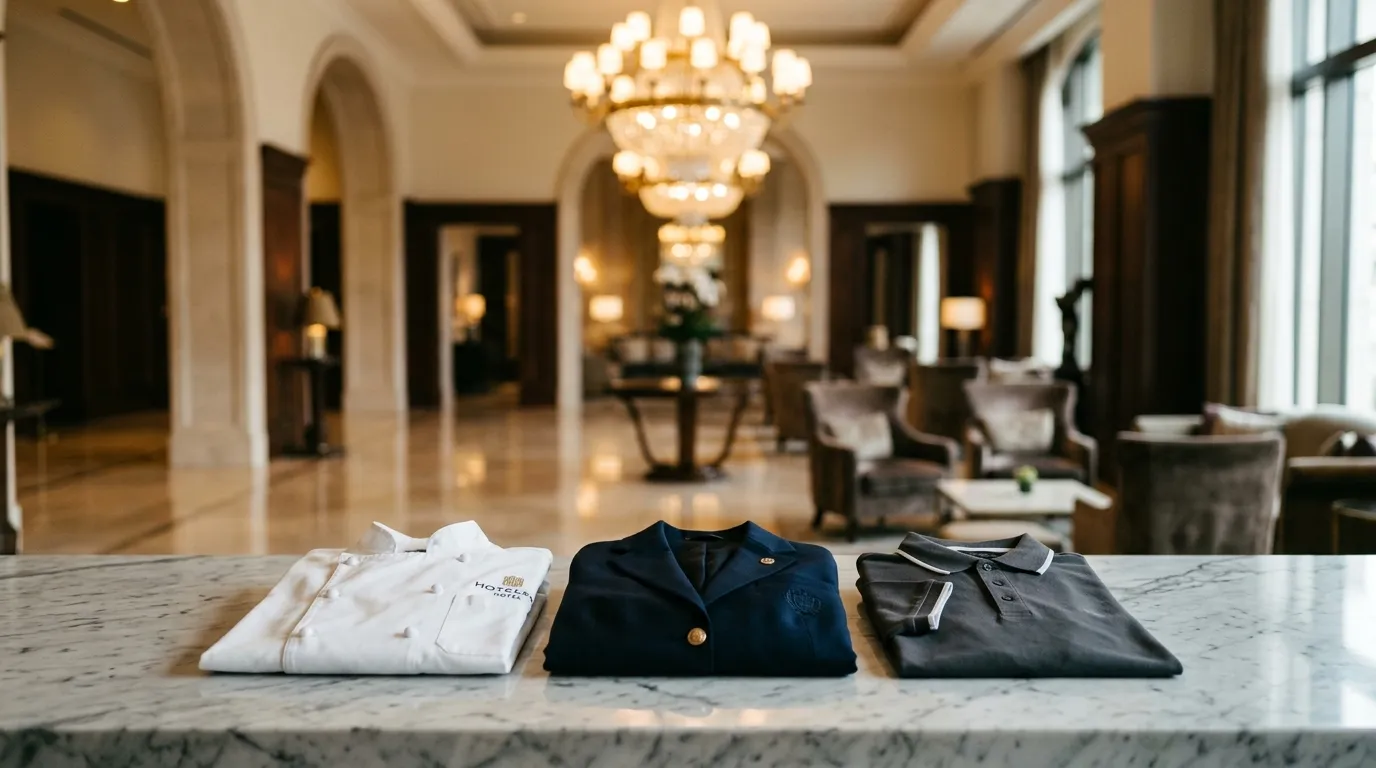
In hospitality, the gap is even more visible. Dubai's 152 five-star hotels compete on every detail of guest experience. Staff uniforms sourced from commodity suppliers — the same suppliers that outfit three-star properties — create a visual inconsistency that guests perceive even if they cannot articulate it. European-manufactured hotel uniforms from Portugal or Italy are what guests at European five-star properties already experience. The Dubai market is catching up.
The "Made in Portugal" Shift
Why are Dubai companies switching to European-manufactured uniforms?
The shift is driven by three converging factors:
1. ESG and sustainability pressure. Companies listed on DFM and ADX, government entities, and multinationals with global sustainability commitments are auditing their supply chains. Uniform procurement is a visible, easy-to-improve line item. OEKO-TEX and GOTS certified fabrics from European manufacturers provide the documentation that sustainability reports require.
2. Total cost realisation. Procurement teams are moving from per-unit costing to total-cost-of-ownership models. When uniform programmes are evaluated over 24–36 months instead of per purchase order, European-made garments consistently come out equal or cheaper — with the added benefit of eliminating mid-cycle replacement logistics.
3. Market differentiation. As Dubai's economy matures, B2B companies are competing on brand perception. In professional services, technology, hospitality, and real estate, the quality of staff clothing is a visible differentiator. "Made in Portugal" — from the same manufacturing base that supplies established European fashion brands and luxury houses — carries a quality signal that resonates in a brand-literate GCC market.
Portugal has become Europe's premium textile manufacturing hub specifically because it offers the intersection of quality, certification, and accessible minimum order quantities. Where Italian manufacturing requires 500+ unit MOQs and premium pricing, Portuguese manufacturers like White Cotton start from 75 pieces per colourway — making European quality accessible to mid-size companies, not just hotel groups and multinationals.
How to Evaluate Your Current Uniform Programme
How do I know if my company's uniforms contain harmful substances?
Ask your current supplier three questions:
- 1."Can you provide the OEKO-TEX or equivalent chemical safety certificate for the fabric?" If they cannot produce a certificate, the fabric has not been tested. Most Dubai uniform suppliers cannot provide this documentation because their supply chain does not include fabric-level testing.
- 1."What is the fabric weight in GSM?" If the answer is below 200gsm for cotton polos or below 300gsm for sweatshirts, the garment is at the commodity end of the spectrum — lighter, thinner, and shorter-lived.
- 1."Where is the fabric milled and where is the garment manufactured?" If the answer is vague ("Asia" or "overseas"), or they do not know, you are buying through a trading chain with no visibility into the production facility.
If your supplier cannot answer these questions, you do not have a uniform programme. You have a promotional products supplier adding your logo to the cheapest blanks they can source.
Making the Switch: What the Process Looks Like
How do I transition to European-manufactured corporate uniforms?
The transition does not require replacing everything at once. Most companies phase the switch over 6–12 months:
Phase 1 — Pilot (75–100 units): Order one garment type — typically the most visible (front-desk polos or sales team shirts) — from a European manufacturer. Run it alongside existing uniforms for 3–6 months. Compare durability, staff feedback, and total cost.
Phase 2 — Expand (200–500 units): Based on pilot results, expand to additional departments. By this stage, specifications are on file and reorders are faster (4–5 weeks).
Phase 3 — Full programme (500+ units): All departments transitioned. Reorder cycles drop from every 6 months to every 18–24 months. Procurement workload decreases. Staff satisfaction increases. Brand presentation is consistent.
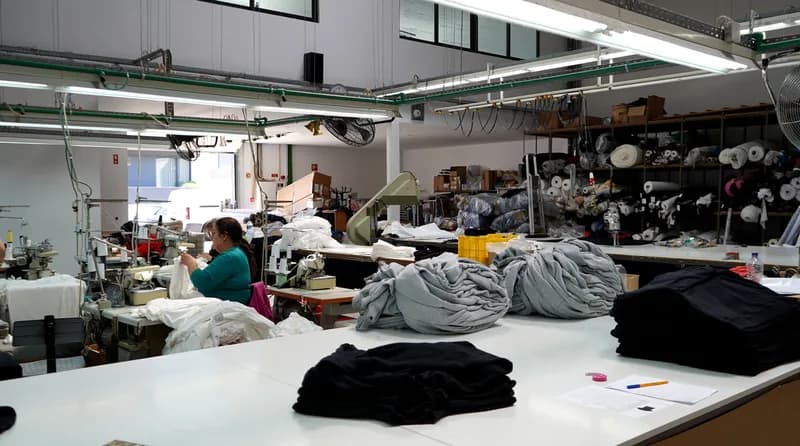
At White Cotton, a clothing manufacturer for Dubai, we produce corporate uniforms and branded team wear for companies across the GCC — from tech startups in DIFC to hotel groups along Sheikh Zayed Road. Production starts at 75 pieces per colourway (100 pieces in a single colourway), all manufactured in Barcelos, Portugal using OEKO-TEX certified fabrics.
For a cost comparison against your current uniform supplier, request a quote with your garment types, quantities, and current per-unit cost. We will return a detailed like-for-like comparison within a few days — including 2-year total cost of ownership, not just unit price.

Pedro Carreira
Founder of White Cotton, a textile manufacturer in Barcelos, Portugal. Producing custom clothing collections for brands across 15+ countries.
Continue Reading
![250,000 New UAE Companies in 2025 — Every One Needs Branded Clothing [2026]](/_next/image?url=%2Fimages%2Fgenerated%2Fblog%2Fnew-uae-companies-branded-clothing.webp&w=1920&q=75)
250,000 New UAE Companies in 2025 — Every One Needs Branded Clothing [2026]

Dubai Fashion Market 2026 — Opportunities for Emerging Brands
![Why Dubai's Smartest Companies Are Switching to European-Made Team Wear [2026]](/_next/image?url=%2Fimages%2Fgenerated%2Fblog%2Fwhy-european-made-team-wear-dubai.webp&w=1920&q=75)
Why Dubai's Smartest Companies Are Switching to European-Made Team Wear [2026]
Case Study: Five-Star Dubai Hotel Switches to Portuguese-Manufactured Staff Uniforms