Clothing Labels, Tags, and Packaging: The Details That Build Your Brand
A guide to garment labelling, hang tags, care labels, and product packaging. Legal requirements, branding opportunities, and how to specify them for your manufacturer.
 Pedro Carreira··13 min read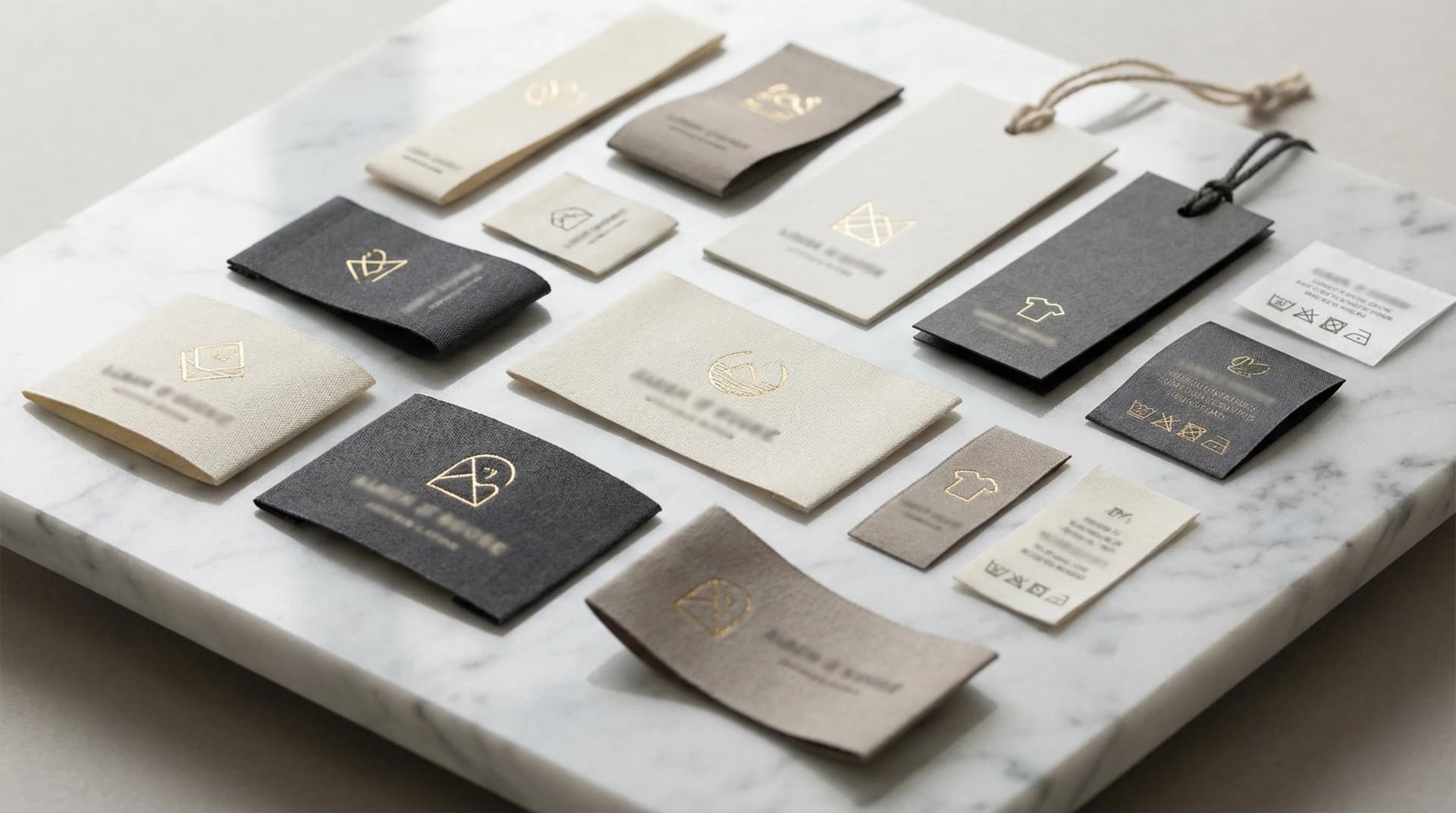
The Small Details That Matter Most
Labels and packaging are the first things your customer touches after unboxing. They are the finishing touches that separate a generic garment from a branded product. They communicate quality before the customer even puts the garment on.
More practically, labels are a legal requirement. Every garment sold in the EU and most global markets must carry specific information. Getting this wrong can result in products being seized at customs or pulled from retail.
Types of Garment Labels
Main Label (Brand Label)
Your brand identity on the garment. Usually positioned at the centre back neck.
Woven labels: Fabric labels with your logo or brand name woven into the material. The premium standard. Durable, detailed, and professional.
- —Damask weave: Highest quality, smooth surface, fine detail. Best for intricate logos.
- —Satin weave: Smooth, shiny surface. Good for text-heavy labels.
- —Taffeta weave: More textured, slightly rougher. Most affordable option.
Printed labels: Satin or cotton tape with your design printed on. Softer against skin, lower cost, but less durable. Common in activewear and underwear.
Woven vs printed: the spec comparison
This is the first real decision in your label set, and it is usually made on cost when it should be made on where the label sits and how the garment is washed.
| Woven label | Printed label | |
|---|---|---|
| Cost per unit | €0.15–0.35 | €0.05–0.15 |
| Minimum run | 1,000+ pieces, from the label supplier | 500–1,000, and more flexible |
| Durability | Survives the life of the garment; the weave is the image | Print degrades with washing and abrasion — visibly so on dark grounds after 30–50 washes |
| Detail resolution | Damask holds fine detail and small type; taffeta is coarser | Excellent detail, including gradients and photographic artwork that no weave can hold |
| Hand-feel against skin | Firmer; can scratch at the back neck unless satin-woven or folded correctly | Softer, which is why activewear and underwear default to it |
| Colour matching | Pantone-matched thread, limited to the number of colours in the weave | Effectively unlimited colours at no extra cost |
| Best placement | Centre back neck, side seam, flag tab | Anywhere touching skin; multi-language care booklets |
The practical rule: woven for the brand label, printed for the care label. A woven main label is the single cheapest signal of quality in a garment, and a printed care label is the one nobody wants to feel.
Once you know which you want, our label studio walks through specifying artwork, dimensions and fold type, and care labels covers the compliance side in detail.
Leather / faux leather labels: Debossed or printed. Common on jeans, jackets, and premium positioning.
Specifications to provide:
- —Dimensions (e.g., 50mm × 20mm)
- —Fold type: centre fold (sewn into seam), end fold (folded at edges), straight cut
- —Colour: Pantone references for background and logo
- —Material: satin, cotton, damask
- —Artwork: vector file (AI, EPS, or PDF)
Care Label
Legally required. Must include fibre composition and care instructions.
EU requirements:
- —Fibre composition by percentage (e.g., "100% Organic Cotton" or "80% Cotton, 20% Polyester")
- —Care symbols following ISO 3758 / GINETEX standard (wash, bleach, dry, iron, professional care)
- —Country of origin ("Made in Portugal")
- —Importer details (for goods imported into the EU)
Care symbols (the five basic categories):
- —Wash tub: washing instructions (temperature, hand wash, do not wash)
- —Triangle: bleaching (allowed, non-chlorine only, do not bleach)
- —Square: drying (tumble dry, hang dry, flat dry)
- —Iron: ironing (temperature settings, do not iron)
- —Circle: professional cleaning (dry clean, wet clean)
Placement: Usually sewn into the left side seam or below the main label. Many brands use a folded booklet label for multiple languages.
Important: Care instructions must be accurate for the specific fabric. Incorrect care labels can lead to garment damage and legal liability. Your manufacturer should provide the correct care instructions based on the fabric composition and finishing.
Size Label
Indicates the garment size. Can be:
- —Integrated into the main label
- —A separate woven or printed label
- —Integrated into the care label
- —Heat transfer printed inside the garment (tagless)
Tagless printing is increasingly popular for comfort, especially in t-shirts and underwear.
Flag Label / Tab Label
A small folded label that protrudes from a seam, usually on the side or hem. A subtle branding element.
- —Typical size: 10–15mm × 30–40mm (folded)
- —Often woven with a small logo or brand initial
- —Low cost but high-impact branding touch
Hang Tags and Swing Tags
The tag attached to the garment by a string, pin, or plastic fastener. Removed by the customer before wearing.
Design considerations
- —Size: Common sizes are 55×85mm, 65×90mm, or custom shapes
- —Material: 300–400 GSM cardstock is standard. Options include kraft paper, textured stock, soft-touch lamination
- —Content: Brand logo, tagline, size, price, product code/SKU, care summary, sustainability messaging
- —Finishing: Matte or gloss lamination, spot UV, embossing, foil stamping, die-cut shapes
- —Attachment: Cotton string (premium), plastic fastener (standard), ribbon
Information to include
- —Brand name and logo
- —Product name or style code
- —Size
- —Price (if retail)
- —Brief care or composition summary
- —Website or QR code (links to product page, brand story, or care guide)
- —Country of origin
- —Sustainability certifications (GOTS, OEKO-TEX logos if applicable)
Packaging
Poly bags
The minimum packaging for shipping and storage:
- —Standard sizes: fit garment when folded (e.g., 30×40cm for a folded t-shirt)
- —Material: LDPE or biodegradable alternatives (PLA, compostable film)
- —Finishing: clear (standard), frosted (premium feel), printed with brand logo
- —Sustainability note: Many brands are switching to recycled or compostable poly bags. Cost increase is minimal (€0.02–0.05 per bag)
Folding
How the garment is folded before bagging:
- —Standard fold: Simple flat fold to fit poly bag. Most common.
- —Retail fold: Folded around a board insert for clean presentation. Higher cost.
- —Rolled: Garment rolled instead of folded. Used by some DTC brands for a different unboxing experience.
Tissue paper
Acid-free tissue paper wrapping the garment inside the poly bag or box:
- —White (standard), black (premium), or custom printed
- —Adds €0.10–0.30 per unit
- —Significant perceived value increase for the unboxing experience
Boxes
For brands that ship direct-to-consumer:
- —Mailer boxes: Corrugated, branded. The standard DTC packaging. €0.50–3.00 per box.
- —Rigid boxes: Non-collapsible, premium. Used by luxury brands. €2–10+ per box.
- —Printed with brand: Minimum order for custom printed boxes is usually 100–500 units.
Stickers and extras
- —Branded stickers sealing tissue paper or closing boxes: €0.02–0.10 each
- —Thank you cards: €0.05–0.20 each
- —Product care cards: €0.05–0.15 each
Legal Requirements by Market
Before the detail, the version you can put in front of your manufacturer. This is what has to appear on the garment itself in each market:
| Requirement | EU | UK | United States | Canada |
|---|---|---|---|---|
| Fibre composition by percentage | Required, descending order | Required | Required (FTC) | Required |
| Care instructions | ISO 3758 / GINETEX symbols | ISO 3758 symbols | Symbols or text; ASTM D5489, not ISO | Symbols or instructions |
| Country of origin | Required | Required | Required | Required |
| Importer or dealer identity | Importer name and address if made outside the EU | UK importer details | RN number or company name | Dealer identification |
| Language | Language(s) of the member state of sale | English | English | English and French, both |
| Chemical compliance | REACH | UK REACH | CPSIA where applicable | — |
Two traps worth naming. The US does not accept ISO care symbols on their own — it runs its own ASTM standard, and text instructions are the safe route if you sell into both markets. Canada requires bilingual labelling, which is a size problem rather than a legal one: fitting English and French onto a single label usually forces a folded booklet, and that has to be decided before the labels are ordered, not after.
If you sell across several of these, specify one multi-market label from the start. Re-labelling finished stock costs more than over-specifying at the outset, and it is the correction we are asked for most often.
European Union
- —Fibre composition (by percentage, in descending order)
- —Care symbols (ISO 3758)
- —Country of origin
- —Importer name and address (if not manufactured in EU)
- —REACH compliance (restriction of certain chemicals)
United Kingdom (post-Brexit)
- —Same as EU requirements
- —UK importer details required
United States
- —Fibre composition (FTC requirement)
- —Care instructions (can use symbols or text)
- —Country of origin
- —RN (Registered Number) or company name
- —No requirement for care symbols to follow ISO standard (US uses ASTM D5489)
Canada
- —Bilingual labels (English and French)
- —Fibre composition
- —Care symbols or instructions
- —Dealer identification
Specifying Labels for Your Manufacturer
When placing an order, provide:
For woven labels
- —Vector artwork file (AI, EPS, or high-res PDF)
- —Dimensions (width × height)
- —Fold type
- —Colour Pantone references
- —Material preference (damask, satin, taffeta)
- —Quantity (your manufacturer will advise on minimum runs — typically 1,000+ pieces)
For care labels
- —Fabric composition for each style
- —Target markets (EU, US, UK — determines legal requirements)
- —Languages required
- —Your manufacturer should generate the correct care instructions and symbols
For hang tags
- —Print-ready artwork (front and back)
- —Paper stock and weight
- —Finishing (lamination, foil, emboss)
- —Attachment method
- —Quantity
Cost Expectations
For a typical order of 200 units:
- —Woven main labels: €0.15–0.35 each (minimum run 1,000+, so you will have spares)
- —Printed care labels: €0.05–0.15 each
- —Size labels: €0.05–0.10 each (or integrated into care label)
- —Flag labels: €0.10–0.20 each
- —Hang tags: €0.15–0.40 each (depending on finishing)
- —Poly bags: €0.05–0.15 each
- —Total per garment: €0.50–1.35
For a premium finish adding tissue paper, stickers, and a custom mailer box, add €1.50–4.00 per unit.
Minimum Orders: The Part That Catches People Out
Labels and packaging have their own minimums, and they rarely match your garment order. A 100-piece first run does not mean 100 labels — it means buying the supplier's minimum and storing the remainder.
| Component | Typical minimum | What it means on a 100-unit first order |
|---|---|---|
| Woven main labels | 1,000 pieces | You buy 1,000, use 100, and keep 900 for the next run. Budget the full run, not the per-unit price |
| Printed care labels | 500–1,000 pieces | Same pattern, lower cost. Do not finalise until the fabric composition is locked |
| Hang tags | 250–500 pieces | Shorter runs are available from digital printers at a higher unit cost |
| Custom printed poly bags | 1,000–5,000 pieces | Plain or generic compostable bags have no minimum — most brands start there |
| Custom printed mailer boxes | 100–500 pieces | The most accessible custom packaging item at low volume |
| Tissue paper, stickers, cards | 250–1,000 pieces | Cheap per unit, but the minimums still apply |
The strategic read: your labels outlive your production run, so design them to survive a fabric change. A woven label that names a specific composition ties 900 spare labels to one fabric. Keep composition on the care label, which is cheaper to reprint, and keep the woven label to brand only.
Our Approach
At White Cotton, we handle all labelling and packaging as part of your low-MOQ production in Portugal. We work with specialised label suppliers in Portugal to produce custom woven labels, care labels, and hang tags to your specifications.
If you do not have label designs yet, we can help. Many of our clients start with a brand name and a rough idea — we connect you with our labelling partners who can design and produce your full label set. Our label studio is the fastest way to specify one, and care labels covers what the law requires in each market.
We ensure all labels meet the legal requirements for your target market. If you are selling in the EU, US, and UK, we produce multi-market compliant labels from the start.
Related reading: embroidery and heat transfer are the two techniques most often used for tagless neck branding, and how to create a tech pack covers where label specifications belong in the document your factory works from.

Pedro Carreira
Founder of White Cotton, a textile manufacturer in Barcelos, Portugal. Producing custom clothing collections for brands across 15+ countries.
Frequently Asked Questions
Usually 1,000 pieces from the label supplier, regardless of how many garments you are making. On a 100-unit first production run that means buying 1,000 labels and storing 900 for later — so budget the whole run rather than the per-unit price, and design the label so it survives a fabric change. Printed care labels start lower, around 500.
Fibre composition by percentage, care instructions, and country of origin in every major market, plus importer or dealer identity where the goods are imported. The differences matter: the EU and UK use ISO 3758 care symbols, the US uses its own ASTM D5489 standard and accepts text, and Canada requires both English and French on the same label. If you sell across several markets, produce one multi-market label from the start.
Around €0.50–1.35 per garment for a standard set — woven main label, printed care label, size label, hang tag and poly bag. Adding tissue paper, branded stickers and a custom mailer box for a direct-to-consumer unboxing takes that to roughly €2.00–5.35 per unit. The packaging is often where a mid-market garment starts feeling premium, and it is the cheapest place to buy that impression.
Woven for the brand label at the back neck, printed for the care label. Woven survives the life of the garment because the weave is the image rather than ink on a surface, which is what makes it read as quality. Printed is softer against skin and handles unlimited colours and small multi-language type, which is exactly what a care label needs.
They should, and you should insist on it. Care instructions have to be correct for the specific fabric and finishing used in your production — an incorrect symbol can damage the garment in the wash and creates real liability. Your factory knows the composition and how it behaved through dyeing and finishing, so they are the right source for the symbols. Ask for them in writing before the labels are ordered.
Continue Reading
What Is a Tech Pack for Clothing? A Real Example, Page by Page

Clothing Brand Founder Mistakes: The Ones That Cost Real Money

How to Advertise a Clothing Brand: The Numbers Before the Creative
How to Market a Clothing Brand Without Ads: The Organic Routes