MANUFACTURING INSIDER SERIES
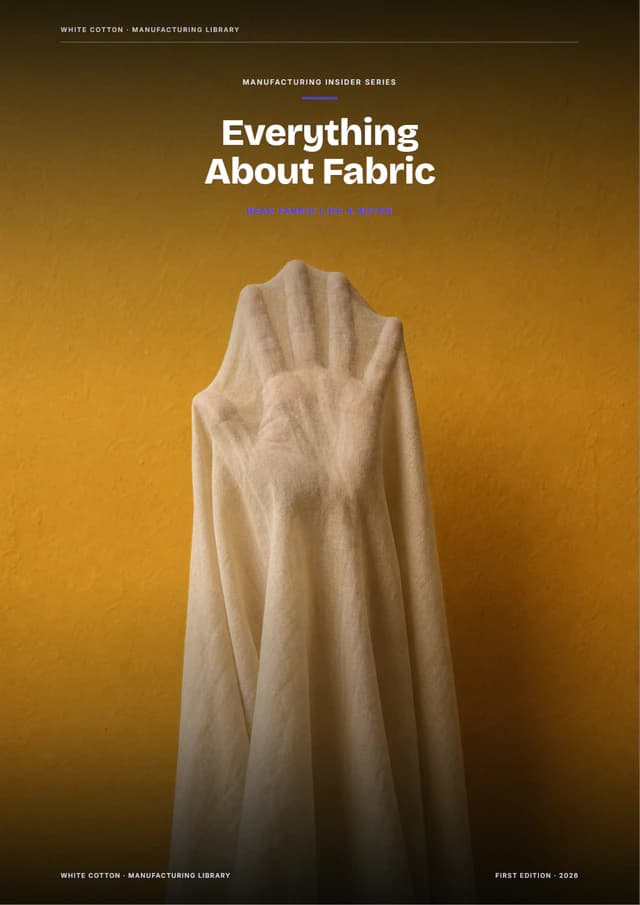
Everything About Fabric — Read Fabric Like a Buyer.
Most brands that get burned on their first bulk order got burned on fabric — a swatch that photographed well but shrank 6%, or a 'premium hoodie weight' that turned out to be a summer-tee GSM. This is the buyer's field guide that gets you to a real fabric family — and the evidence to back it — before you order anything.
All playbooksMANUFACTURING INSIDER SERIES
78 pages, 6 chapters.
Most brands that get burned on a first bulk order got burned on fabric — a swatch that photographed well but shrank 6%, or a 'premium hoodie weight' that turned out to be a summer-tee GSM. Everything About Fabric exists to close that gap with the Fabric Decision Tree: garment, then four questions, then a real fabric family and GSM band you can actually specify.
Across four parts it covers the label vocabulary (GSM, hand, drape, construction), a 26-band GSM map across 10 garment types straight from White Cotton's own production registry, every knit and woven family pictured and priced in masked ranges from 52 active mill quotes, three head-to-head spreads (Poplin vs Oxford, French Terry vs Fleece, Canvas vs Twill), the real cost formula behind an 11.7× cost spread across garment types, shrinkage and dye-variance numbers by family, and a fill-in worksheet that turns the whole book into a factory-ready brief.
76 pages, Manufacturing Insider Series. Every fabric in this book is cotton-family — jersey, fleece, terry, wovens, linen; sourcing technical performance synthetics is a different book. Pairs naturally with Production, Explained and How to Price a Garment once a fabric choice becomes a real cost.
“You don't need to become a textile engineer. You need to stop choosing fabric by photo.”
Digital edition · instant delivery
Reading, choosing and approving fabric across everyday cottons, wovens and performance systems — activewear, swim, intimates and outerwear shells — with the evidence ladder and testing standards to back every call. It's a buying framework, not a lab procedure or a PPE/protective-clothing spec.
Digital delivery by email. No refunds—check “Who it’s for” below.
Part of a set
Manufacture Correctly — 7 books for €55 €105, saving €50.
Or the whole library — 15 books for €97 €244.
Browse all 15 playbooksWhat’s inside
- fill-in worksheet1
- brief template1
- checklists1
- decision tools3
Table of contents
What's inside.
Read the Cloth
Five layers — fibre, yarn, construction, mass and finish — turn 'nice fabric' into a material another person can identify, quote and reproduce.
- · The requirement stack: composition, yarn, construction, mass/dimensions and finish, with what to ask a supplier at each layer
- · Knitted vs woven vs shaped-knitwear construction — the architecture that decides direction, recovery and drape before any spec number matters
- · Why GSM (grams per square metre) is mass, not thickness, warmth or quality — and how to compare it honestly
Meet the Families
Knits, wovens and shaped-garment systems as starting points — the exact article, finish and evidence still decide the product.
- · Foundation knits (jersey, interlock, rib, piqué), sweat/pile families (French terry, brushed sweatshirting, waffle, sherpa) and everyday wovens (poplin, oxford, twill, linen, canvas, voile), each read face and reverse
- · Fashion and shaped textiles — crepe, satin, lace/mesh and sweater knitwear — where drape and shape come from yarn, gauge and construction, not the swatch alone
- · The systems atlas: five garment categories (active, swim, lace/mesh intimates, outer shell, sweater knitwear) where fabric is a system, not a swatch
Choose by Garment
The fastest route isn't 'which fabric is best?' — it's 'what must this garment do, feel and survive?' Six garment routes, then the exact fibre systems behind active, swim, intimates and outerwear.
- · Six garment routes: tees/next-to-skin layers, activewear/performance layers, hoodies/sweatshirts, shirts/dresses/soft tailoring, denim/workwear/outerwear, and structured tailoring/sweater knitwear
- · Full performance specs: activewear (72–80% polyamide/20–28% elastane or 85–92% polyester/8–15% elastane, 150–360gsm), swimwear (PA-EA vs chlorine-resistant PBT/polyester) and intimates (80–90% nylon/10–20% elastane power mesh)
- · Outerwear shell systems broken into face fabric, membrane (ePE/ePTFE/PU) and backer — plus what denier (30–150D) actually tells you
Predict Behaviour
A swatch is not static — fold it, extend it, heat it, wet it, wash it and make it meet a seam before you approve it.
- · Drape and hand: fold-and-hang, scrunch-and-release and doubled-layer tests that go beyond a flat swatch
- · Stretch and recovery read in both directions, plus why opacity has to be checked in the stretched state, not just at rest
- · Air permeability, thermal resistance, water-vapour resistance and liquid moisture handling — four separate questions marketing often collapses into one
Buy and Approve
A beautiful development sample begins the control process — it doesn't replace the specification, evidence or incoming-lot decision.
- · The fabric brief: 11 fields (garment/use, silhouette, construction, composition, mass, finish, behaviour, evidence, commercial terms, decoration, approval object) another person can quote without guessing
- · The seven-rung evidence ladder — from reference image to incoming lot — and what each rung is and isn't allowed to approve
- · How to read a quote (kg vs metre vs lot pricing) and the incoming-lot release checklist to run before cutting
Desk Guide
Keep it beside your desk — a one-page shortlist matrix across 10 garment jobs, plus a working sheet to lock in your own fabric decision.
- · Shortlist + validate matrix for every garment job in the book — tee, hoodie, shirt/dress, active, swim, intimates, denim/workwear, outerwear shell, tailoring, sweater knit
- · A fill-in 'my fabric decision' worksheet: silhouette, shortlisted families, exact article/supplier, required evidence, lot-release owner and date
- · A 16-source verified index (EU regulation, ASTM, ISO, AATCC, AS/NZS standards) reviewed 15 July 2026, so you can ask suppliers precise questions
Preview
See the pages, before you buy.
Real pages from the shipped PDF, not marketing mockups.
Who it's for
Built for these founders.
- Founders choosing fabric for the first time and tired of specifying by photo
- Brands who got burned by a shrinkage or GSM surprise on a past bulk order
- Anyone who needs a real €/kg or €/metre cost floor before requesting a mill quote
- Designers deciding between two close fabrics — French Terry vs Fleece, Canvas vs Twill, Poplin vs Oxford
Not for
- Brands sourcing technical performance synthetics — moisture-wicking poly, lycra blends, activewear fabrics — this book is cotton-family only (jersey, fleece, terry, wovens, linen)
- Anyone looking for margin or retail pricing math — that's How to Price a Garment; this book stops at the fabric cost floor
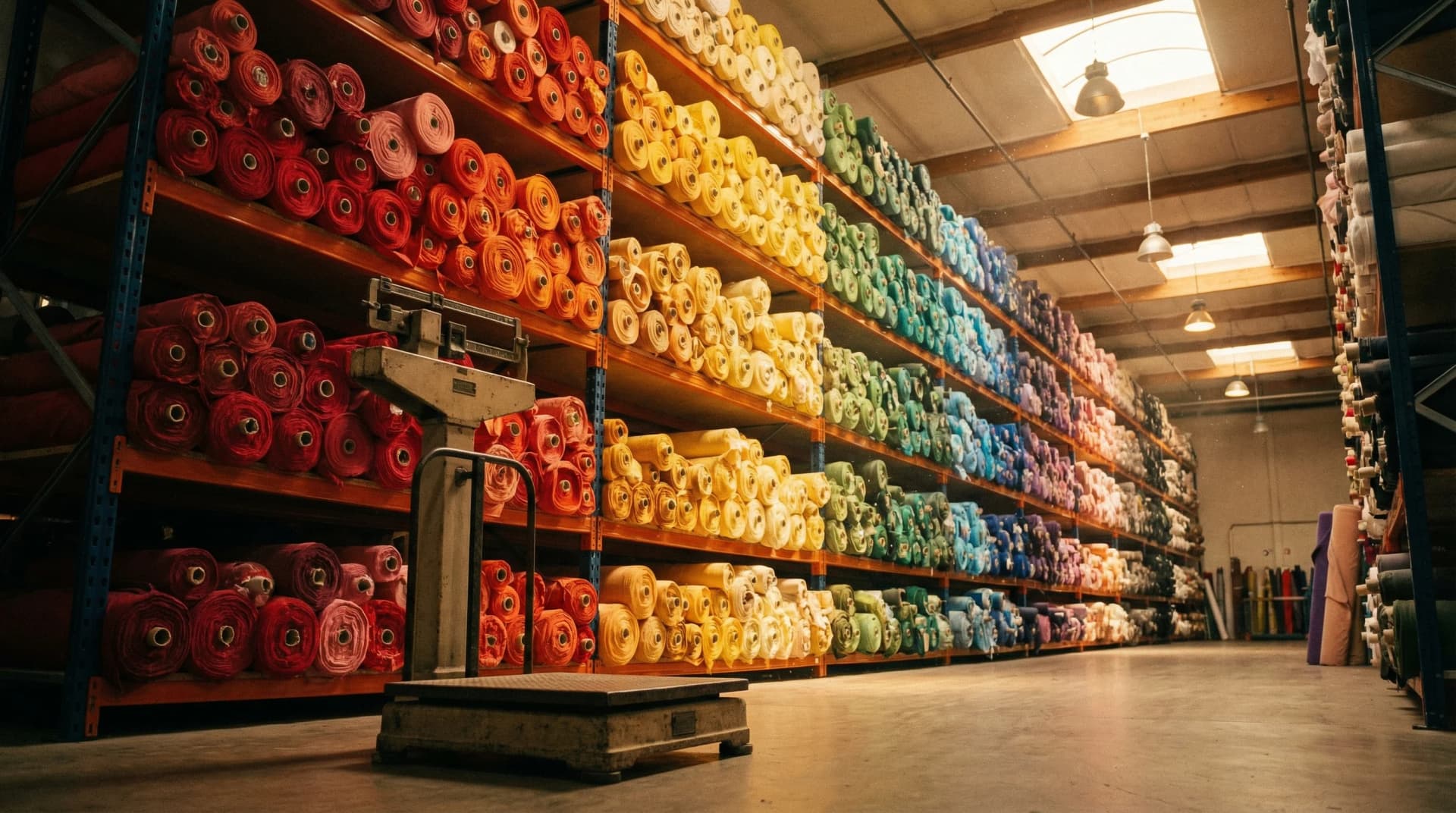
Straight from the factory
“You don't need to become a textile engineer. You need to stop choosing fabric by photo.”
1kg
Fabric per piece, heavyweight hoodie (401–500 GSM)
€5.05–€14.00
Real per-kg spread across our active Portuguese mills
260–580
GSM range of the Fleece branch on the Fabric Decision Tree
The Library
Every playbook, one shelf.
14 more guides from the same factory floor — Manufacturing Insider Series and Elite Brand Builder Program, from your first tech pack to scaling past your first million.
Production, Explained
€13
How to Price a Garment
€13
The Tech Pack, Page by Page
€13
Factory Red Flags
€13
Choosing Your Factory
€13

The Law and the Fines
€20

Organic Growth: Every Channel
€20
First 100 Sales
€20

The Founder's Brain
€20
From Sample to Scale
€13
Ads That Don't Look Like Ads
€20
Why Nobody's Buying
€20

Plan the Next Drop
€13
What Your Factory Won't Tell You
€20
Common questions
Quick answers.
Still have a question about Everything About Fabric? We answer every email personally — usually the same day.
office@genuineblanks.comDoes this book cover activewear or performance fabrics?
No — every fabric in this book is cotton-family: jersey, fleece, terry, wovens, linen. Sourcing technical performance synthetics like moisture-wicking poly or lycra blends isn't covered here.
What format is it delivered in?
Digital PDF — instant download after checkout.
Is the PDF watermarked?
Yes — every digital playbook is watermarked and EU IP protected.
Do I need to already know textile terminology?
No — Chapter 1 builds the vocabulary from scratch (GSM, hand, drape, combed vs carded) before the Decision Tree asks you to use it.
Are the mill prices real, or industry averages?
Real — every price is a masked range pulled from White Cotton's own active mill quote ledger (52 quotes, 9 Portuguese mills), never a generic textbook number.
One book. Nine more.
Your brand, our library.
18 playbooks, one factory — from your first tech pack to scaling past your first million.