How to Advertise a Clothing Brand: The Numbers Before the Creative
How to advertise a clothing brand without burning the margin: one breakeven formula, six openings that don't look like ads, and kill rules written first.
 Pedro Carreira··12 min read
Every Platform Will Spend Your Budget Whether or Not You Can Afford the Customers
I am going to say something a factory owner is not supposed to say about advertising: ads amplify a margin structure, they never fix one. If the garment leaves 30% gross margin and you are buying customers at a cost that assumes 60%, the ad account is working perfectly and the brand is dying anyway. The dashboard will look fine right up until the bank does not.
So this is not a guide to campaign settings. If you are working out how to advertise a clothing brand, the order of operations matters more than any tactic: know the number you cannot exceed, then make creative that does not look like advertising, then write the rules that stop you before you find out the expensive way.
I make garments in Barcelos, Portugal, for brands in more than fifteen countries. I do not run their ad accounts. But I see the cost sheet on one side and, months later, whether they reorder on the other — and the brands that got scaled advertising to work almost all did these three things in this order.
How to Advertise a Clothing Brand Profitably: Start With One Formula
Breakeven MER = 1 ÷ gross margin.
MER is the marketing efficiency ratio: total revenue divided by total ad spend, across the whole account rather than per campaign. Your breakeven is the point where the ads are paying for themselves and nothing more.
| Gross margin | Breakeven MER | Meaning |
|---|---|---|
| 60% | 1.67× | Every €1 of spend must return €1.67 in revenue |
| 50% | 2.0× | Every €1 must return €2.00 |
| 40% | 2.5× | Every €1 must return €2.50 |
| 30% | 3.33× | Every €1 must return €3.33 |
Below your number, ads eat the brand. Above it, they feed it. That is the entire scoreboard.
The uncomfortable part is that most founders do not know their real gross margin, because the cost of the garment is not the cost of goods. Landed cost includes the unit price, the trims and labels, decoration, freight, import handling where it applies, and the share of sampling you have not amortised yet. A hoodie at €18 a unit from us is not an €18 cost of goods once a woven label, a hangtag, a print, a poly bag and freight are on it.
Work the real number before you spend anything. Our production cost breakdown has the honest ranges — t-shirts €9 to €13 a unit, hoodies €21 to €29, joggers €17 to €26 before decoration, depending on fabric weight, construction and quantity — and the pricing guide walks the stack from landed cost up to the number on the page.
If that arithmetic tells you the margin will not carry paid traffic at any plausible cost per customer, stop here. The repair is the product, the price or the production quantity, not the ad account. There is more on how quantity moves the unit cost in minimum order quantities explained.
The Polish Tax
Here is the thing about advertising clothing in 2026 that founders find hardest to accept: the more your ad looks like an ad, the more efficiently it gets skipped.
Polish is a targeting signal — for the skip. A colour-graded product film with a licensed track and a logo sting tells a viewer in under a second exactly what it is, and the thumb moves. A one-take clip filmed on a phone in a kitchen, where you can hear the kettle, does not trip that reflex.
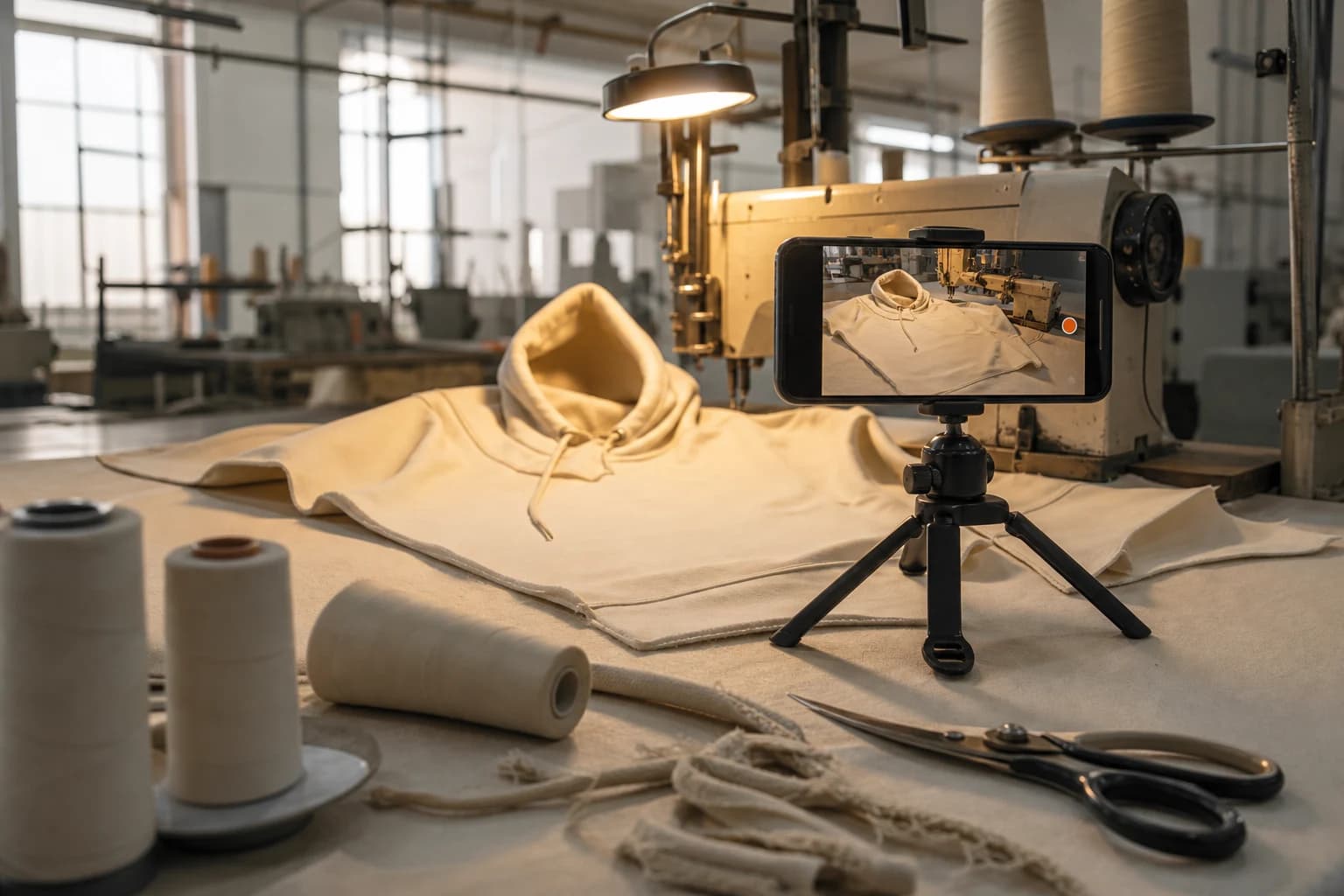
I have watched this play out with brands whose garments we made. The same hoodie, two treatments: an expensive production, and a founder standing in her hallway explaining why she changed the cuff ribbing after the first sample came back too loose. The hallway clip carried the account for a season. It cost a phone and eleven minutes.
Use the native test before anything goes live. Drop your first frame between two stories and three messages on your own phone, then show it to somebody for one second. If they can point to the ad, it failed.
Six Openings That Do Not Look Like Ads
Your creative has roughly 700 milliseconds to earn the second second. Open with the moment, not the product.
- 1.The get-ready. Someone putting the garment on as part of an actual morning.
- 2.The unboxing. Not staged — the real one, including the bit where the tape does not cooperate.
- 3.The mirror check. The three seconds a person spends deciding whether it works.
- 4.The detail. One close, specific thing. The seam, the weight, the way the ribbing recovers.
- 5.The before and after. The old one worn out beside the new one. This sells fabric weight better than any spec sheet.
- 6.The confession. "We got this wrong on the first sample, here is what we changed."
Five of those can be filmed in one afternoon with one garment and one phone. That is the point. Volume beats perfection: five hooks over one body of footage will out-earn one polished asset almost every time, because you cannot predict which opening lands and the platform will find out faster than you can theorise.
The confession angle deserves a note, because it is the one manufacturing makes possible and most brands never use. If you know why your product is built the way it is — the fabric family, the GSM, the seam type, the thing you rejected at sampling — you have material nobody buying blanks from a catalogue can produce. That is not a marketing trick. It is the only genuinely defensible content a small brand has.
The Landing Page Keeps the Promise or Kills It
An ad that promises "the heavyweight hoodie that survives forty washes" and lands on a homepage grid has broken the chain. The click is spent and the visitor is gone.
Whatever the ad claims, the page it lands on has to restate in the first screen, in the same words. Same garment, same photograph if possible, same promise, and the checkable reason underneath it — the weight, the fabric, where it was made, the fit measured on a real body.
If clicks are arriving and nothing is converting, the problem is downstream of the ad and no amount of creative testing will find it. That is a different diagnosis, and I wrote it up separately in why your clothing brand is not selling.
Write the Kill Rules Before You Launch
This is the part that separates a €10-a-day budget that teaches you something from one that quietly drains for four months. Six rules, written down before the first euro moves, when you are still capable of being objective.
- 1.Spend three times your product price with zero purchases and the creative is dead. No debate at the time, because at the time you will find one.
- 2.A creative that sells gets protected, not replaced. Winners die of founder boredom far more often than of genuine fatigue.
- 3.Nothing gets judged in its first three days. Early numbers are noise wearing a suit.
- 4.Every test gets an end date, written at the start.
- 5.One override only. A wrong price, a broken checkout or a claim you cannot back gets paused immediately, rules or not.
- 6.Change exactly one thing at a time. Two changes and a result teaches you nothing.
Then a fifteen-minute weekly check, and only that: spend, revenue, blended MER, position against your breakeven, and one action. The action is either scale gently or diagnose — never both in the same week. A week where you raise budgets and change creative and swap the offer is a week you cannot read afterwards.
The Fixing Ladder
When something is not working, climb in order. Skipping a rung is how founders end up rewriting captions when the problem was the checkout.
- 1.Seen? Is the ad getting delivery at all, or is the budget too thin to leave the learning phase?
- 2.Watched? Do people stay past the first second? If not, the problem is the opening frame, not the offer.
- 3.Clicked? Do watchers act? If not, the ad is entertaining rather than selling.
- 4.Bought? Do clickers convert? If not, the problem is the page, the trust signals or the checkout.
- 5.Again? Do buyers come back? If not, the problem is the product or the post-purchase experience — and it is the most expensive of the five to ignore.
Only one rung is ever the answer at a time.
What Changes in 2026
Two things worth knowing, both dated, because platform mechanics in this space go stale within quarters and anything you read without a date on it should be treated as a guess.
Broad beats stacked interests, and creative does the segmenting. Both major platforms have moved the targeting work inside their own ranking systems. What that means practically for a small clothing brand is that fifteen genuinely different ads in one campaign now outperform fifteen carefully built audiences with one ad each. Your creative is the targeting.
Disclosure obligations tighten from 2 August 2026. Transparency obligations for AI-generated and AI-manipulated content — including synthetic images and video used in marketing — apply from that date (EU AI Act, Reg. 2024/1689, Art. 50). If you are generating model imagery, faces or garment shots with AI, get advice on labelling before you scale spend behind it. This one is a legal question, not a marketing one, and the timeline is worth re-checking against the Commission's own guidance rather than a marketing blog.
Beyond those, be sceptical of platform-published performance figures generally. When a platform reports that its own new product improved cost per purchase, that is the platform grading itself. Your account is the only study that matters.
What Really Decides Whether You Can Advertise a Clothing Brand
The honest summary from where I sit: advertising magnifies whatever the business already is. A garment with a defensible reason to exist, a real margin and a page that keeps its promise gets cheaper to advertise every month. A thin product with a borrowed spec sheet gets more expensive, forever, and the ad account is where you find out.
If the margin arithmetic above sent you back to production, that is our end. We manufacture from 75 units per colourway (100 in a single colourway) with 4 to 6 week production from approved sample, and sampling runs €50 to €150 per style. Start at our craft page, read what changes when you make things in Europe at manufacturing in Portugal, or send the specifics through order request and we will come back with an itemised quotation.
The full version — the breakeven worksheets, ten complete ad scripts written word for word, the one-page creator brief and the weekly switchboard — is Ads That Don't Look Like Ads, a 38-page PDF in our playbooks library. If you have no organic base under the ads yet, start with how to market a clothing brand without ads instead.

Pedro Carreira
Founder of White Cotton, a textile manufacturer in Barcelos, Portugal. Producing custom clothing collections for brands across 15+ countries.
Frequently Asked Questions
Less than most guides suggest, and only after you know your breakeven MER, which is 1 divided by your gross margin. €10 a day is a genuinely workable starting budget provided the kill rules are written before launch: three times your product price spent with zero purchases means the creative is dead, nothing gets judged in its first three days, and every test carries an end date agreed at the start.
Percentage-of-revenue rules are commonly quoted in the 5% to 15% range for consumer brands, and figures attributed to fashion and apparel specifically usually sit at the upper end of that. Treat all of them as folklore rather than as our data: none of them knows your gross margin, and a brand at 30% margin and a brand at 60% cannot safely spend the same share of revenue. The number that actually governs the account is your breakeven MER — 1 divided by your gross margin — because it tells you what a euro of spend has to return rather than how many euros you are allowed to spend. Set the budget from what you can afford to lose while a test runs, then let the MER decide whether it grows.
That is rung four of the fixing ladder, and it is almost never the ad. Clicks arriving with no purchases points downstream — a landing page that does not restate the ad's promise in the same words, missing trust signals, or a checkout the buyer cannot complete. Buy from your own store on a real phone with real money before you touch the creative again.
Openings that look like content rather than advertising: the get-ready, the unboxing, the mirror check, the detail shot, the before-and-after, and the confession about something you got wrong. Polish reads as an ad and gets skipped efficiently. Five hooks over one body of phone-shot footage will usually beat one expensive production, because you cannot predict which opening lands.
You need to know it, which is different. At 50% gross margin every euro of spend must return two euros before you are level; at 30% it must return €3.33. The number itself is not a verdict — plenty of brands run profitably at 50% — but advertising without knowing it is how a growing account and a shrinking bank balance happen at the same time.
Continue Reading

Clothing Brand Founder Mistakes: The Ones That Cost Real Money
How to Market a Clothing Brand Without Ads: The Organic Routes

How to Plan a Clothing Drop: The One Page Before the Money Leaves
Why Is My Clothing Brand Not Selling? Diagnose It in One Evening