How to Plan a Clothing Drop: The One Page Before the Money Leaves
How to plan a clothing drop on one page: the piece, the count, the bill, the date, and the five gates you pass before you pay the factory.
 Pedro Carreira··15 min read
Most Drops Do Not Fail on Launch Day
They fail weeks earlier, in the plan. A lineup chosen by excitement, a count chosen by hope, a date announced before anything was true. By the time the launch goes quiet, the mistake has already been paid for — it was paid the day the deposit cleared.
I make garments in Barcelos, Portugal, for brands in more than fifteen countries, which means I see the order before the drop and I hear how it went afterwards. That is an odd vantage point, and it is the reason I can be specific about how to plan a clothing drop: the difference between the ones that land and the ones that go quiet is almost never talent. It is whether anyone wrote down what had to be true before the money moved.
This is the page I would hand a founder the week before they commit. It takes an evening and it fits on one side of paper.
How to Plan a Clothing Drop on One Page: Five Fields
A drop is planned on one page or it is not planned. Five fields, one decision each. The order matters — every field constrains the ones after it.
| Field | The decision | Gets it wrong when |
|---|---|---|
| The piece | What this drop is for | Five ideas share one budget |
| The count | How many, and who carries the wait | The number came from a feeling |
| The bill | Everything it costs before any money returns | Only the garments were counted |
| The date | When, built backward from written facts | It was picked first |
| The gates | Five statements you grade before paying | Ordering was mistaken for progress |
The real function of writing it down is not tidiness. It is that a new idea arriving at midnight has to renegotiate with every decision you already made, in front of you, on one page.
The Piece: One Hero, and Everything Else Argues for Its Seat
Every style you add splits three things that do not split well: your proof, your pictures and your money. Five styles in one drop is not five chances to win. It is five half-tests, and half-tests all return the same answer — not enough signal to learn anything.
The test is blunt. Would you run this drop if the hero were the only thing in it? If yes, you have a drop. If no, no supporting cast repairs that.
A support earns its seat by passing one of three arguments, and it has to be able to say which:
- 1.It completes the picture. It is worn with the hero in every photograph, so the buyer assembles the look in one click instead of imagining it.
- 2.It catches the second yes. Someone already buying the hero adds it without deliberating — lower price, same world, no explanation needed. A €28 beanie beside an €88 hoodie is a support. A second €88 hoodie in a different cut is a competing hero wearing a support's badge.
- 3.It carries a returning proof. A piece a previous drop already proved, back in a new colour. Known appetite, low risk.
There is a manufacturing reason underneath this, and it is the part founders discover late. Factories price and schedule in runs, and every separate style is a separate run with its own setup and its own minimum. Spread one budget across five styles and you can miss the threshold on all five at once. Concentrate the same money into one hero and you clear it in one order. Our floor is 75 units per style per colour, which is deliberately low — but low is not the same as free, and minimum order quantities explained covers where the breaks actually sit.
The Count: Size It to Evidence You Can Point At
The count is the drop's most expensive sentence and most founders write it with hope. "A hundred feels real" is not a count. It is a mood with a currency symbol on it.
You have three sources of evidence and none of them needs a tool you do not own. People who asked to hear from you — askers, not followers, and only a slice of any warm list buys on the day. What you sold before — the fastest sizes, the colour that died, the week-one shape. What real conversations told you — behaviour, not compliments. One stranger who tried the sample on and asked the price outweighs fifty likes.
Then run the honesty check that makes this field work: cover the number, read only the evidence line underneath it, and ask what count a stranger would write from that evidence alone. If the number you wrote embarrasses the line, the line is right.
The two failure shapes are not symmetrical, and this is the part worth internalising:
- —Too many costs cash asleep in cardboard, and then costs again when you discount to move it — because the discount teaches your earliest customers that your launch price is an opening offer and that waiting is free. That lesson compounds against every future drop.
- —Too few costs some patience. You sell out with people still at the door, and you bank a true sell-out plus a waitlist of named demand. That is the cheaper failure and the better evidence line for the next sheet.
If you must err, err small. And decide the limit now, while it is still a planning cell and not a caption — is the colour coming back, is the run numbered, is "first release, next unknown" actually true. A scarcity claim you cannot defend is not a marketing flourish; in the EU it is a regulatory problem.
The Bill: Four Pockets, and the Money Leaves in Order
A drop never costs what the garments cost. Open four lines:
| What sits in it | |
|---|---|
| Product | The run, plus labels, packaging, delivery to you, currency and bank fees |
| Pictures | Hero shots, the on-body set, the launch video someone films |
| Launch | Storefront bill, email tool, a creator fee if that is part of the plan |
| Cushion | Untouched money sized to the drop's worst plausible week |
Two disciplines make this field real. First, write UNKNOWN where you do not know, never a zero. An unknown you have named is a task with an owner. An unknown you guessed is a landmine with a euro sign on it. Second, note the three dates: the biggest out-day, the last out-day, and the first honest in-day. The stretch between the first and the third is the drop's exposure — the weeks when the money is gone and the proof has not arrived. Every drop has that stretch. Planned, it is a fact. Unplanned, it is a two in the morning feeling.
Real numbers help here, so: t-shirts run €9 to €13 a unit with us before decoration, hoodies €21 to €29, joggers €17 to €26, depending on fabric weight, construction and quantity, and sampling is €60 to €300 per style. The full production cost breakdown has the rest. What the product pocket needs at plan level is the total plus one honest flag: which lines are quotes in writing, and which are still guesses wearing confidence.
Then the test that outranks every other number on the sheet. Assume the worst plausible week — the drop sells a third of what you hoped, slowly. Rent paid, next drop fundable, no card carrying the difference? If yes, the bill is signable. If no, the plan is too big for the money, and there are exactly three honest shrinks: a smaller count, a leaner lineup, or made-after-order so buyers fund the run. The fourth option founders actually reach for — keep the plan and feel lucky — is not on the sheet.
The cushion is the pocket founders cut first, because it is the only one that buys nothing visible. From where I stand, the brands still here are not the ones that never made mistakes. They are the ones whose mistakes were pre-funded.
The Date: Set It Last, Build It Backward
The date is the first thing founders decide and the last thing they should. A date picked from enthusiasm is a promise made on behalf of the maker, the courier and the photographer, none of whom were asked.
The chain only reads honestly backward. By drop day, goods in hand — counted, checked, actually yours. Never launch on a production promise. Before that, the launch runway, whose assets have to exist before it starts. Before that, arrival, plus your own day of counting. Before that, the making itself, which is the factory's window to state, not yours to wish. Before that, this sheet, signed.
Notice what that paragraph did not give you: a number of days. That is deliberate. Every printed duration is someone else's drop decaying on the page. Ours is usually 6 to 12 weeks from the deposit, plus shipping, plus however long sampling takes before it — usually another 4 to 8 weeks from payment — and even that belongs on your sheet only once we have written it for your specific order. "What is the production window for this order, in writing?" is a question any serious factory answers routinely. Collect the answers, add honest estimates for the work you control, and the calendar assembles itself. The production timeline guide covers what each stage actually contains and where it slips.
Then put a named block of slack between goods in hand and drop day. Not padding — a buffer you chose, sized to how much of your chain is still estimates. A chain of written facts with a deliberate buffer produces a boring calendar, and boring is the goal. Drops should be thrilling at the front door and dull in the loading bay.
One rule holds all of it together: the date goes public last. Announcing early to create pressure creates exactly one thing, which is an audience holding a promise you do not yet control. Moving a private date costs nothing.
The Gates: Five Statements Between the Sheet and Your Bank
Money leaving your account is not progress. It only feels identical to progress at the exact moment you most need the difference.
So grade five statements in writing, dated, before you pay:
- 1.Proof. Someone wants this and I can point at them. True looks like the count's evidence line surviving the stranger test. Not true looks like follower counts and kind comments.
- 2.Piece. The thing I am funding exists and I have held it. The final sample, worn and washed and judged good enough to sell to the stranger in gate one. This gate has no exceptions, and your first clothing sample covers what that round has to catch.
- 3.Count. The number is evidence-sized, the limit is true, the size split is decided — never divided evenly just because the arithmetic is tidy.
- 4.Money. Four pockets totalled, cushion intact, the worst-week paragraph ends with life continuing, and no UNKNOWN left in a cell. Unknowns block signatures. That is their whole job.
- 5.Date. Every calendar cell is a written fact or resolved, the buffer is named, and nothing is public yet.
Five trues, then sign and authorise the money. More than one no, repair in that order — proof before piece before count before money before date — because each repair changes the inputs of the gates after it. Polishing the calendar while the proof gate is red is scheduling a drop nobody asked for.
And the moment this whole section exists for, said plainly: somewhere around week three, with the evidence thinner than you hoped, a thought arrives dressed as decisiveness. "I will just place the order, it will force me to figure the rest out." The confirmation lands, the relief is real, and nothing about the gates has changed except that your money is now on the wrong side of them. The run arrives on schedule either way — factories do their job — and lands in the middle of the same silence you ordered your way out of, except now the silence has boxes in it.
How to Plan a Clothing Drop With No History at All
The five fields still work on a first drop. Two of them just read differently.
The count's second evidence source — what you sold before — is empty, and that emptiness is instruction rather than a gap. It says the run is small on purpose. A first run of a brand, or of an unproven piece, has one job: prove the mechanism. Does the announcement move anyone, which size goes first, does anyone come back. A small run answers all of that at small cost, and if it sells out, the sell-out is the loudest asset a young brand ever owns. You cannot buy "gone in a day". You can only size for it.
The other difference is who carries the wait. A run made before buyers pay risks your cash. A run made after they order risks their patience and has to say so honestly on the page. A first drop with a thin evidence line and made-after-order is a completely respectable sheet — an honest wait stated up front costs far less than stock nobody claimed.
What does not change is the gates. A first drop passes the same five or it waits, and if it has to wait, the missing thing is almost always proof rather than money. That is an attention problem, and marketing a clothing brand without ads is where the warm routes get built.
Where This Leads
Fill the sheet before you talk to anyone about quantities. It changes the conversation on our side too: a brief with a hero, a count with its reasoning, and a date built backward gets quoted the same day, because there is nothing left for us to guess.
When the plan is ready, that is our end of the table. We manufacture from 75 units per colourway (100 in a single colourway) in Barcelos, with production usually running 6 to 12 weeks from the deposit, for brands in 15+ countries. See how the process runs at our craft page, read what changes when the factory is a short flight away at manufacturing in Portugal, or send the specifics through order request and we will come back with an itemised quotation.
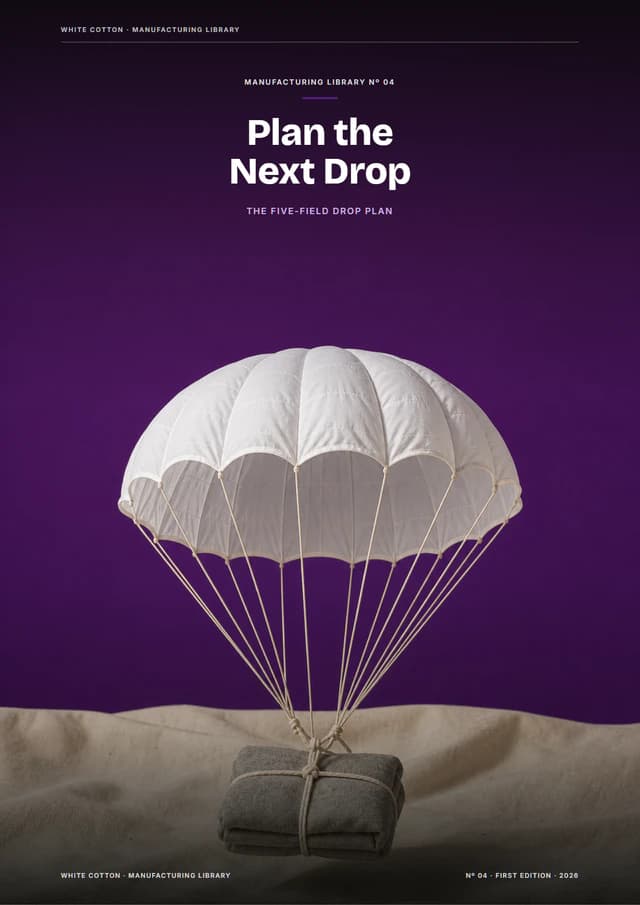
The long version — the blank drop sheet, the lineup card, the gates checklist, the backward calendar and the next-drop sheet as records you fill in — is Plan the Next Drop, a 90-page PDF in our playbooks library. The two brands worked through it are constructed composites, and the book says so on its own edition page: their numbers are teaching inputs, not benchmarks.

Pedro Carreira
Founder of White Cotton, a textile manufacturer in Barcelos, Portugal. Producing custom clothing collections for brands across 15+ countries.
Frequently Asked Questions
One hero and at most two supports, and each support should be able to say in one sentence why it earns its seat — it completes the picture, it catches the second yes, or it carries a proof a previous drop already established. The manufacturing reason is that every style is a separate run with its own setup and its own minimum, so one concentrated hero clears a threshold that five scattered styles can miss at the same time.
Fewer than the number in your head, and the honest way to find it is the evidence line rather than a benchmark. Count the people who actually asked to hear from you, weigh behaviour over compliments, and then check whether a stranger reading only that line would write your number. Our floor is 75 units per colourway, or 100 in a single colourway, precisely so a first run can be a real test — a founder who orders 75 and sells 60 has evidence, where 500 across eight styles is eight half-tests and a storage problem.
Far enough that the date is the last thing you set rather than the first. Build the chain backward: goods in hand before drop day, the launch runway before that, arrival before that, and the making before that — our production is usually 6 to 12 weeks from the deposit, plus shipping, and a first sample round — usually 4 to 8 weeks from payment — adds its own time ahead of it. Then add a buffer you chose deliberately, and only announce once the chain behind the date is written fact.
Four pockets, and the money leaves in this order: product, pictures, launch and cushion. Product is the run plus labels, packaging, delivery to you and bank fees — hoodies run €21 to €29 a unit with us before decoration, t-shirts €9 to €13, sampling €60 to €300 per style. Pictures and launch are separate budgets that founders routinely discover mid-drop, and the cushion is the untouched money sized to the drop's worst plausible week, which is the pocket cut first and missed most.
When any of the five gates reads no. No proof you can point at, no final sample in your hands, a count the evidence does not support, an UNKNOWN still sitting in the bill, or a date whose chain is still estimates. A no reached honestly three weeks before the money moves is the plan working, not failing — and the repair order matters, because proof comes before piece, piece before count, count before money and money before date.
Continue Reading
Clothing Brand Founder Mistakes: The Ones That Cost Real Money
How to Advertise a Clothing Brand: The Numbers Before the Creative
How to Market a Clothing Brand Without Ads: The Organic Routes
Why Is My Clothing Brand Not Selling? Diagnose It in One Evening