What Is a Tech Pack for Clothing? A Real Example, Page by Page
What is a tech pack, what belongs in one, and what a finished one looks like — a Portuguese factory walks its own 27-page hoodie tech pack, page by page.
 Pedro Carreira··17 min read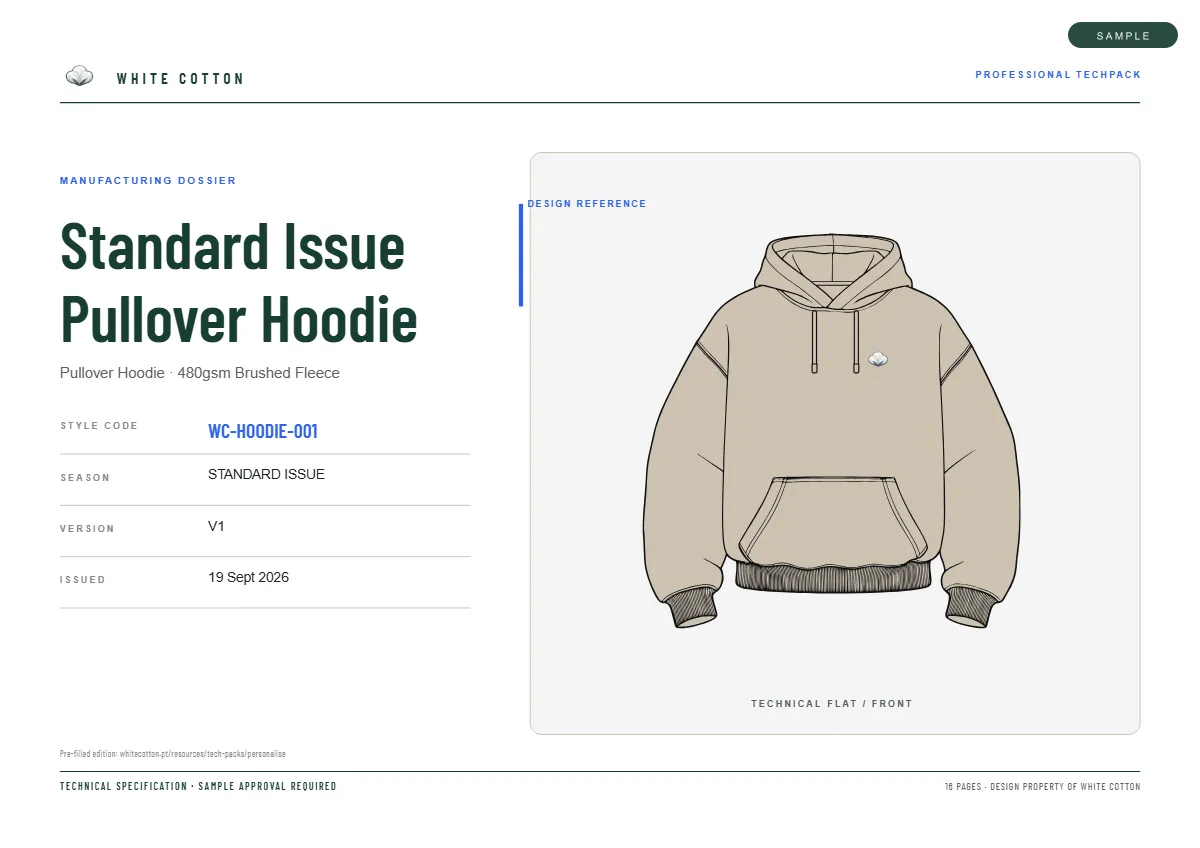
What Is a Tech Pack? The Short Answer
The tech pack for a pullover hoodie in our catalogue runs to 27 pages. Most of the documents brands send us and call a tech pack are one page — a flat sketch, a few measurements typed beside it, and a colour named in words. That gap is the single biggest reason a first sample comes back wrong.
So let me answer the question — what is a tech pack? — from the side of the desk that has to read one. I am Pedro Carreira, and I run White Cotton, a garment factory in Barcelos, Portugal. Every week our production team opens documents like this, quotes from them, and cuts from them.
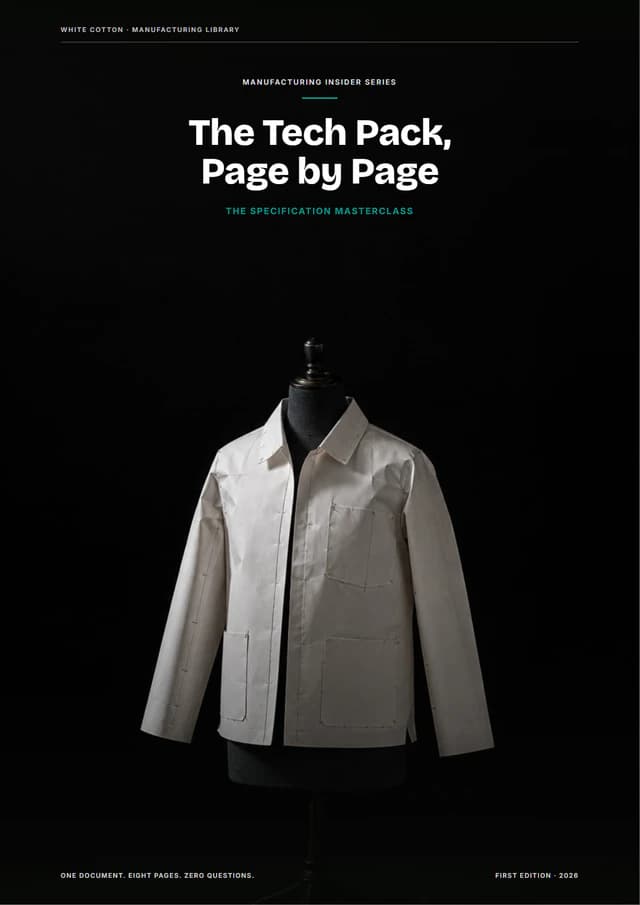
A tech pack is the complete manufacturing instruction for one garment in one document. It is not a mood board and it is not a design. A design says what the garment should feel like. A tech pack says what it is made of, how big it is in every size, which machine sews each seam, where the print sits in centimetres, and what happens if a measurement lands 1 cm off.
The test is blunt: hand the document to a factory that has never spoken to you, and if they can quote it and cut it without asking a question, it is a tech pack. If they have to email you back, it is a sketch with ambition.
A tech pack is the only document in fashion where being boring is the entire point.
What Goes Inside a Tech Pack for Clothing
A tech pack for clothing has a fixed spine. The order varies by studio, the content does not. Here is what each section decides, and what it costs you when it is missing.
| Section | Whose job | What it decides | What happens when it is missing |
|---|---|---|---|
| Cover and style summary | Yours | Style code, version, season, base fabric | Two versions of the same style go into production at once |
| Colourway flats | Comes written | Front and back line drawings, one set per colour | The factory guesses which panel is which colour |
| Design details | Comes written | Numbered callouts on visible features | Pocket ends up 4 cm from where you pictured it |
| Inside construction | Comes written | Seam type and machine for every join | The line uses its house default, not yours |
| Points of measure | Comes written | Where each measurement is taken from | Your 52 cm chest and ours are measured differently |
| Graded specification | Rows written, numbers yours | Every measurement in every size | The factory grades it for you, to its own rules |
| Material references | Yours | Fabric, weight, composition, handle | You get 280 gsm when you wanted 480 |
| Colourways and Pantone | Yours | Exact colour references per component | Dye lot is approved from a phone screenshot |
| Bill of materials | List written, fabric and trims yours | Every component, composition, placement, quantity | Trims are ordered late and hold the whole run |
| Artwork placement | Convention written, artwork yours | Method, size in cm, position, colour count | Print lands centred instead of 8 cm below the neck |
| Labels and care | Format written, composition yours | Composition and care to EU 1007/2011 | Garments cannot legally be sold in the EU |
| Packaging and folding | Comes written | How each unit reaches the box | Wholesale receives a carton nobody can merchandise |
| Production notes and revisions | Comes written | What changed, when, and who approved it | Nobody knows which version the sample was made from |
Read the second column before you read anything else, because it answers the question most guides never address: who is supposed to produce all this. Half the document is written in factory language — seam types, machine names, points-of-measure conventions, tolerances — and the honest answer there is: not you. That layer is standard build practice for the silhouette. A good factory writes it, or a finished pack for that garment already carries it, and either way it gets confirmed against your approved sample rather than invented from a blank page. The fields that genuinely belong to a brand are narrower than they look: the fit and its measurements, the fabric, the colours, and the artwork.
The bill of materials is the one people underestimate. It is the section our team reads first, because it is the section that decides whether we can even quote — a drawcord tip finish or a specific eyelet can carry a longer lead time than the fabric.
A Real Tech Pack Example, Page by Page
Most guides describe this document. Very few show one, and the ones that do usually show a cropped screenshot or put the real file behind a paid consultation. So here is ours, opened page by page. This is the pullover hoodie pack, 27 pages, and you can download the whole thing free at the end.
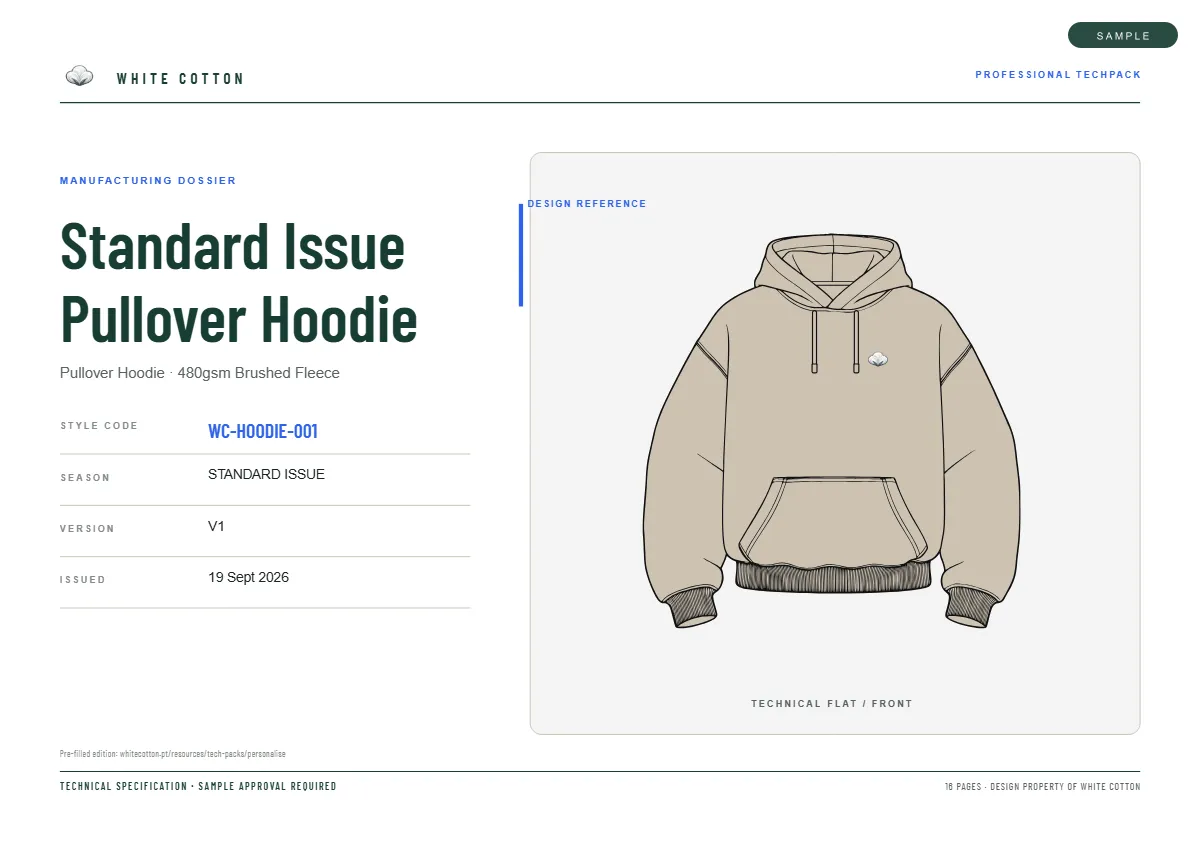
Page 1 — Cover. Style name, style code, season, version, issue date, the base fabric line (480 gsm Italian brushed fleece on this one), and the technical flat, front view. Nothing decorative. A cover exists so that six months later, someone in a warehouse can match a carton to a document.
Pages 2 to 4 — Style summary, colourway flats, design details. The summary is the one-paragraph brief. The colourway flats are the front and back line drawings repeated per colour, so a two-colour range does not travel as one drawing plus a note. Design details are numbered callouts pinned to the flat.
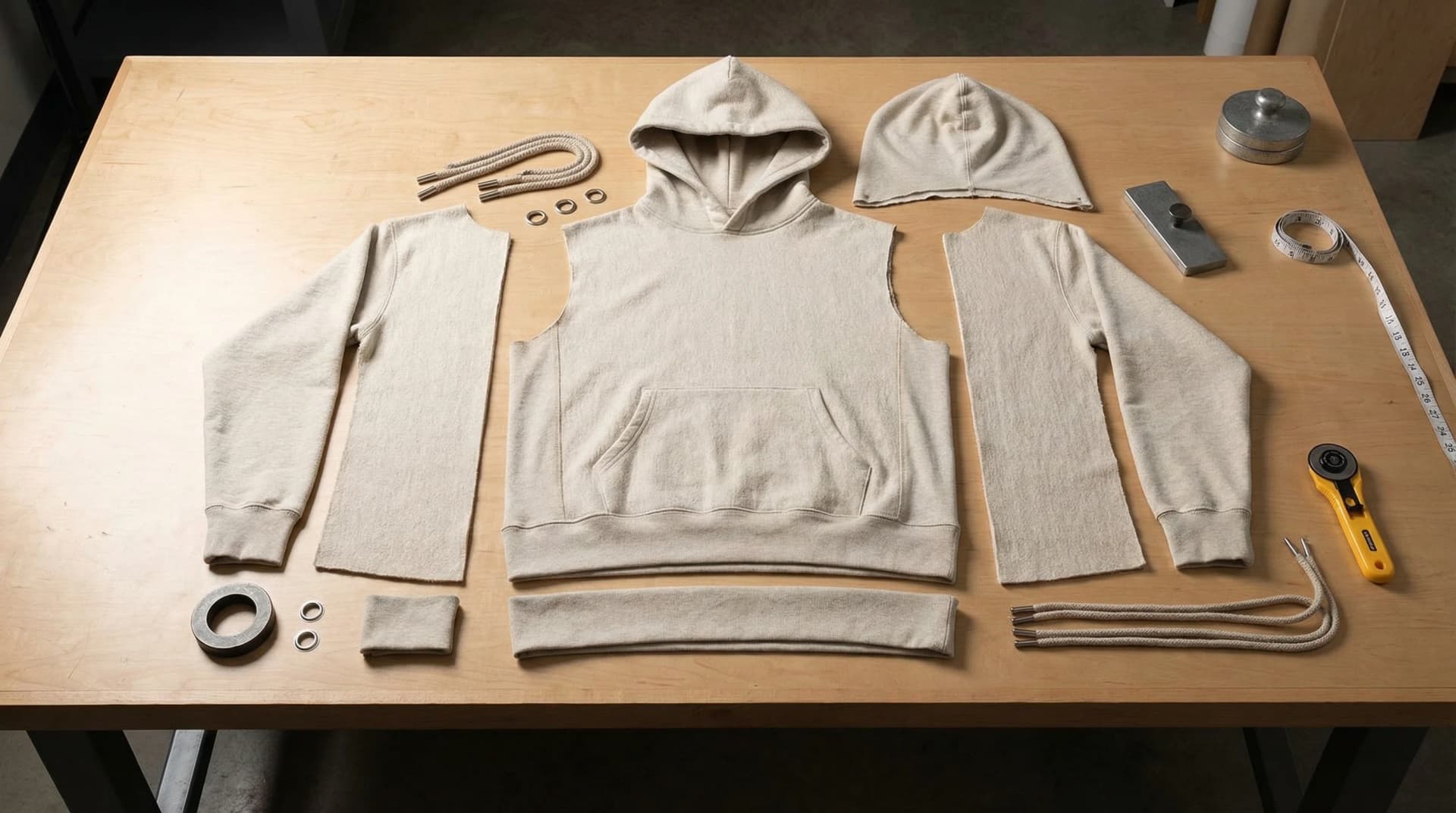
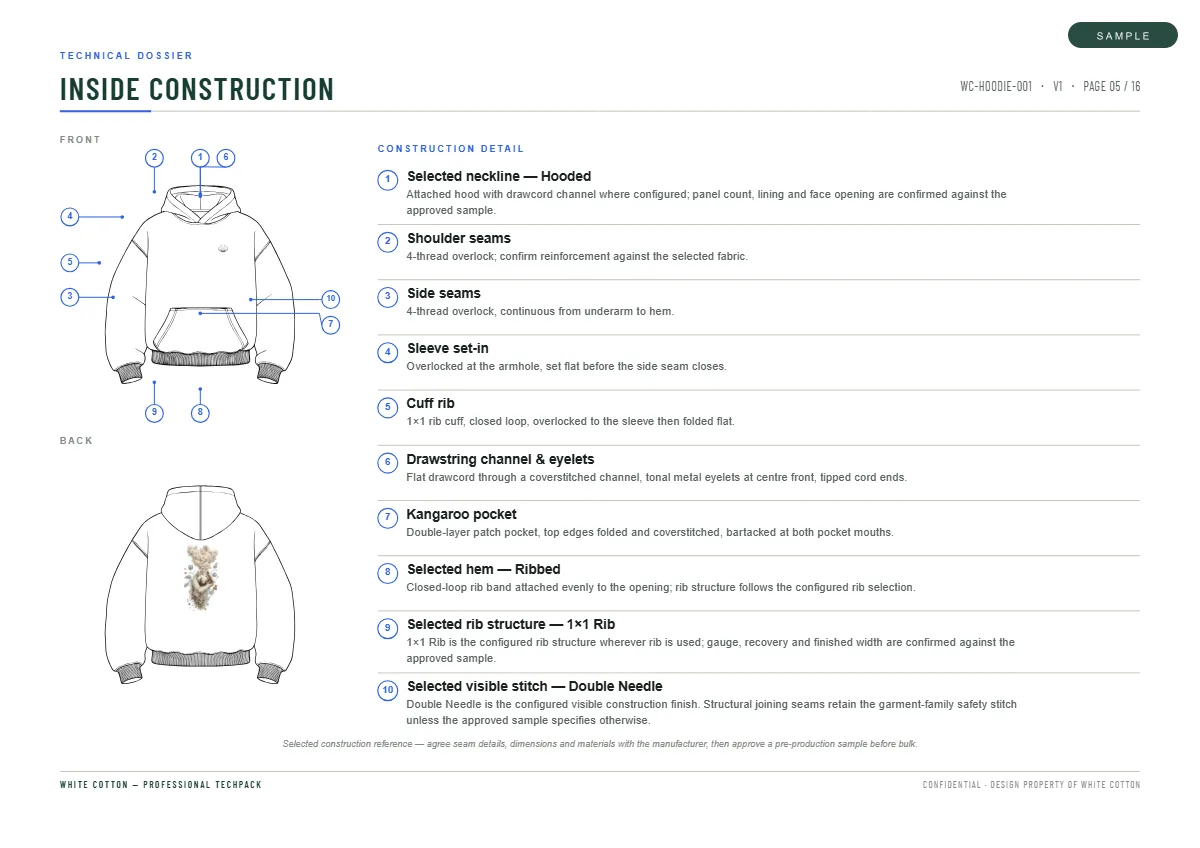
Page 5 — Inside construction. This is where a real document separates itself. Ten numbered callouts, each naming the join and the machine: shoulder seams 4-thread overlock, taped for stability on brushed-back fleece; side seams 4-thread overlock, continuous from underarm to hem; sleeves overlocked at the armhole and set flat before the side seam closes; 1×1 rib cuff as a closed loop, overlocked to the sleeve then folded flat; drawcord through a coverstitched channel with tonal metal eyelets at centre front; kangaroo pocket as a double-layer patch, top edges folded and coverstitched, bartacked at both pocket mouths.
If that paragraph reads like another language, that is the correct reaction and not a problem you have to solve. Naming the machine is our job, not the brand's. It arrives written, and the only decision on this page belongs to you after the first sample is in your hands — keep it, or change it.
Pages 6 and 7 — Points of measure and component measurements. Every measurement point is defined before any number is attached to it. Width is measured across the garment 2 cm down from the armholes, laid flat. Length is measured from the highest point of shoulder straight down to the bottom edge. Two factories will otherwise return two different chests for the same garment and both will be right. Like construction, the convention itself comes written; what a brand supplies is the fit those numbers describe.
Page 8 — Graded specification. One row per point of measure, one column per size — S through XL as standard, extended sizes when you choose them — plus a tolerance column and the grade increment. Chest width, body length, shoulder width, sleeve length, armhole, lower sleeve, hem width, neck opening, front and back neck drop, bicep 3 cm below the armhole, cuff rib height, hem rib height, hood height from HPS to top, hood width at mid height, pocket width, pocket height, pocket position above the hem rib. That is the row set. A one-size spec sheet is not a substitute for it.
Pages 9 and 10 — Material references and colourways. Fabric by weight, composition and construction, then the colourways with Pantone references per component, so the rib and the body are approved as separate decisions rather than assumed to match.
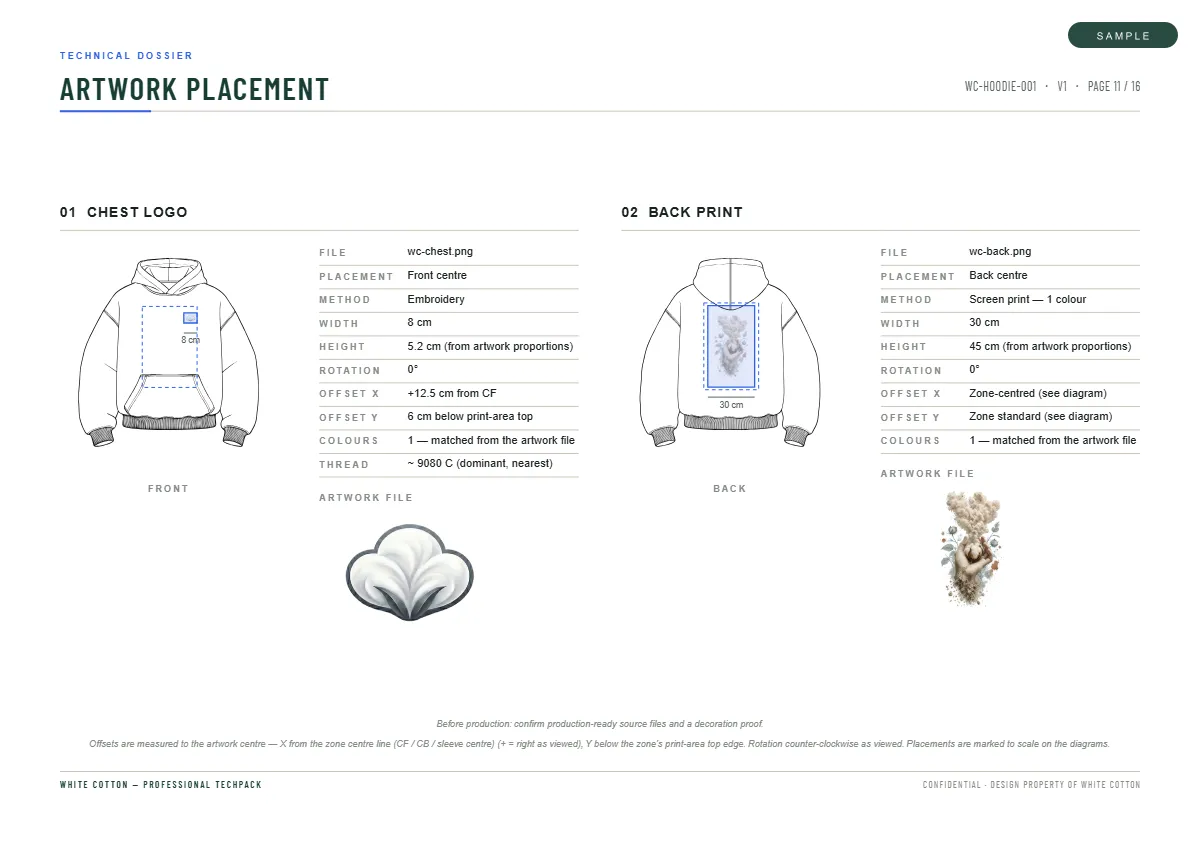
Page 11 — Artwork placement. Per placement: the artwork file name, the placement zone, the method, width and height in centimetres, rotation, offset X and Y, and the number of colours. The convention is written on the page — offsets measured to the artwork centre, X from the zone centre line, Y below the print zone's top edge. That is what turns "chest print, medium" into an 11 cm mark a print house can hit twice.
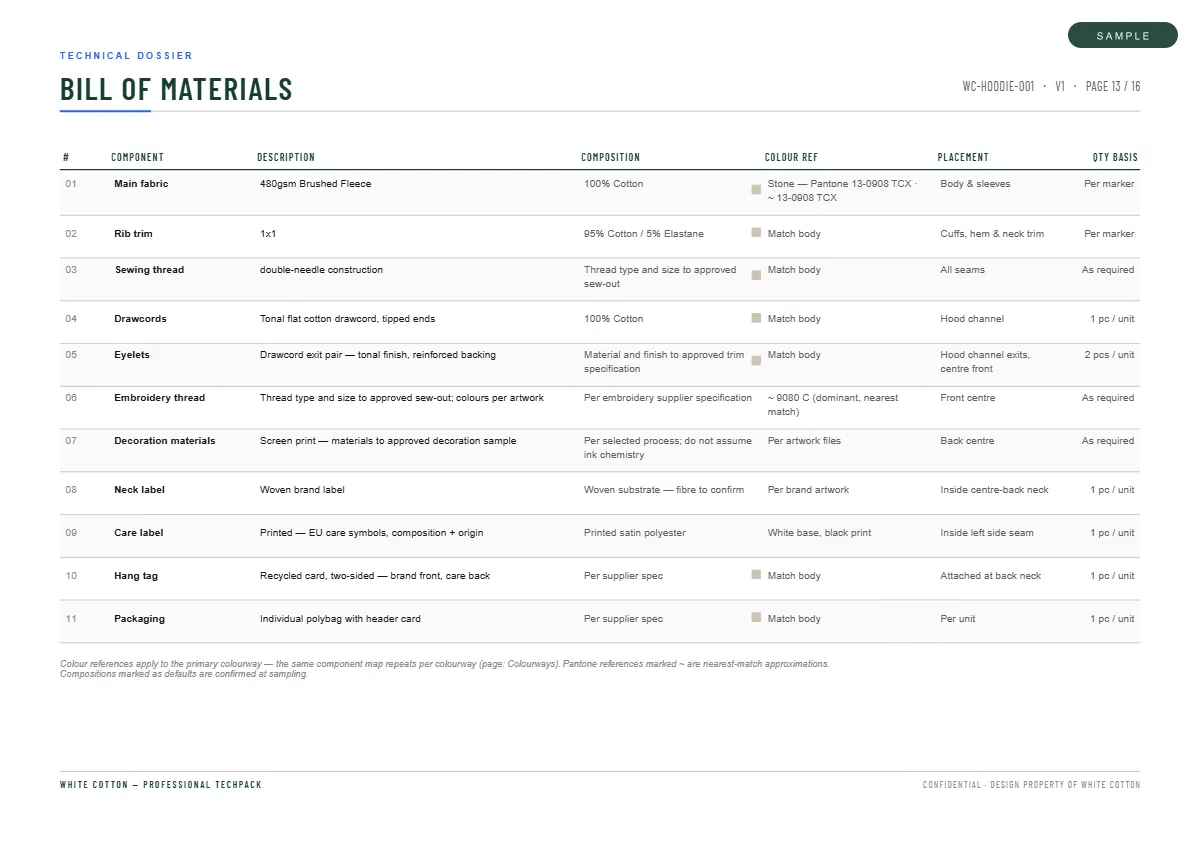
Page 13 — Bill of materials. Numbered component rows, each with a description, composition, colour reference, placement and quantity basis. Real lines from ours: 1×1 rib trim for cuffs, hem and neck; sewing thread 100% polyester core-spun, Tex 27, double-needle construction; eyelets in nickel-free metal, two per unit at the hood channel exits; a woven damask neck label; a printed satin polyester care label at the inside left side seam.
Pages 14 to 17 — Labels and care, packaging and hangtag, production notes, folding, revisions. Care and composition are written to EU 1007/2011 because a garment without compliant labelling cannot be sold in the EU regardless of how well it was made. The revision log is the cheapest page in the document and the one that saves the most arguments.
The reference half. The last third of every pack is not the specification — it is the catalogue the brand keeps: stitch and seam options, ribbing, cuffs, hems and necklines, washes and finishes, 31 printing and decoration methods, and trims and accessories. It exists so the next style can be specified by pointing at a named option instead of describing it in prose.
The Numbers That Make a Tech Pack Real
A tech pack example without numbers is a layout. Here is the actual block our pattern room drafts a hoodie to, in centimetres, finished garment, laid flat.
| Point of measure | S | M | L | XL | Per size |
|---|---|---|---|---|---|
| Chest width, 2 cm below armhole, laid flat | 50 | 52 | 54 | 56 | +2 cm |
| Body length, HPS to hem | 70.5 | 72 | 73.5 | 75 | +1.5 cm |
S to XL is the standard run, graded out from M as the base size. XS, 2XL and 3XL exist on the same block and get added when a brand decides to sell them — a decision worth making before the chart is drawn, not after.
Three things in that table matter more than the numbers themselves.
It is a garment measurement, not a body measurement. A 52 cm chest width, measured flat, is 104 cm around the finished hoodie. Body charts and garment charts get confused constantly, and the result is a sample two sizes off.
The grade is stated, not implied. +2 cm per size on the chest, +1.5 cm on the length, graded out from base size M. Our blocks are drawn from published European blank-garment charts and cross-checked against the EN 13402-3 size intervals, and the pack says so on the page rather than presenting the numbers as house secrets.
Every row carries a tolerance. No factory hits a measurement exactly, on every unit, in every size. The tolerance column is the difference between a QC pass and a dispute — it is the number that says a 52.5 cm chest is a good garment and a 55 cm chest is not.
Fashion Tech Pack, Apparel Tech Pack, Spec Sheet — Are They Different?
Mostly no. A fashion tech pack, an apparel tech pack and a tech pack for clothing are the same document with different search habits attached. Nobody in a factory distinguishes them.
A spec sheet is genuinely different, and smaller. A spec sheet is the measurement table — usually one size, sometimes graded. It answers how big. A tech pack answers how big, what from, how joined, in what colour, with what printed where, labelled how, packed how. Every tech pack contains a spec sheet. No spec sheet contains a tech pack.
The practical version: if a manufacturer asks you for a tech pack and you send a spec sheet, you will get a quote with caveats and a sample built on house defaults. Those defaults will be competent and they will not be yours.
What a Factory Actually Does With Your Tech Pack
Once it reaches us, the document does five separate jobs, in this order.
- 1.Quoting. The bill of materials plus the graded chart give fabric consumption per size, trim quantities and a construction time. That is the quote. A vague tech pack produces a padded quote, because we price the uncertainty.
- 2.Sourcing. Every BOM line becomes a purchase with its own lead time. Fabric is rarely the long pole — a specific eyelet finish or a woven label often is.
- 3.Pattern and marker. The graded chart becomes patterns per size, and the patterns become a cutting marker. This is where a missing grade rule forces us to invent one.
- 4.The line. The construction page tells the sewing line which machine does which join. Without it the line uses its own standard, which is why two factories return two different garments from the same sketch.
- 5.Quality control. Finished garments are measured against the graded chart and the tolerance column. No chart, no objective pass or fail.
That sequence is also why a good tech pack shortens a project. Our normal production runs 4 to 6 weeks after an approved sample, and the sample round is where the time is won or lost — see our breakdown of clothing production timelines for the full calendar, and what a first sample really involves for the round itself.
Where to Get a Real Tech Pack Example, Free
We publish free tech packs for 13 garments — hoodies, zip hoodies, crewnecks, half-zips, tees, long sleeves, tanks, polos, woven shirts, sweatpants, shorts and more. Each one is 27 to 28 pages, laid out exactly as described above, with the full row set on the graded page and the reference catalogue at the back. They carry no supplier details, so they work with any factory, including one that is not us.
They arrive with the brand-specific values marked to fill in — your fabric, your colours, your measurements — because those are the fields that belong to you. The structure, the row sets, the construction language and the reference catalogue are already there. That is the part that takes a designer a week to build from a blank page, and it is the part you are never asked to write.
Or have us fill it in for you. From the same page you can hand over the fields instead of typing them — measurements graded to your fit, colourways chosen and written in with their Pantone references, your artwork placed to the centimetre — and the same document comes back finished, ready to send. It still carries no supplier details, so it still works with any factory, including one that is not us.
If you want to see the one described in this article, the hoodie tech pack is the same document, page for page.
And if your design is still moving, that is normal. A tech pack ensures we manufacture your exact vision, so we would rather build it with you than receive a guess. Send reference images, a description, and a sample garment if you have one, and we will develop the document alongside the first sample. Our minimums are 50 units for hoodies and joggers and 100 for tees, and you can see what a garment actually costs to make in our production cost breakdown.
Ready to put a real document in front of a factory? Read how to make a tech pack step by step, or start a project with us — we are a clothing manufacturer in Portugal and we read these documents every day.

Pedro Carreira
Founder of White Cotton, a textile manufacturer in Barcelos, Portugal. Producing custom clothing collections for brands across 15+ countries.
Frequently Asked Questions
A tech pack is the complete manufacturing instruction for one garment: flats, bill of materials, points of measure, a graded size chart with tolerances, construction notes, colourways with Pantone references, artwork placement, labelling and packaging. Ours run 27 to 28 pages per garment. If a factory can quote and cut from it without emailing you a question, it is a tech pack.
At absolute minimum: front and back technical flats, a bill of materials listing every fabric and trim, a graded measurement chart covering every size you intend to sell with a tolerance on each row, construction notes naming the seam type for each join, Pantone references for every colour, and artwork placement given in centimetres. Anything less and the factory fills the gaps with its own defaults.
Yes. We publish 13 complete tech packs free at /resources/tech-packs, one per garment type, each 27 to 28 pages. They are the same documents our own production team works from, they carry no supplier branding, and you can take them to any manufacturer.
Practically, yes. Without a bill of materials and a graded chart, a factory cannot calculate fabric consumption or construction time, so any number you receive is padded to cover the unknowns. A complete tech pack usually produces a tighter quote and a shorter sampling round, which is where most of the cost and the calendar actually sits.
No. A spec sheet is the measurement table — it answers how big the garment is. A tech pack contains that table plus materials, construction, colour, artwork, labelling and packaging. Every tech pack includes a spec sheet; a spec sheet on its own leaves the factory to decide everything else.
Continue Reading

Your First Clothing Sample: What to Expect, What It Costs & Timeline

Manufacturing Oversized Streetwear: Patterns, Fabrics & Production Tips
Polo Shirt Manufacturing: Piqué, Jersey & Premium Construction
How Joggers Are Made: The Complete Manufacturing Process